While doing some research I discovered an exceptional resource which provides information on everything you ever wanted to know about 80 different species of woods. The information covers everything from things like carvability and density to stainablity and the size of the knots.
I was so impressed by the mass of information available on these lists that I thought I would share them with you here on Wood Chip Chatter.
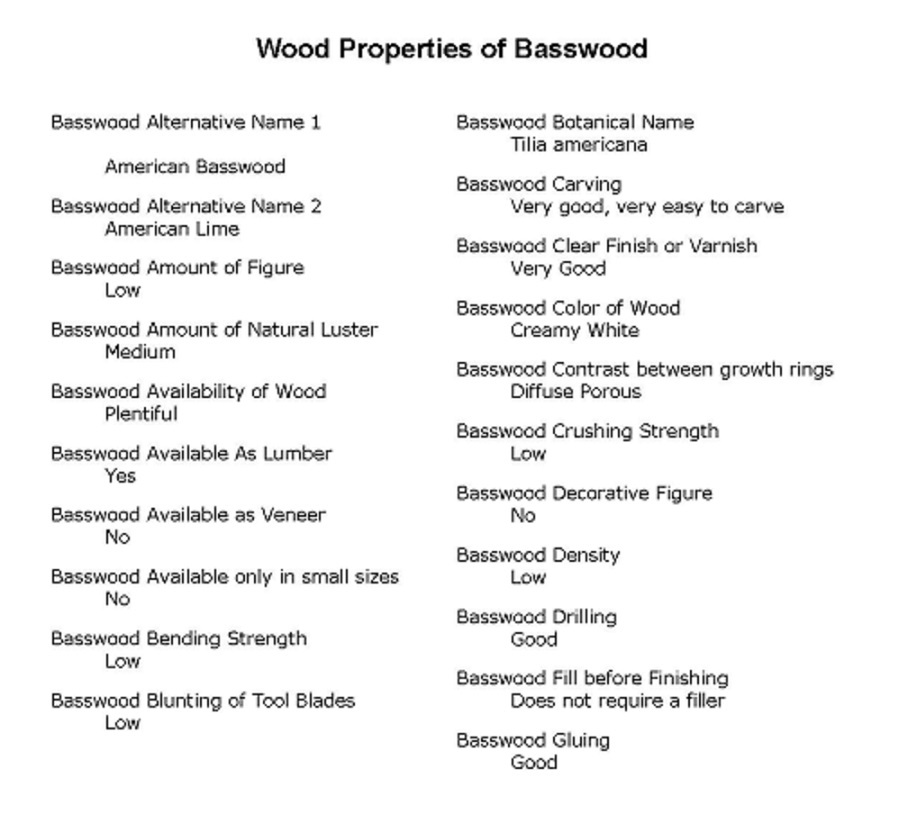
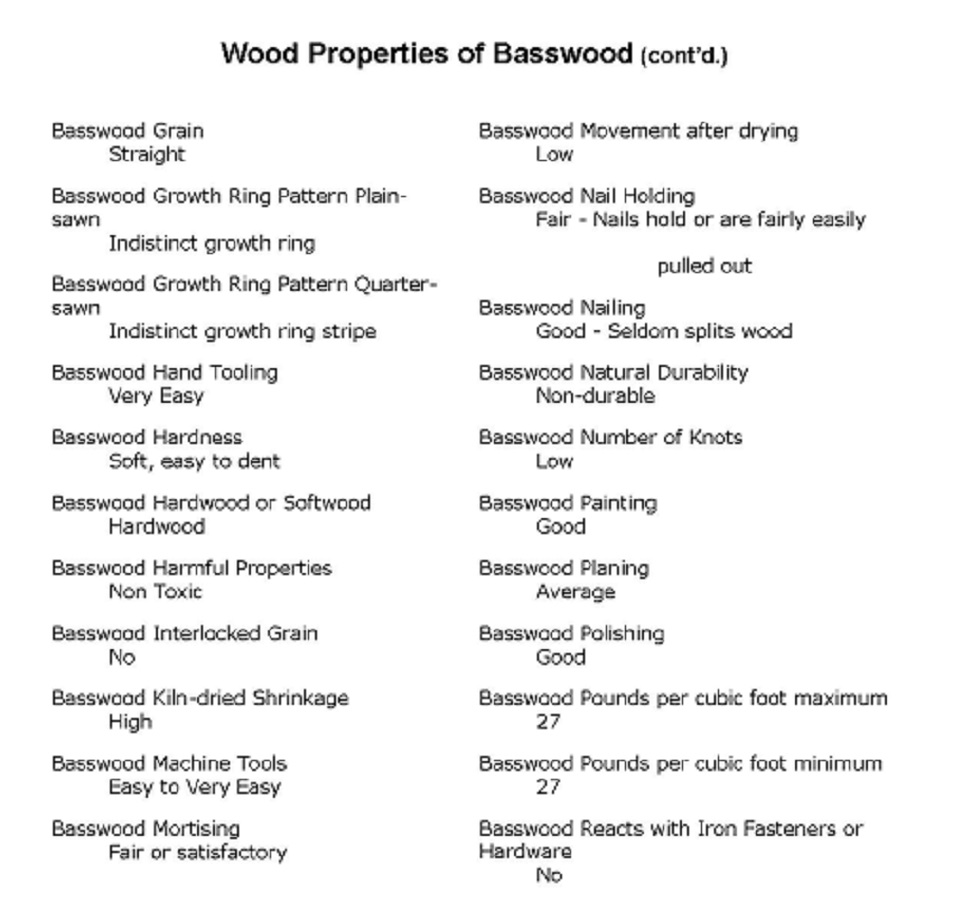
I don’t intend to cover all 80 species but I will try to periodically provide the list of information for certain specific wood species here on the blog. Since most of us carve basswood I figure that’s the wood most of you would be interested in so here below is the list of Wood Properties of Basswood:
Wood Properties of Basswood
I encourage your feedback on what you thought about this list. Did you find it interesting or useful? Would you like to see more lists like this on the properties of other woods?
How To Carve A Curly Mustache
As a follow up to one of my earlier blogs on how to carve curls in hair, here is a short picture tutorial by Tony Harris on how he carves a curly mustache.
1
2
3
4
APOLOGY: I want to apologize for the blurry writing on the back cover of ‘Carving The Old Sea Captain’ in my last blog. It looked fine in my draft but for some reason it came out blurry once I published it.
EMAILS
Our first email comes from Jakobo Santiago with some comments and a question regarding baking wood. Jakobo writes:
“Hello everyone. I hope you are having some long and profitable wood carving sessions
I’ve been reading and watching some videos on how to bake wood in the home oven to dry and harden it. They also comment that its physical properties stabilize, its fibers compact and it tends less to deform. moreover, wood insects no longer attack it. I understand it is not suitable for carving characters, but for spoons and the like, it can be interesting. What do you think about Bob?”
The basswood I use here is already kiln dried and stable so I don’t run into any of the problems you describe. I understand that many spoon carvers carve their spoons from live (wet) wood so I can see where the baking process might come into play there. I know the process works. Perhaps some of our spoon carvers or other readers can provide some more input on this topic.
Jakobo wrote back to say:
“And so, you’re right. I’ve been watching again the videos and they talks about wet wood (my english is not as good as it should be, so I lost parts of the speeching)
As a curiosity, here where I live (Canary Islands) the traditional method of curing wood was to immerse it in the sea for a few months and then dry it under the sun on the beach also for a long time.
Best wishes for you and your family”
That’s a very interesting way of curing wood, Jakob. It must take a lot of time. We would like to know more about this process. Also, what kind of wood do you use for carving in the Canary Islands?
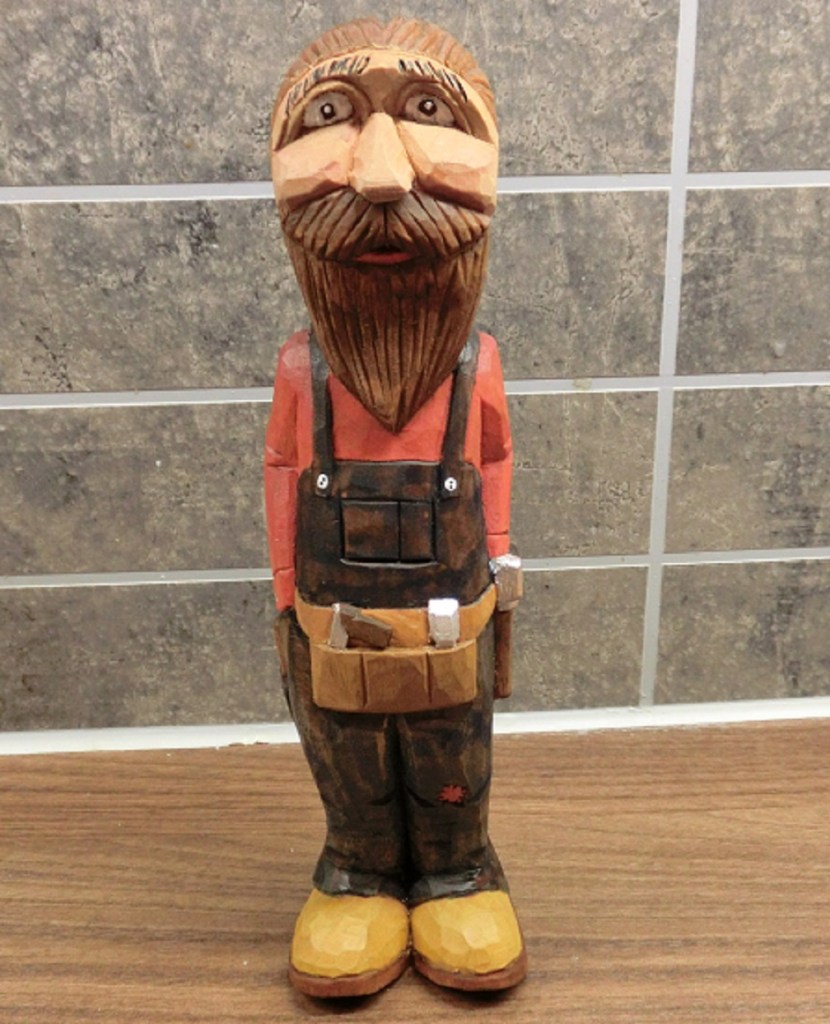
Our next email comes from Roar Martinsen of Norway who shares some photos of a carpenter he carved:
“Hi Bob
I would like to share this carpenter with you.
Roar Martinsen
Norway”
That’s a terrific carving, Roar! It has a lot of nice details. How tall is it?
Thank you so much for the photos! We need more readers to send in their photos.
Let the chips fly! Tell your wood carving friends and spread the word about Wood Chip Chatter, and don’t forget to send in your questions and comments so we can keep Wood Chip Chatter active and keep the conversations going!
And remember, we need your photos! I’m sure you all have some terrific carvings to share and photos of your carvings will help to liven up the blog’s appearance and make it more interesting. Perhaps we can start a carvers photo section! Email your photos to carverbobk@woodchipchatter.com (let me know if you have any trouble attaching your photos).
“Whittling The Old Sea Captain and Crew” is a delightful wood carving book written by Mike Shipley. Mike, who is a noted wood carver is also, and perhaps more well known as a knife maker. His top notch OCCT line of knives and gouges are sold by most any woodcarving supplier. In addition, Mike Shipley has made dozens of rough outs, many of which are available through Van Kellys Carving. Published by Fox Chapel Publishing Co., Inc. in 1996 this 30 page paperback book covers 3 main projects; The Old Sea Captain, The First Mate and The Second Mate. All the necessary nautical accessories such as buoys, lobster traps, crates and boat oars are also included.
In the front of the book there are 6 pages with 12 color photos of the three projects from different views. Chapter One covers the actual carving of the Old Sea Captain. A convenient list of the necessary tools is given on the first page. Then there are 16 pages with step by step black and white photos which take the carver through the process from start to finish. Chapter Two covers painting and Chapter Three covers staining the finished project. Chapter Four provides brief descriptions for how to make and paint the nautical accessories. Full patterns for everything covered in the book are located at the end.
Beginner’s and experienced carvers alike will have fun carving everything in this book. The projects are easy to carve. The characters all have their hands in their pockets so there are no hands to carve and the eyes are fairly simple. I highly recommend this book, especially to anyone looking to carve something besides cowboys and Santas.
COMMENTS & QUESTIONS
I received a few comments and questions this week in reply to my last blog on Scroll Saws. Our first comment comes from Dean Stewart who comments:
“Bob, Two follow up comments on the scroll saw. Mine is a low end model that neither has light or dust blower tube to remove the saw dust. I remove the dust by blowing on the work. I don’t recommend this. I inherited the machine, but if I was to buy one, dust removal would be a must. I have found a way to use the tilting table to cut square blocks into triangular pieces for carving “off the corner” projects. I clamp a piece of wood the length of the base near the blade. When I tilt the base 45 degrees the clamped piece become the rest for the stock allowing a clean cut through the stock. I hope that description makes sense, but it works really well. I’d like to hear if others have devised other ways to use the saw.”
Dean, that’s a very ingenious way to cut your blocks into diagonal pieces for carving “off the corner” projects. Ironically enough the current Fall 2021 issue if WCI has a neat little article (tip) on page 15 on how to make a jig for cutting wood blocks on the diagonal right on your scroll saw or band saw. The project is easy as pie and is definitely worth a look!
Our second comment comes from Wade Harvey who writes:
“Bob,
Thanks for the discussion on scroll saws. It seems the apparent new gold standard for a bandsaw and a scroll saw is the Pegasus brand. I’ve seen both in action and they amazing…and come with an amazing price. I’ve long thought about getting a scroll saw, but I generally use wood blocks for my cut outs that are larger than 2”-2.5”. I may have to pick up a used one and play around with it for a bit.
Thanks for helping me along with the research.
wh”
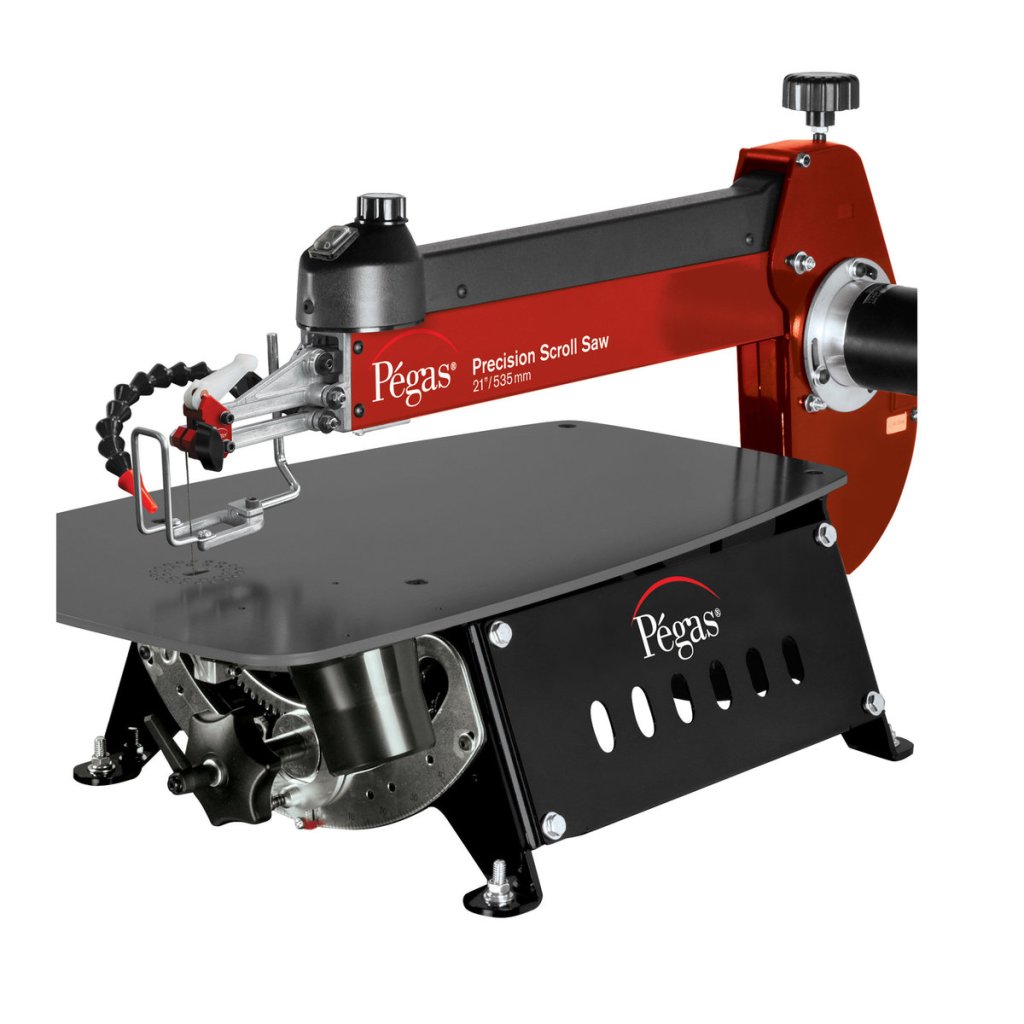
You’re welcome for the research on the scroll saw. I learned a lot from doing it as well. It does seem like the Pegas saw is the best thing to come along in wood carving since the invention of the wheel. I’ve heard a lot of positive comments about it and saw Dwayne Gosnell demonstrating one at a show 2 years ago but never got the opportunity to go up and look at it. I know Pegas makes a scroll saw (one shown near the top of this blog) but do they also make a band saw? The machine I saw being demonstrated looked to be like a band saw but I could be wrong because I didn’t get to see it up close. I also heard through the grapevine they have a combination scroll saw and band saw machine, although I don’t know how that’s possible, and I’ve never seen such a unit. Can you or anyone else out there answer these questions for me?
Our last comment comes from Dan Bennett. Dan comments:
“Bob, I’ve had best success scroll cutting my blanks up to 2” Basswood with SR12 from Flying Dutchman: .067 x .020 7 tpi/6 Rev. It’s slow and a bit tedious with 2 inches, faster with less’ Dan Bennett”
Thanks so much for that input, Dan. That’s good information. It’s sounding like 2″-2 1/2″ is about the maximum size for the average scroll saw. Two inches, in my opinion is fairly thick wood and I even notice a difference when I’m cutting 2″ blocks on my band saw compared to cutting 1″ blocks.
Let the chips fly! Tell your wood carving friends and spread the word about Wood Chip Chatter, and don’t forget to send in your questions and comments so we can keep Wood Chip Chatter active and keep the conversations going!
And remember, we need your photos! I’m sure you all have some terrific carvings to share and photos of your carvings will help to liven up the blog’s appearance and make it more interesting. Perhaps we can start a carvers photo section! Email your photos to carverbobk@woodchipchatter.com (let me know if you have any trouble attaching your photos).
Keep a sharp edge and keep on carvin’!
A man goes to his doctor with a strawberry growing out of his head. So he gave him some cream to put on it.
Today I thought we would learn a little something about Scroll Saws…not owning one it’s a topic I personally knew very little about until I did some research on them. We have discussed scroll saws a bit here in past blogs and I’m sure there are many carvers out there who use them. I’m hoping this information about scroll saws will open up some discussion, questions and comments about the various aspects of scroll saws and their use. For example, I would like to know more about the dust collection systems used with these saws. Perhaps someone can expand on that.
The Scroll Saw
A Scroll Saw is a small electric operated saw used to cut intricate curves in wood, metal, or other materials. The fineness of its blade allows it to cut more delicately than a power jigsaw, and more easily than a hand coping saw or fretsaw. Like those tools, a scroll saw is capable of creating curves with edges, by pivoting its table.
The scroll saw’s name derives from its traditional use in making scrollwork, sculptural ornaments which prominently featured scroll-head designs.
Advantages of using a Scroll Saw
While somewhat similar to a band saw, a scroll saw uses a reciprocating blade rather than a continuous loop type blade. Like a hand coping saw, the scroll saw’s blade can be removed and placed through a pre-drilled starting hole, allowing interior cutouts to be made without an entry slot. A band saw can’t do that. Also, the fineness in both width and tooth count of a scroll saw’s blade permits significantly more intricate curves than even the narrowest gauge band saw blade.
The majority of scroll saws offer a small light on a flexible arm to illuminate the work area and a dust blower nozzle to keep the work space clear while working. The table tilting capability enables angled cuts to be made precisely and easily. The variable speed support allows even finer control over cuts when working with delicate materials or when making intricate cuts.
Types of Scroll Saws
Pegas 21″ Scroll Saw
Rockwell 16″ Variable Speed Scroll Saw
Scroll Saws are classified according to the size of their throat, which is the distance from the blade to the rear frame of the saw. The throat depth determines how large a piece of material can be cut. Smaller saws have a throat of as little as 12 inches (300 mm), while commercial saws can approach 30 inches (760 mm) deep.
Not surprisingly, scroll saws vary in price. The more costly saws are more accurate and easier to use, usually because they minimize vibration, though this is dependent in part upon design and frequency, with many models offering no vibrations in some frequencies, and increased vibration in others.
Scroll Saw Uses
Scroll sawing is a popular hobby for many woodworkers and hobbyists. The saw allows a substantial amount of creativity and requires comparatively little space. Additionally, many scroll saw projects require little more than the saw itself, thus reducing the investment in tools. A drill is required for interior cutouts. A drill press is handy for finely detailed work.
Scroll saws are often used to cut intricate curves and joints, a task they can complete quickly and with great accuracy. They can also be used to cut dovetail joints and are a common tool for intarsia projects. When a fine blade is used, the kerf or incision of a scroll saw is almost invisible.
Scroll saws are comparatively safe. In particular, inadvertent contact between the blade and the operator’s fingers or limbs is unlikely to result in serious injury, due to a smaller blade and relatively slower speed compared to tools such as a band saw or table saw.
Types of Scroll Saw Blades
With the exception of blades made for very light duty saws, typical scroll saw blades are 5 inches (130 mm) long. The major types of blades are:
Skip tooth (or single skip tooth) which have a tooth, a gap, and then another tooth;
Double skip tooth (two teeth, a gap, then two teeth);
Crown or two-way, which have teeth facing both up and down so that the blade cuts on both the down-stroke (as with all other blades) and the up-stroke;
Spiral blades, which are basically regular flat blades with a twist, so that teeth project on all sides;
Metal cutting blades made of hardened steel;
Diamond blades (wires coated with diamond fragments), for cutting glass.
Pin end blades are generally a bit thicker and are made to use on scroll saws that require pin end blades which are generally older, less expensive or made for entry level scroll saw users. Most newer higher-end scroll saws do not accept pin end blades.
Blades come in many weights, ranging from #10/0 (for making jewelry—about the size of a coarse hair) to #12, which is similar to a small band saw blade.
Another variation is called a reverse tooth blade. On reverse tooth blades, the bottom 3/4″ (19 mm) of the teeth are reversed (point up). This arrangement helps to reduce splintering on the bottom edges of the cut. However, it does not clear sawdust out of the cut as well as a regular blade. Cutting is slower and produces more heat. This heat reduces blade life and makes scorching of the project more likely. Reverse tooth blades are especially useful when cutting softwood and plywood such as Baltic birch where splintering (“fuzzies”) of the wood is common.
The latest variation in scroll saw blades is called “ultra-reverse”. These blades are configured with 4–5 teeth down and then one up, repeated through the length of the blade. The blade clears dust very well and leaves a much cleaner back side (very few “fuzzies”). These blades’ sizes range from #1 through #9.
Reference: Wikipedia
My research didn’t mention this but with the typical scroll saw blade being 5 inches (130 mm) long my guess is that 2″ – 2 1/2″ is the maximum thickness piece of wood you could cut. Perhaps some of you scroll saw users out there can comment on this.
I hope you all found this article as enlightening as I did. I sure learned a few thing I never knew!
Our next blog will have another book review on a terrific book by Mike Shipley.
EMAILS
We received several emails this week in response to our last blog containing the Woodcarving Suppliers list:
Our first email comes from Wade Harvey who writes:
“Bob,
Thanks for putting this list together I’ve used many of these folks and all were easy to deal with and provided a quality product.
I’m gonna save this list and do my darnedest to remember WHERE I saved it when I need it.
Thanks, wh”
I have also used many of the suppliers on that list, Wade, and agree they have all been easy to deal with and provide quality products and they all stand behind their products as well. In fact, some of the suppliers on the list are members of the CCA who sell rough outs.
Our second email comes from Phyllis Stone who wrote in a nice comment and a question regarding scroll saw blades:
“Hi Bob,
First of all thanks so much for the list of woodcarving suppliers, there are quite a few on the list that I have never heard of so I just might have to check them out.
Second, thank you also for the sketches of how to do a curly beard. That’s very informative.
The new Fall 2021 issue of Woodcarving Illustrated is out now and on page 16 is your great article about your first carve. I love the camel, he’s adorable.
My final thought is about Dean’s message about scroll saws. I have used mine to cut out 2″ thick wood but it takes so very long to cut out a pattern. I’m not sure what blade I’m using, I think it’s a reverse tooth, but I was wondering if there is a blade that helps the process along and make it faster? I’d appreciate any help with this matter that might save me some frustration.
Thanks, Phyllis”
Thank you for your compliment on my write up in WCI. That camel was the first carving I ever did over 50 years ago. Regarding your scroll saw blade, a 2″ block of wood is pretty thick and I believe that’s pushing the limit as far as how thick a scroll saw can cut so it would only be natural that it would cut slower. Even my band saw cuts slower though a 2″ block than it does through a 1″ block.
A different blade might make a difference, though, and perhaps a reverse tooth blade is not the right blade for the job. Hopefully, some of our readers who are scroll saw owners can help you with the an answer to that question. How about it? Can anyone help Phyllis out?
My very first carving done in 1965
Our next email comes from Timothy Sisko in response to our Woodcarving Suppliers list:
“Bob, I feel remiss, after reading your latest blog it occurred to me that I hadn’t sent you the information on one of my favorite suppliers. Cascade Carvers Supply is located in the tri-cities area of Washington State Their web site can be found at cascadecarvers@msn.com . Check them out, Ron Lunde is the owner and he has always been very helpful.”
Thanks for the addition to our list, Tim! I’ll be sure and add Cascade Carvers to it, and let’s all check them out.
The next email is from my good friend Andy Loughlin who writes:
“Bob, thanks for posting your woodcarving supply list. Some I was aware of, but you definitely had some hidden gems in there. I love the blog so far. We all appreciate the time and effort that you put into it! Keep up the great work. You have tons of knowledge and experience that I look forward to soaking up !”
Thank you for the kind words, Andy! I’m glad you found the Woodcarving Suppliers list helpful.
Our next email comes from Paul Endicott of the UK who has some nice things to say and also provides some insight to carving in the UK:
“Hi Bob
Firstly, thanks for the blog, it’s really informative, and although some of the information may not be relevant for me at the moment, it’s great to know it’s there and as a reference for the future.
I’m a novice woodcarver based in the Southwest of the UK (Devon). Whilst there is some interest in wood carving, it is mainly relief style, and not a great deal of interest in caricature carving. This is where YouTube, Instagram and your blog come in so useful.
Bass wood is difficult to find, I can get lime (with effort) which I think is pretty much the same. Tools too are a bit of a challenge, we have many fantastic chisel and gouge manufacturers, not so much for knives though. You may be interested to know that I recently purchased two OCCT knives from Chipping Away in Canada, the cost, including postage, was almost the same as buying two flex cut knives over here. Obviously buying like this means you can’t handle the knives before purchasing them, but I thought it was worth taking the chance as they have such good recommendations, not least from yourself and Doug Linker. I love them! Cindy from Chipping Away was really helpful and made it very easy.
I’ll leave it there Bob, just to say thanks once again for the blog, and to let you know that we are thinking of you and wishing both you and your wife well.
PS on occasion, the likes of you, Kevin Coates and Doug Linker have “liked” some of my carvings on Instagram. This really gives encouragement, and I’d just like to say thanks.
Paul Endicott”
Thank you, Paul, for your gracious thoughts and words for me and my wife, and for the kind comments about my blog and the encouragement I give to others. I thoroughly enjoy doing both.
The OCCT knives you purchased from Chipping Away were an excellent choice. One you won’t regret. Next to Helvies, OCCT knives are my next favorite go to knives. I agree buying over the internet is always risky, especially when it comes to something as personal as a carving knife. It’s difficult to say whether you will like the knife unless you’ve actually held it in your hand which is one of the reasons why you should always purchase your carving supplies (especially knives) from a reputable supplier. Next to a recommendation from a friend or noted wood carver, working with someone like Cindy at Chipping Away is your next best bet.
Let the chips fly! Tell your wood carving friends and spread the word about Wood Chip Chatter, and don’t forget to send in your questions and comments so we can keep Wood Chip Chatter active and keep the conversations going!
And remember, we need your photos! Photos of your carvings will help to liven up the blog’s appearance and make it more interesting. Perhaps we can start a carvers photo section! Email your photos to carverbobk@woodchipchatter.com (let me know if you have any trouble attaching your photos).
A couple of weeks ago I decided to put together a list of suppliers as a reference for anyone looking to purchase woodcarving supplies. The following list of suppliers is a compilation of my own list plus some contributions from some of you. These suppliers carry anything from knives and gouges to accessories and wood, and everything in between.
However, this is by no means a complete list. I’m sure there are many other woodcarving suppliers who are not listed here. If anyone knows of any others who are not on the list please send them in and I will add them. They can even be knife makers or wood suppliers. We would love to hear from you to make our list even longer.
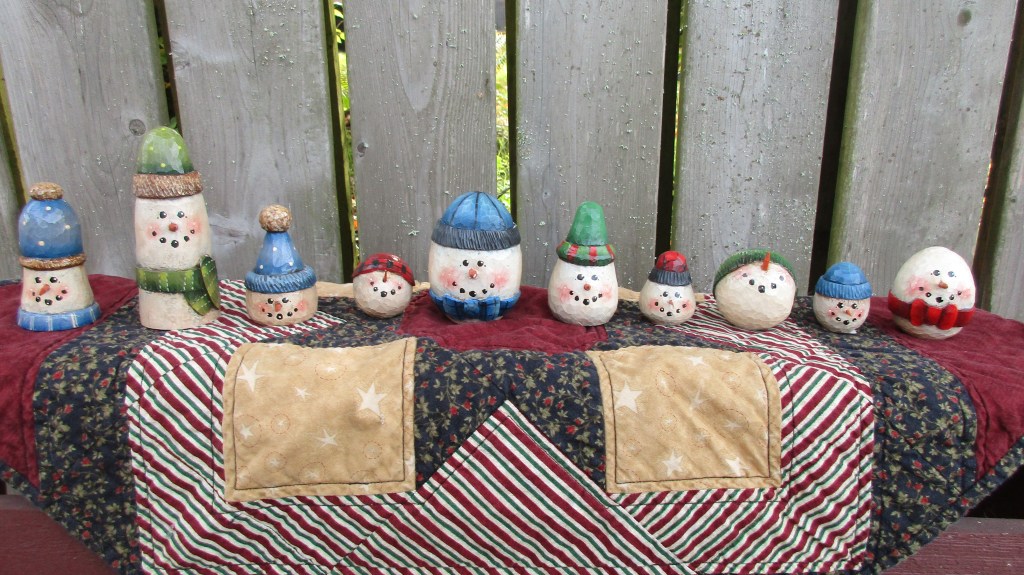
Christmas is less than 5 short months away. It’s time to get started on your Christmas carving. Here are two photos of some Santas and Snowmen carved by John Tuttle Thanks for the photos, John:
QUESTIONS & COMMENTS
We start off today with some fine suggestions & comments from Dean who writes:
“On the topic of pattern versus measurements. I’ve used both. I don’t have a band saw but I do have a scroll saw. It works looks a band saw up to 2 inches. That’s something to consider if you don’t have room in the house or the budget for a band saw. I prefer measuring especially when I plan to “modify” a design. When I’m trying to more closely match a design then I find patterns handy. One down side to patterns IMHO is they can be tricky to get started. Sometimes it’s just hard to visualize the proper sequence of steps. That’s my $.02. Who else has something to add.”
You make some interesting points, Dean, which I agree with. When working from a pattern you’re kind of bound by the outlines of that pattern and sometimes it can be hard to visualize where to start first. Sometimes with some patterns the carver gets ‘locked’ into the design and has a hard time making their own changes. When measuring you have the freedom to go in any direction you like. Also, to those of you who can’t afford or don’t have room for a band saw a scroll saw is a good alternative. Let’s hear some others’ thoughts on this subject.
Next we have some interesting insight from my good friend Wayne Smith in response to our earlier discussion on Choosing the right knife. Wayne writes:
Hi Bob, ….. just finished reading your most recent post and it got me to thinking or reminiscing of when I got started carving. I like so many others had no clue as to what I needed for tools, all I knew was that ” I needed ’em all “… lol. Somebody (might of even been you ) on WCI forum suggested that I get the beginners kit from Little Shavers (Rick Ferry). I did , and it consisted of a Murphy knife, 2 flat skews (which I very seldom use), a V tool ( which I later ruined trying to learn how to sharpen it ) a # 11 gouge, and 2 # 3 gouges ( one straight ,and one bent). I use those 2 # 3’s on practically every carving I do these days, but as you probably know I fell under the spell of Lynn Doughty and traded the Murphy knife for a Stanley # 199 which I use almost exclusively. As for the age old question ” what is the best tool ? ” My answer would be ” A sharp one “.
Keep up the good work with your blog, I will continue to look forward to it regardless of the frequency that you publish it.
Wayne
That’s a great email with some good information, Wayne, but first let me say that it wasn’t me who suggested you buy a beginner’s set of tools because I very rarely recommend purchasing tools in sets. The reason being, as you found out you usually find that you never use 40% of the tools that came with the set. My suggestion to any carver looking to buy tools is to buy them individually. This way every tool you buy is the one you want and will use and won’t have wasted your money buying tools you’re never going to use.
I never could get my head wrapped around the thought of using a box cutter as a carving knife but Lynn Doughty swears by them and he’s a pretty darn good carver. Also, anyone else who I’ve come across that uses box cutters swears by them too so there must be something to them.
Your last remark may be the most important, and that is the best knife to use is a sharp one! That statement couldn’t be more true. Regardless of what kind of knife you use make sure it’s sharp! A sharp knife cuts easily and makes whole carving experience that much more pleasurable. A dull knife does not cut through the wood easily causing the carver to struggle and become discouraged. More importantly, however, is that a dull tool is dangerous to use. Because a dull tool doesn’t cut well the carver has to use more force to push or pull it through the wood. A dull tool is more apt to slip and the carver is more likely to get injured…maybe seriously. Make sure your tools are sharp!
We also have a gracious comment from Bob Nesbit of the Conewago Carvers. Bob writes:
“Bob Thanks for all you do with your blog, and I look forward to reading it every night. Hope you will continue with it. We at Conewago Carvers like to discuss some of the comments and learn from the blog as well. Keep up the good work and I look forward to the blog being continued. Bob Nesbit”
Thank you for the encouraging words, Bob! I work hard to put out an informative blog every time. I, too am a member of the Conewago Carvers. Please spread the word and encourage more members to subscribe to Wood Chip Chatter. The more followers I can get the better I can make the blog. Thank you again!
Steve Garrett asks the question:
“How do you carve the curls in Santa’s beard?”
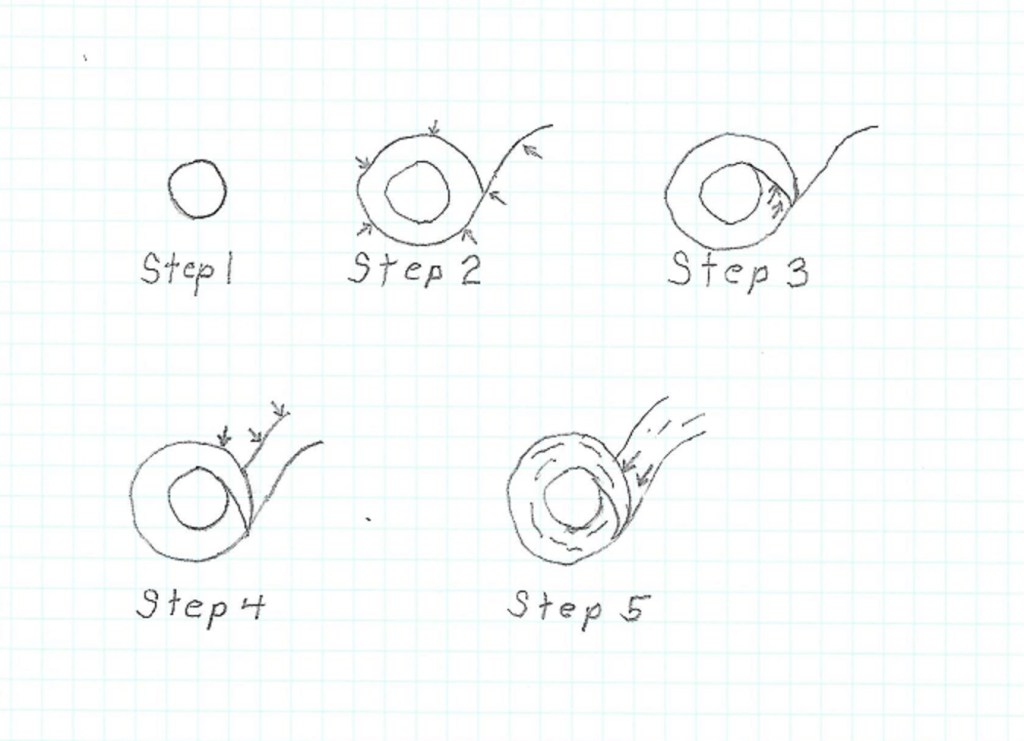
Great question, Steve, and one I’m sure a lot of readers are wondering about. Without the benefit of a video the best way I can tell you is through a series of diagrams which I have drawn below. There are several ways to approach this but this method is easy and it works. Here is a Santa ornament I carved with a curly mustache. We’ll use it as a reference.
HOW TO CARVE A CURL IN HAIR
Step 1. Carve out a small circle using the gouge of your choice. Usually a #6 works fine.
Step 2. Starting out a distance away from the circle (this will become the hair) make a long stop cut all away around the circle until it meets the stop cut again. This can be done with either a V-tool or a knife. From the outside of the large circle you have made with your stop cut carve back to it from the outside in the direction of the arrows, thus raising the curl.
Step 3. From the top edge of the inner circle make a small stop cut to the outer stop cut making sure it comes to a point with the top outer stop cut. Cut back to this point in the direction of the arrows.
Step 4. Above the outer curl make another stop cut somewhat parallel to the first stop cut you made, thus forming the hair. Cut back to the curl (in the direction of the arrows) to raise the hair.
Step 5. Cut back to the curl (in the direction of the arrows) to raise the curl above the hair. Finally, carve “C” and “S” type cuts around the hair and curl.
NOTE: A V-tool can be used for a lot of this work if you choose. It’s up to you. Some carvers prefer working with V-tools and others are more comfortable using a knife. Whatever tool works for you is the right tool.
Let the chips fly! Tell your wood carving friends and spread the word about Wood Chip Chatter, and don’t forget to send in your questions and comments so we can keep Wood Chip Chatter Active and keep the conversations going!
And remember to email your photos to carverbobk@woodchipchatter.com
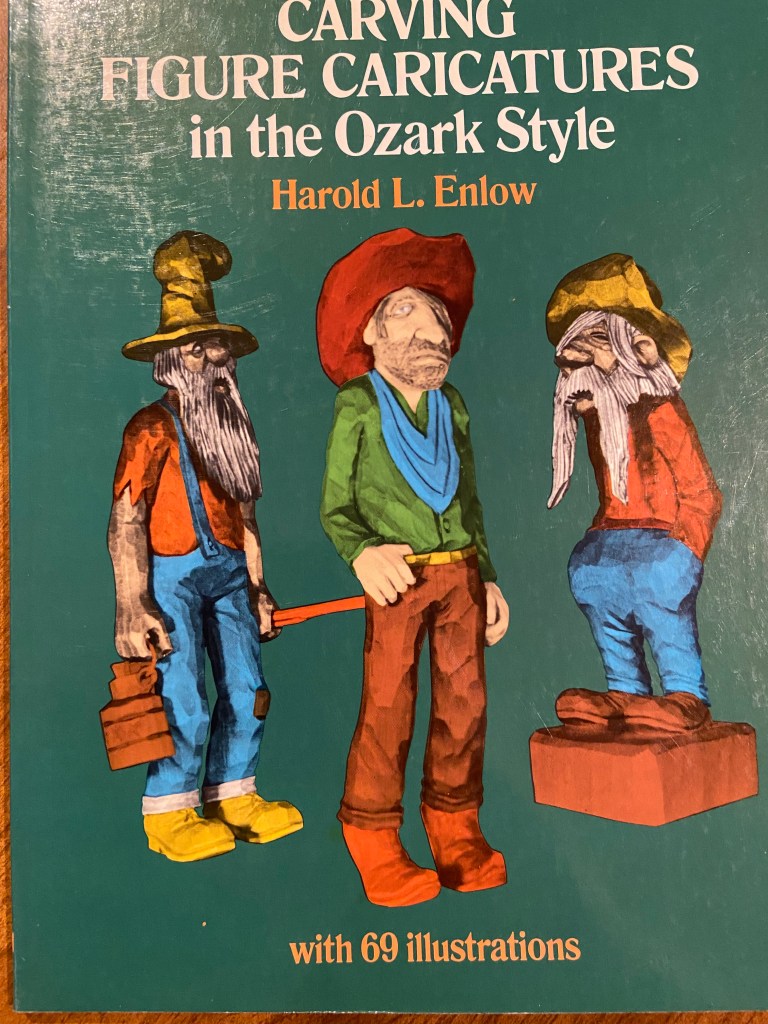
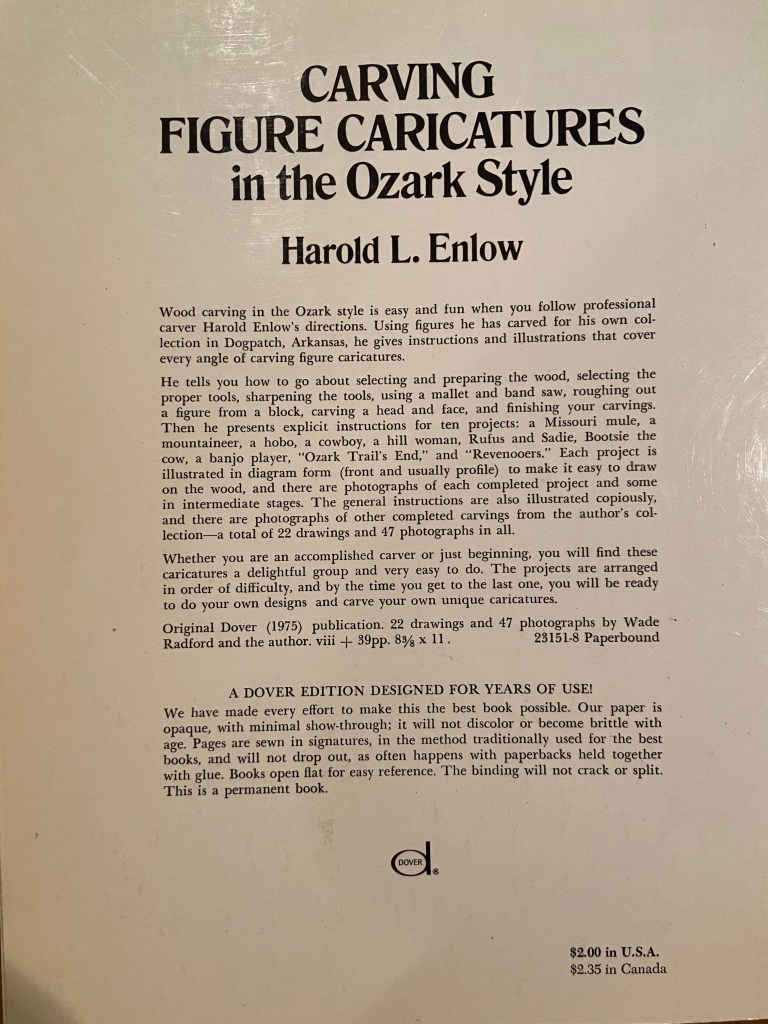
“CARVING FIGURE CARICATURES in the Ozark Style” is just one of many excellent woodcarving books written by noted wood carver and instructor Harold L. Enlow. Published by Dover Publications Inc. in 1975 this 39 page paperback book contains 22 drawings and 47 black & white photographs, and covers 10 projects which go from easy to somewhat more difficult to carve. Each project has large, easy to copy patterns.
There are sections in the book that cover topics such as selecting and preparing the wood, selecting the proper tools, roughing out your carving, and finishing your project. In addition to the 10 projects, Harold has included a section on How to Carve a Head and Face.
Typical Project
“Rufus” – my favorite character from the book
Most of the projects provide a list of tools needed, which is helpful. Although comprehensively written all of the projects are delivered in clear, easy to follow text form. In most cases, there are only photos of the finished project with an occasional photo of a project in stages of completion. Some of the projects include: A Missouri Mule, A Mountaineer, A Hobo, Rufus and Sadie (who you are all familiar with), and A Banjo Player.
If you are a visual person who needs a lot of instructional pictures to go by this is not the book for you, but if you can take a pattern and one or two go by photos and wing it, there are some fun hillbilly projects inside.
EMAILS & COMMENTS
We received several emails this week with some interesting questions and comments. I hope you will find them engaging.
Our first email comes from Timothy Sisko who writes:
“Bob, in the one month that you have been publishing your blog, I believe I have read every one of your articles. I must say that I have enjoyed them and appreciate your efforts. Please keep up the good work. I enjoy reading your articles.”
I am truly humbled to hear you say that, Tim. I’m so glad you are enjoying Wood Chip Chatter. It’s for folks like you who make it all worthwhile.
Our second email comes from garyscarving. Gary writes:
“Hey Bob, I hope life is treating you well and my prayers go out to your wife!!! I’m new to carving & social media but I enjoy reading your blogs they are always full of great information & you tend to hit on all the questions a beginner has and i thank you very much for doing it especially with all the time you put into it!! When i started carving a couple of months ago I only let myself purchase a knife and a small v-tool to get me started but I think i am ready to purchase a few gouges &/or v-tools & take the next step. I am somewhat of a tool nut & prefer quality tools, a buy once cry once type of guy (yes we all have our weaknesses lol). My question is on the gouges is it best to get the bent gouge or straight gouge or a little of both when doing caricature carvings? Would love any feedback that you have or anyone else that reads these, it would be greatly appreciated. Thanks for the ears & whittle on”.
First of all, thank you for your prayers for my wife. She is undergoing treatments for her cancer and is doing well. I’m glad you’re enjoying Wood Chip Chatter, and thank you for your thoughtful comments. Second, let me say in my opinion you made a wise decision to start out with just a carving knife and a small V-tool. When it comes to carving small caricatures a small (1/8″ or 1/4″) V-tool is about the only other tool you need besides your carving knife. Once you get into carving more ‘advanced’ type carvings is when you want to start branching out into different types of gouges, and as far as gouges go the sky is the limit when it comes to shapes and sizes! Most wood carvers become tool collectors as well. I, like so many other carvers have boxes full of tools, yet we never have enough. There’s always that one more tool out there that you just gotta have!
Now to finally answer your question about straight gouges vs. bent gouges. I have both and I use both. For years I used both types and never gave them a thought, but lately I am beginning to lean towards bent gouges (at least for the type of carving I do). To me, a bent gouge can do the same things a straight gouge can do but it can also get into tight spots where a straight gouge cannot. I just bought two Drake bent gouges but haven’t had the opportunity to use them yet. I’m anxious to see how they perform. By the way, when you buy Drake gouges they are offered as either straight or bent.
I’m not saying to only buy bent gouges. These are just my thoughts from my own experience.I really encourage feedback from our readers on this subject to get other’s opinions on straight vs. bent gouges. Perhaps we can open an informative discussion on the matter.
Our next email come from John Pearson who writes:
“Bob, I understand your disappointment with the early stages of your blog. Please know I am an avid reader/follower of your blog plus Instagram. I encourage you to press on.
I’d like your thoughts on pattern usage vs. those instructors that provide measurements in videos and/or step by step instructions via print with pictures.
I do not have a bandsaw and those folks that provide patterns to copy onto the wood (such as from books) usually provide a front and side view. While I am fairly proficient following measurements and print guidance, I have difficulty matching up front and side views of patterns. Most do not have grid lines. Any do’s and don’ts out there to help overcome this? I really enjoy how you present your instructions.
John”
Thank you for your kind words, John. I want you and everyone else to know that I truly covet you all as readers and followers. Your loyalty and support mean a great deal to me, and on my ‘down’ days thinking of you is what picks me up and keeps me going.
To address your concern about the use of patterns let me first warn everyone to be careful when using them. With many patterns you find (in books for example) the front and side views don’t always match. Sometimes you have to reduce, expand or even redraw one of the pattern views so that the front and side views match which is a pain.
Whenever using paper patterns, like from a book (assuming they are sized correctly) I always transfer them to the wood using graphite paper. I carefully align the bottoms of both patterns (front & side views) with the bottom of the block. This insures that both views line up perfectly top to bottom.
When an instructor provides measurements and step by step instructions such as Doug Linker does there are some advantages. For one, your measurements are always spot on and there is no guess work as to whether you have the pattern correct. The other advantage is that this method gives the carver much more ‘license’ to change things up and make the carving his or her own. I hope this answered your question, John, and like always we welcome our readers to follow up with their thoughts and comments on the subject.
srjudge wrote a very nice email to say:
“Love your blog and find the information very useful, especially to this “newbie.” Keep up the good work.”
Thank you for your kind and encouraging words. I’m glad you are finding Wood Chip Chatter informative.
We have one final email from Phyllis who writes:
“Thank you Bob for your blog. I for one have learned several things from the knowledge you have been giving us. I quite understand your wanting to do fewer blogs a week and fully support you no matter how many you do because I enjoy reading them. You have so much information for carver’s to learn from.”
Phyllis, thank you so much for your understanding and words of encouragement. It’s for folks like you which is why I write Wood Chip Chatter. I’m glad you enjoy it and find it helpful. I greatly enjoy sharing my knowledge and helping other carvers, especially beginners. It is my hope that Wood Chip Chatter will continue to help serve that purpose.
This was a particularly long blog, mostly due to all the emails we received in the past few days, and THAT’S GREAT! Your emails are so important to the success of Wood Chip Chatter. They are what help keep this blog interesting and informative. I want to especially thank those of you who contributed this week. “Keep the chips flying!”
Let the chips fly! Tell your wood carving friends and spread the word about Wood Chip Chatter, and don’t forget to send in your questions and comments so we can keep Wood Chip Chatter Active and keep the conversations going!
And remember to email your photos to carverbobk@woodchipchatter.com
The nature of the wood being carved limits the scope of the carver in that wood is anisotropic and not equally strong in all directions. The direction in which wood is strongest is called the “Grain” (wood grain may be straight, interlocked, wavy, fiddleback, etc.). For strength purposes it is always wise to arrange the more delicate parts of the figure along the grain direction instead of across it. Often, however, a “line of best fit” is instead employed, since a figure’s design may have multiple weak points in different directions, or the orientation of these along the grain would necessitate carving detail on end grain. Carving on the end grain is considerably more difficult than carving with the grain. Carving blanks are also sometimes assembled out of many smaller blocks of wood or boards, and in this way, one can orient different areas of a carving in the most advantageous way, both for the carving process and for durability. Carousel horses are a good example of this practice. Less commonly, this same principle is used in solid pieces of wood, where the fork of two branches is utilized for its divergent grain, or a branch off of a larger log is carved into a beak (this was the technique employed for traditional Welsh shepherd’s crooks, and some Native American adze handles). The failure to appreciate these primary rules may constantly be seen in damaged work, when it will be noticed that, whereas tendrils, tips of birds beaks, etc., arranged across the grain have been broken away.
Probably the two most common woods used for carvingin North America are basswood (aka tilia or lime) and tupelo; both are hardwoods that are relatively easy to work with. Chestnut, butternut, oak, American walnut, mahogany and teak are also very good woods; while for fine work Italian walnut, maple, apple, pear, box or plum, are usually chosen. Decoration that is to be painted and of not too delicate a nature is often carved in pine, basswood or tupelo which are relatively soft and inexpensive.
“THE PROCESS”
A wood carver begins the carving process by selecting a block of wood the approximate size and shape of the figure he or she wishes to create, or if the carving is to be large, several pieces of wood may be glue together to create the required size. The type of wood is important. Hardwoods are more difficult to shape but have greater strength and luster. Soft woods are easier to carve but are more prone to damage. Any wood can be carved but they all have different characteristics. The choice of wood will often depend on the requirements of the carving being done.
Once the block of wood has been selected the wood carver then cuts out the general shape of the figure he or she wants to carve. Generally, a pattern is drawn onto the block before cutting. The pattern can traced on from and paper pattern or cut out cardboard pattern, or it is sometimes just roughly drawn on with a pencil. Most times a front and side view pattern are drawn onto the block. Following the shape of the patterns the general figure is cut out using s band saw, scroll saw or coping saw. This process removes a great deal of the ‘waste’ wood which saves the carver a lot of time.
When the carver has the figure shape cut out he or she begins a general shaping process, known as blocking out. Carving knives and gouges of various sizes and shapes are used. A gouge has a curved blade that can remove large amount of wood at one time. For harder woods, the wood carver may use gouges sharpened with stronger bevels, about 35o, and a mallet similar to that of a stone carver’s. When carving softer woods the bevel will usually be about 20o. The terms gouge and chisel are open to confusion. Correctly, a gouge is a tool with a curved cross-section and a chisel is a tool with a flat cross-section. However, many professional carvers tend to refer to them all as ‘chisels’. Very large carvings require the use of a mallet and large gouges whereas smaller carvings usually require the woodcarver to use only a knife and small palm gouges. No matter what wood is selected or tools used, the wood carver must always remember to carve either across or with the grain of the wood and never against the grain.
Once the general shape is made or blocked out, the carver may use a variety of tools for creating details. For example, a “veiner” (also called a “fluter”) can be used to make deep cuts into the surface, or a “v-tool” for making fine lines or decorative cuts. Once the finer details have been added, the wood carver finishes the surface. The method chosen depends on the desired quality of the finish. The texture left by shallow gouges gives ‘life’ to the carving’s surface and many carvers prefer this ‘tooled’ finish. If a completely smooth surface is required the carver may use “Rifflers”. Rifflers are similar to fine rasps, usually double-ended, and of various shapes for working in hard to reach folds or crevasses. The finer ‘polishing’ is done with abrasive paper usually referred to as sandpaper. Large grained sandpaper with a rougher surface (higher grit) is used first, with the carver then using finer and finer grit sandpapers that can make the surface of the carving smooth to the touch.
After the carving is completed, the wood carver may seal & color the wood with a variety of paints or natural oils, such as acrylic or oil paint, or walnut or linseed oil which seals and protects the wood from dirt and moisture. Often a coat of polyurethane or lacquer is added as a final sealant. Carvers seldom use gloss finishes as they create too shiny a surface, which reflects so much light that it can confuse the form. Objects made of wood are frequently finished with a layer of wax, which protects the wood and gives a soft lustrous sheen. A wax finish (e.g. bees wax or carnuba wax), however, is only suitable for indoor carvings.
Mountaineer Moonshiner Carved by Bob Kozakiewicz
A NOTE ABOUT WOOD CHIP CHATTER
My ‘Wood Chip Chatter’ blog is now one month old. I have immensely enjoyed writing it and I hope those who read it enjoy its contents whenever it is published. I work hard and spend a great deal of time putting the blog together, and have tried to publish something worthwhile every day.
After one month, however, I am disappointed in the response I’ve gotten to ‘Wood Chip Chatter’. I’m seeing that the number of folks actually reading the blog is but a fraction of those who are subscribed to it. Participation, in terms of questions, comments and photos (photos of your carvings are especially appreciated) has also been minimal. When I created ‘Wood Chip Chatter’ I envisioned a platform for whittlers and wood carvers to generate discussions through those questions and comments. The overall success of ‘Wood Chip Chatter’ depends to some degree on those discussions.
With readership and participation being as low as they are I have decided to publish fewer blogs per week, perhaps just two or three. Maybe it will help, maybe it won’t. Maybe it will make the blog better and more interesting to read, but it will definitely give me more time to gather information and content for future blogs, though.
Thank you to those of you who read ‘Wood Chip Chatter’.
Let the chips fly! Tell your friends and spread the word about Wood Chip Chatter, and don’t forget to send in your questions and comments so we can keep Wood Chip Chatter Active and keep the conversations going!
And remember to email your photos to carverbobk@woodchipchatter.com
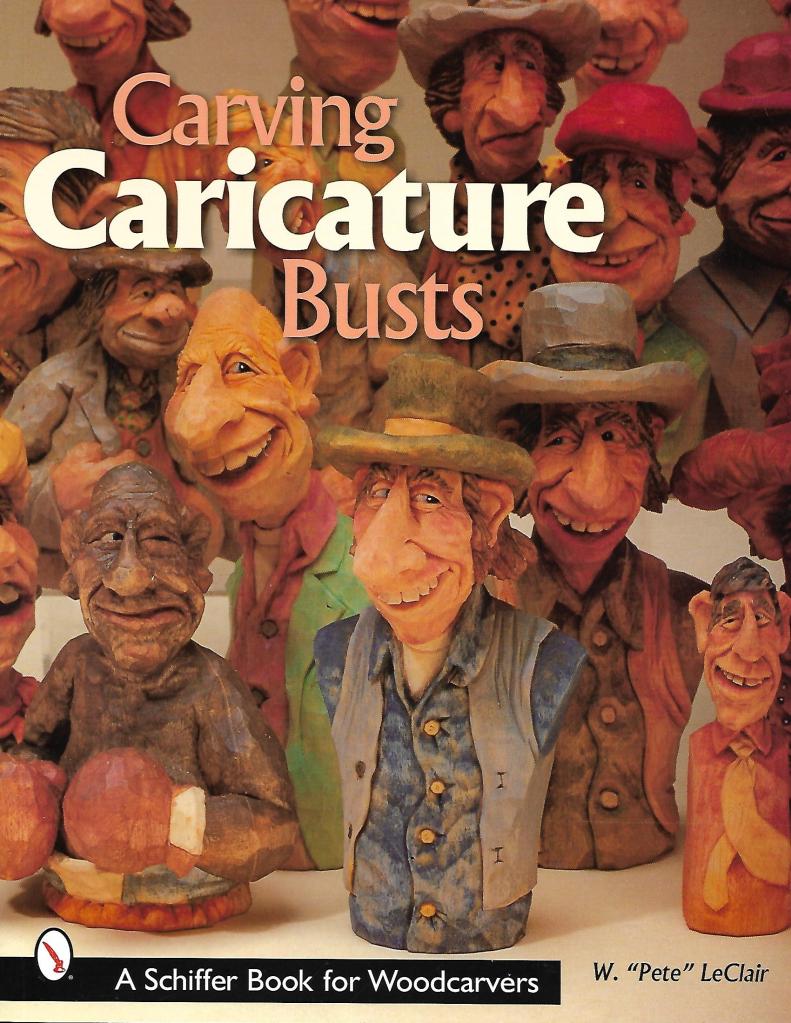
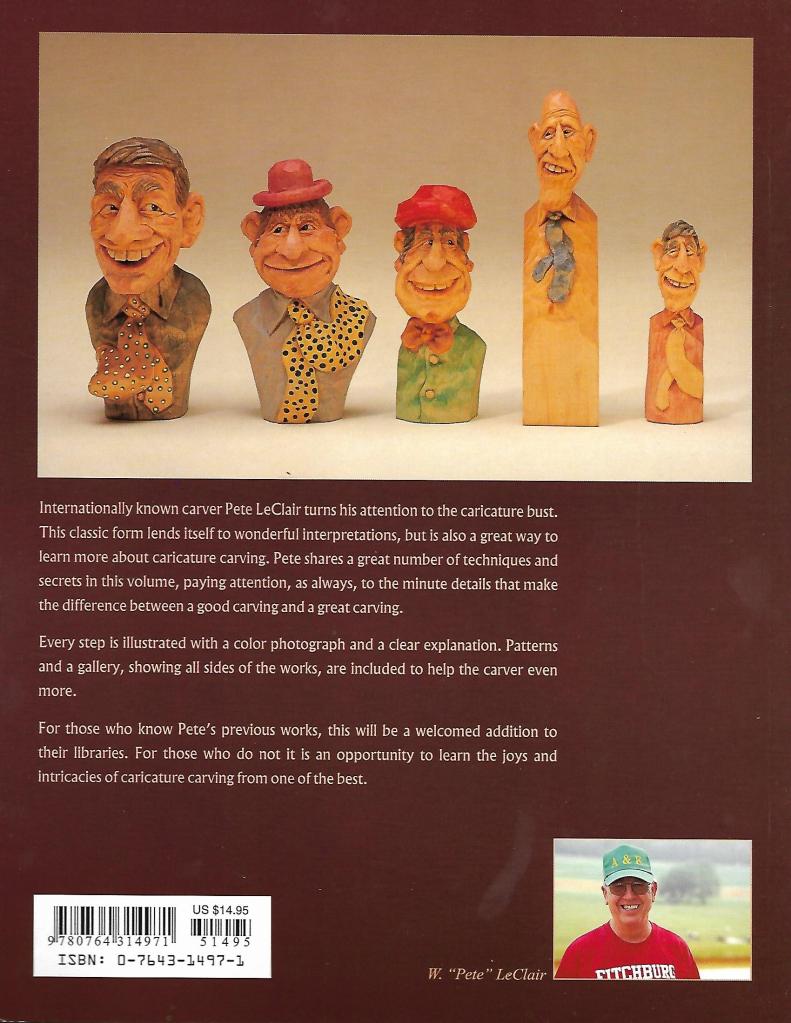
“Carving Caricature Busts” is the latest of three excellent woodcarving books written by noted wood carver and instructor Pete LeClair. Published by Schiffer Publishing Ltd. this 80 page paperback book containing over 350 color photographs takes the carver from start to finish with carving a fun to carve caricature bust. On the very first page Pete gives you a photo and list of all the tools he uses to complete the project.
Tools Used
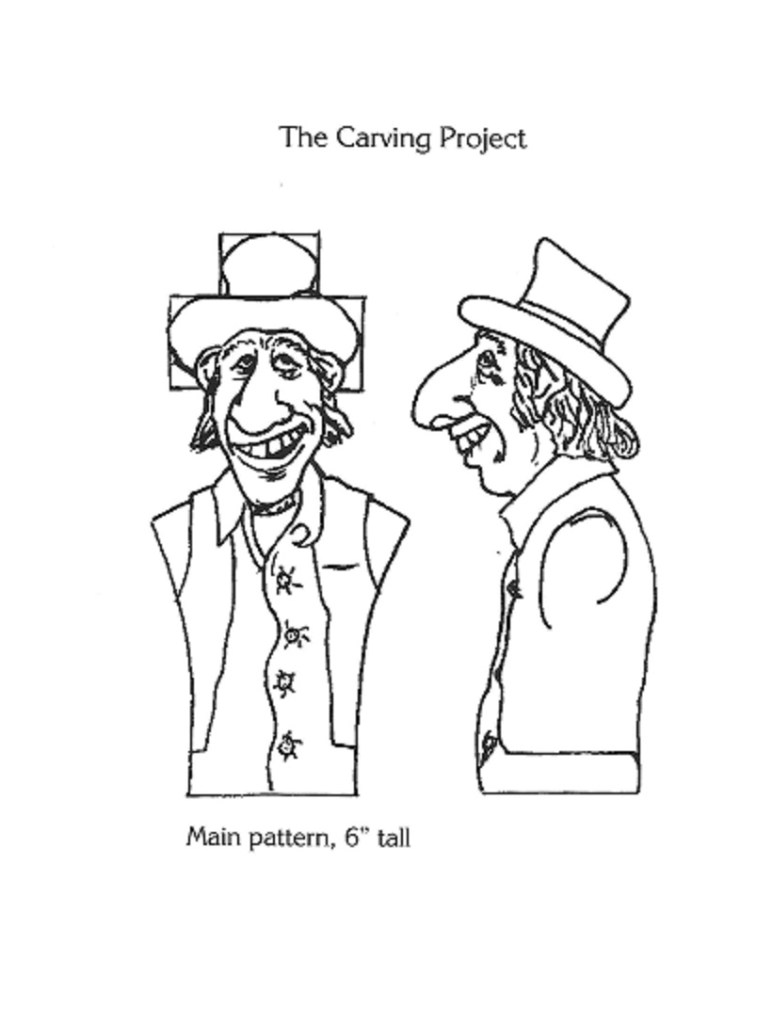
Project Pattern
With 57 pages, each with 5-6 color go by photos just dedicated to carving the project Pete takes you from drawing the pattern on the block step by step all the way through to the finished carving.
Then there are 6 pages dedicated to painting and finishing, each page again filled with lots of color go by photos.
Finally, there is a gallery in the back of the book that shows 25 of Pete’s comical caricatures. This gallery is unique, though in that there is a pattern supplied with each of the carvings in the gallery.
Carving caricature busts is a great way to learn how to carve caricature faces and get into some of the detail of carving caricatures themselves. Carving busts is nice because you don’t have to worry about carving detail into the entire body of a caricature. Instead, you can focus on carving just the face and the torso.
“Carving Caricature Busts” is a well written and illustrated book which I highly recommend to any carver looking to learn about carving caricature faces with a little extra flare.
EMAILS & COMMENTS
We recently got an email from Jakobo Santiago with some photos of a spectacular wood spirit he carved from an oak handle of an old shovel. He estimates the shovel was about 30 years old. I’m sure that old oak handle was hard as a rock to carver. Terrific job Jakobo!
Patsy wrote in and commented:
“I am enjoying your posts. Thank you…”
You’re welcome, Patsy! I’m glad you are enjoying the blog and I hope everyone else is too.
Phyllis Stone sent in an email with a suggestion for our Wood Carving Supplier list. She mentioned: Hillcrest Carving in Lancaster, PA.
Thank you for your contribution, Phyllis! I will make sure I get Hillcrest Carving on the list.
Janie Hall wrote in to say: “Hi Bob. I love the bottle stopper”
Thank you, Janie for your thoughtful words! I greatly appreciate them!
Bill wrote in an email a few days ago in response to my tutorial on Carving A Moravian Star ornament and said:
“Nice, short tutorial that looks like a lot of fun!!! Thanks so much!!”
Thanks for the kind words, Bill. Good luck with carving your star and don’t be afraid to reach out to me if you have any question or need any help.
And finally, “Someone (unknown)” Sent in an email in response to my tutorial on Carving A Moravian Star ornament. “Someone” writes:
“Thank you, this helps a lot and can’t wait to start carving this beautiful star.”
I‘m glad you found the tutorial helpful. Good luck with carving your star and don’t be afraid to reach out to me if you need any help.
A big Thank You to everyone who wrote in today to send a photo or comment! They are much appreciated!
I hope you found today’s book review helpful. I would love to hear from you to get your feedback as to what you thought and to know if you want to see more in the future. Thanks!
Let the chips fly! Tell your friends and spread the word about Wood Chip Chatter, and don’t forget to send in your questions and comments so we can keep Wood Chip Chatter Active and keep the conversations going!
And remember to email your photos to carverbobk@woodchipchatter.com
Keep a sharp edge and keep on carvin’!

My wife and I always hold hands. If I let go, she shops!
The intricately carved wooden lovespoon has traditionally been used as a token of affection in Wales. Each spoon could contain different meanings as shown by the use of various symbols, for instance: a chain would mean a wish to be together forever; a diamond would mean wealth or good fortune; a cross would mean faith; a flower would mean affection; or a dragon for protection. Many sailors carved spoons as they had much free time at sea on their long voyages, they would carve such symbols as anchors or ships into the spoon. Although the Welsh lovespoon has its unique qualities, other styles of lovespoons have been made in Scandinavia and Eastern Europe, particularly Romania.
In Botswana, a republic in southern Africa the wooden spoon is used as a token to share duties, responsibilities and knowledge, the holder contributes to the work in whatever small way, like a group contributing to a dish by adding ingredients, mixed with the spoon.
In the Philippines, wooden rice spoons with carved sacred images of bulul representing deities or ancestral spirits (anito) are traditional among the Ifugao people. Despite the animistic carvings, they are everyday utensils used for eating rice or soups or serving wine. Today, they are commonly sold as souvenirs to tourists.
In the Philippines, giant wooden spoons and forks are traditionally hung in the dining room, framed, or placed inside a cabinet. Both are the most common traditional utensil pairing in the Philippines (as opposed to the knife and fork as in western countries). Along with a painting or tapestry of the Last Supper, they are some of the more ubiquitous decorations in Filipino homes. They are regarded as symbols of good health.
Resource unknown
EMAILS
Jim Morasco sent in an email with an excellent question on staining. Jim writes:
“Hi I was wondering if you have any tips on preparing a piece for staining? Most of the time I end up painting something I intended to stain because the wood looks damaged. I try sanding but sometime it gets worse. Thanks!”
That’s a great question, Jim! Staining wood carvings can be really tricky and if not done properly you can ruin a perfectly good carving in the process. The problem when staining a wood carving is that all of the end grain of the carving soaks up the stain more the sides leaving the unsightly dark blotches many of us have experienced. What I have found when staining a wood carving is that you need to seal the wood before staining. There is a sanding sealer on the market that some carvers use although I have never tried it. You really just need to apply any kind of wood sealer to the carving first before applying the stain. This helps to prevent the stain from soaking into the end grain. Polyurethane or lacquer both work well. I use Deft spay lacquer with success. The key is to be sure your carving is well coated with the sealer, especially on the end grain. As always, it’s a good idea to practice on a scrap piece of wood first.
John Pearson sent in an email with a suggestion in response to my request for recommendations for wood carving suppliers. John writes:
“Hi Bob, I exclusively use Heinecke Wood Products for basswood. They supply their Northern Wisconsin basswood to many well known carvers. John”
Thanks for the suggestion, John! I too, like so many other (noted) wood carvers Use Heinecke basswood exclusively. In my opinion they have the best quality basswood you can find anywhere. I’ve never been disappointed with basswood from Heinecke Wood Products. I will make sure to put them on the list!
We need your contributions to Wood Chip Chatter! A few days ago I mentioned that I’m going to put together a list of woodcarving suppliers and asked for anyone who had suggestions to please send them in. So far I have only gotten two (2) suggestions. Wood Chip Chatter is the type of blog that thrives on the contributions (questions, comments, suggestions) from its readers. I’m sure there are more than two woodcarving suppliers out there so let’s hear from you so we can make this list more comprehensive and worthwhile. Send your suggestions in to carverbobk@woodchipchatter.com or just click on the Comments button. Thanks for pitching in!
Let’s make the chips fly! Tell your friends about Wood Chip Chatter, and don’t forget to please send in your questions and comments so we can keep Wood Chip Chatter Active and keep the conversations going!
And remember to email your photos to carverbobk@woodchipchatter.com
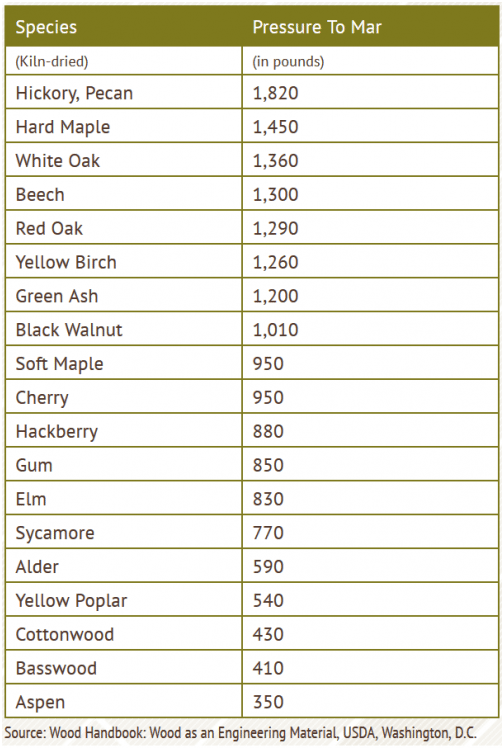
The Janka hardwood rating test is a test that determines the hardness of a piece of wood (used mostly to determine the hardness of flooring planks). Quite often the hardness of a piece of wood relates directly with its density. Wood carvers, however, can use the Janka hardwood ratings to compare one type of carving wood to another. For example, one can easily see that Basswood is near the very bottom of the ratings chart indicating that it is one of the softest of the hardwoods. Black Walnut, on the other hand is much further up on the ratings chart and is considered to be much harder to carve than Basswood. Below is an explanation of the Janka ratings test and a chart including some of the more popular North American hardwood species.
Janka Wood Hardness Ratings
When in doubt about the type of wood to select for your cabinetry, flooring, furniture or millwork project, refer to the Janka Rating System, which measures the relative hardness of woods.
The hardest commercially available domestic hardwood is hickory; it is five times harder than aspen, one of the “soft” hardwoods. And while this example lists just some of the most popular hardwood species, there are hundreds of varieties, representing the North American hardwood population.
Because hardness is an important factor, and hardness varies for each species, the Janka Scale of Hardness is an excellent tool to help identify appropriate choices.
So what does the Janka test consist of? The process of measuring the density of wood begins by embedding a steel ball that has a diameter of 11.28 millimeters (roughly 0.444 inches) halfway into the wood’s surface. The force required to push the ball into the wood (measured in pounds-force, or lbf) indicates how dense and strong the wood is. For example, hickory hardwood has a Janka rating of 1820; this means that it required 1,820 pounds of force to embed the steel ball into hickory’s surface.
The hardness and density of wood is often determined by the direction of its grain. Measuring a wood’s flat or horizontal grain (face) is the most general way to determine its hardness. Although vertical wood grain (edge) is tested, the results are not displayed on the Janka Hardness Scale. The results shown on the Janka Hardness Chart indicate the hardness of a wood’s face, and not its edges (or “side hardness”).
Common Domestic Species Janka Ratings
This should only be used as a general guide when comparing various species of wood flooring. Depending on where the wood is harvested the results may vary. Plank construction and finish are also important factors when determining the durability and ease of maintenance of any wood floor.
COMMENTS
After seeing the above Janka Hardwoods ratings chart I noticed something that sheds some light on a discussion we had a few days ago regarding Cottonwood. Rick Boyer wrote in and asked since cottonwood bark is so widely carved does anyone ever carve cottonwood itself? My response was that while I had never carved cottonwood (only cottonwood bark) I couldn’t say how it carved but did know it is considered to be a hardwood.
Upon looking at the Janka chart I see that cottonwood is very low on the hardness ratings (just above basswood). It’s only 20 rating pounds higher than basswood so my guess is it probably carves very much like basswood. Therefore, like basswood, cottonwood is considered to be among the softest of the hardwood species. So Rick, if you can get a hold of some cottonwood I would definitely give it a try.
SUPPLIER LIST:
I want to put together a comprehensive list of wood carving suppliers who supply anything from tools, accessories, supplies, roughouts, safety equipment, books, etc. Even wood! While I have quite a large list of my own I want to hear from my readers on who they like to use. This way I can add them all together and make up one large list.
So if you have some wood carving suppliers you would recommend send them in! I’ll need their name, contact information (phone #, website), and basically what they supply. Thanks!
Let the chips fly! Tell your friends about Wood Chip Chatter, and don’t forget to send in your questions and comments so we can keep Wood Chip Chatter Active and keep the conversations going!
And remember to email your photos
to carverbobk@woodchipchatter.com
Keep a sharp edge and keep on carvin’!

My wife and I were watching Who Wants To Be A Millionaire while we were in bed. I turned to her and said, ‘Do you want to have Sex?’ ‘No,’ she answered. I then said, ‘Is that your final answer?’
… She didn’t even look at me this time, simply saying, ‘Yes..’ So I said, “Then I’d like to phone a friend.”
A bit of a slow news day today. Being that it’s Sunday I’m taking a little break. We do have a couple of excellent emails to report, however, and a tip on buying from a wood carver that you’ll want to know about. Next week we’re going to go into the Janka wood comparison ratings and hardness chart, and also begin some book reviews which I think you will all appreciate. Have a happy Sunday!
Eagle Head Belt Buckle Carved by Bob Kozakiewicz
Bill sent in a response to my tutorial on “Carving a Moravian Star”. Bill writes:
“Nice, short tutorial that looks like a lot of fun!!! Thanks so much!!”
Thanks, Bill! I’m glad you enjoyed the tutorial.
Gene Kucker sent in an email along with photos of some awesome Moravian stars he carved. Gene writes:
“Hey Bob,
Here are a few Moravian stars I did and was playing with some add on and such. Let me know whatcyou think. I was thinking about doing a ball inside one of the bigger sized stars. I really love the new blog and I’m a huge fan of your carvings. Thank you for inspiring me and others and keeping carving alive.
Thanks
Gene Kucker
Blacklick Ohio transplant from Matawan NJ”
Moravian Stars Carved by Gene Kucker
Detailed Moravian Stars Carved by Gene Kucker
Thank you for your email and your photos, Gene! Those stars are truly magnificent! Very clean cuts and the detail is remarkable. I encourage you to keep pushing the envelope on what you can do with them…borders, balls inside, etc. And just think…we were practically neighbors once! Keep the pictures coming!
Buying From A Wood Carver
This is a matter I touched on about a week ago in response to a reader’s comment but I feel so strongly about it that I thought this particular point was worth publishing:
Let the chips fly! Tell your friends about Wood Chip Chatter, and don’t forget to send in your questions and comments so we can keep Wood Chip Chatter Active and keep the conversations going!
And remember to email your photos to carverbobk@woodchipchatter.com