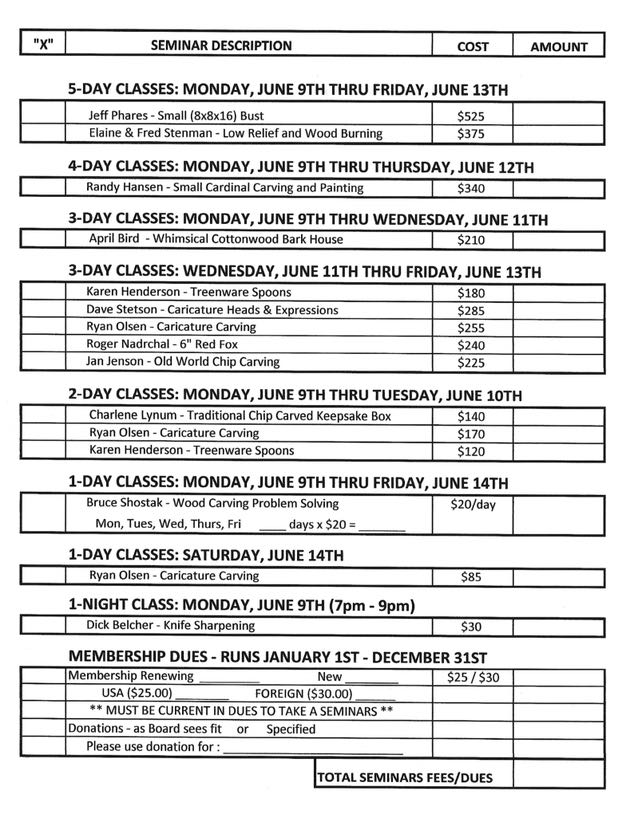
Lumber Production

Lumber Production

Lumber is the product of the sawmill and ordinarily is not manufactured further than by sawing.  It is produced in varying sizes, the usual approximate dimensions being about 3/4″-4″
(2–10 cm) in thickness, about 3″ (8 cm) and greater in width, and about 6′-20′ (2–6 meters) in length.  The conversion of logs to lumber involves breaking them down into boards of various thicknesses by resawing, ripping (edging), and crosscutting.

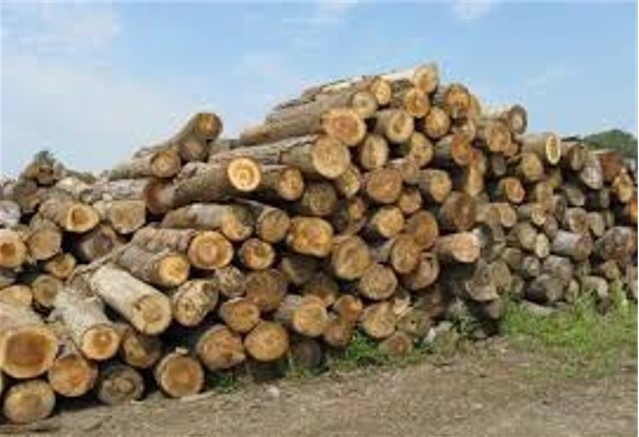
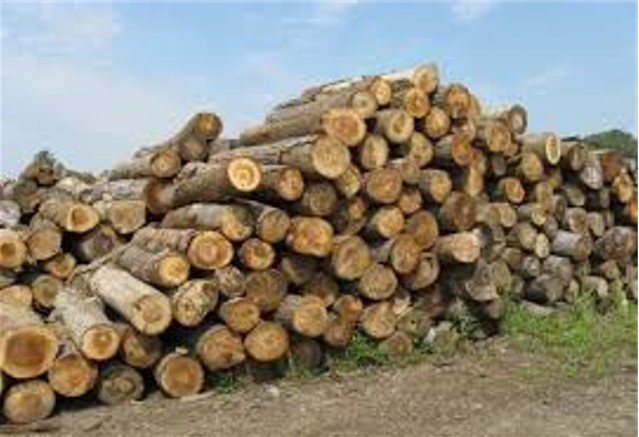
The organization of production varies in its detail in different manufacturing plants but can be described in general terms.  After transport from the forest, logs are stored in water, usually a pond or river, or in a ground storage yard.  Each log enters the mill on a conveyor; in large operations it is mechanically debarked, and in some it is crosscut to length.  Supported on a carriage, it is brought to a headsaw (the first saw), which is one of three types: band saw, frame (gang) saw, or circular saw.

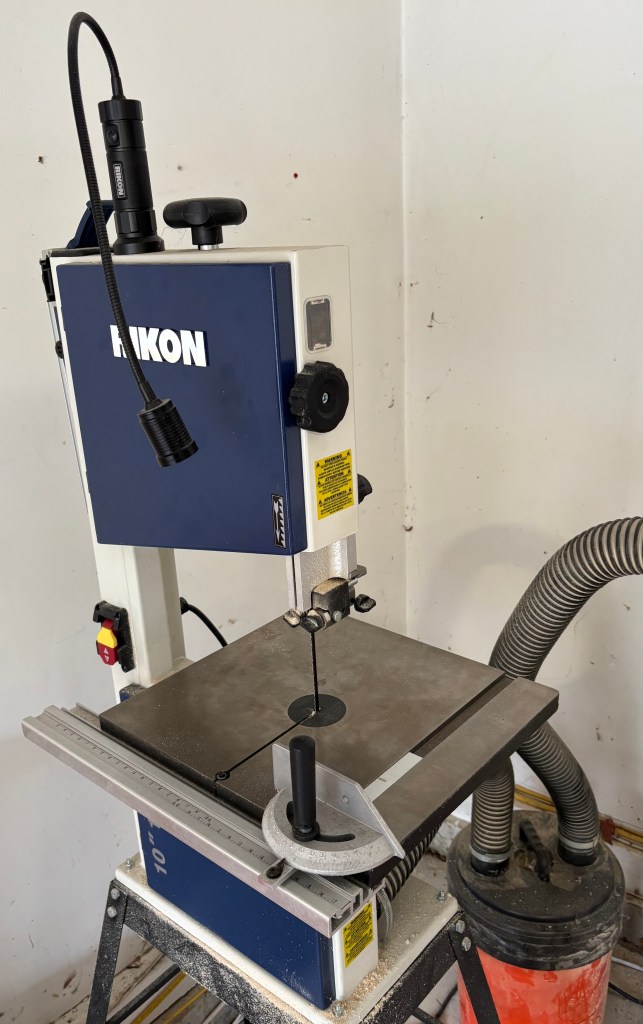
A band saw consists of an endless band of steel, equipped with teeth usually on one edge only, that moves around two wheels—one powered and the other free-running.

Frame saws commonly consist of a reciprocating frame in which a number of saw blades are mounted parallel to each other at predetermined lateral distances.

A circular saw consists of a circular blade having teeth on its periphery and mounted on a shaft.

Band and frame saws have relatively thin blades and are therefore less wasteful than circular saws.  Band and circular saws permit changing board thickness and turning the log after each cut; therefore, breakdown is more advantageous in terms of yield and grade.  Frame saws require that logs be sorted according to diameter, because the position of the blades (and thus the thickness of the lumber) is determined accordingly.  Frame saws are being largely replaced by band saws.  Machines for other operations can be sited behind the headsaw in the production flow; they include resaws (band or circular saws), edgers (band or circular saws, or chippers equipped with knives), and trimmers (circular saws for transverse cutting).

Breakdown is accomplished in one or more operations.  For example, a combination of circular and frame saws, or two frame saws in series, may be used.  The first saw removes slabs (the outside pieces cut from a log) and, in certain cases, some boards. The piece produced is then turned 90° and introduced into the second saw, which converts it into boards (cant sawing).  The second operation may be considered resawing; in general, resawing consists of either dividing thick boards into thinner ones or producing boards from slabs.

Ripping, or edging, is the removal of wane (edge areas with bark or some missing wood) from the sides of boards, frequently done by passing the board through a machine that has two small circular saw blades mounted on a shaft; one blade is stationary and the other can be moved sideways to set board width.  Edging can also be done by chipping in a simultaneous sawing and chipping operation, with the chips directed to pulp, fiberboard, or particleboard manufacture.  (Some valuable furniture woods are not edged in the sawmill.) Finally, certain boards are crosscut with trimmers to square their ends and remove defects.

Other examples of combinations of machines used for breakdown include two band saws (used as headsaw and resaw), followed by edger and trimmer, or a series of double band saws with chipping edgers.  In some sawmills (and other wood-using industries) computers are employed to regulate positioning of logs and other operations.

My very good friend, Jim Babcock, from Columbus, Indiana wrote in with a very interesting question regarding walnut oil finishes.  Here is what he had to say:

“Bob:

Hope things are all well with you, I have a question on walnut oil and would like

your thoughts.

I was at a carving show in Ohio recently and got into a discussion on finishes with

another carver.   He said that he had gotten away from using walnut oil because he

had concerns about someone handling a carving if they had any nut allergies.  I guess that I’ve never thought of it.   He had switched to mineral oils; your thoughts?

Thanks Bob.

Jim Babcock

Columbus, Indiana”

That’s an excellent and important question, Jim.  Here’s how it works:

Raw or unrefined walnut oil can still contain trace walnut proteins – the part that triggers allergic reactions.  When it’s wet or freshly applied, those proteins could pose a risk to someone with a walnut allergy if they touch or inhale it.

Once walnut oil fully dries and polymerizes (a process that happens over several days as it hardens, like in an oil finish on wood or art materials), the proteins are typically bound within the hardened film.  At that point, it’s much less likely to cause an allergic reaction through casual touch.  Once fully cured/dried, it’s generally considered safe to touch, as the allergic proteins are no longer bioavailable.

However, sensitivity varies.  For someone with a severe anaphylactic walnut allergy, even trace exposure before the oil is fully cured could be dangerous.

“Photo Shop” is the section of Wood Chip Chatter where carvers can send in photos of their wood carvings for display. It’s your chance to show off your work…sort of a show and tell. The photos will only be displayed and no comments or critiques will be made.  For critiques on your carvings send them in to the “Carver’s Corner.”  Send your photos to: carverbobk@woodchipchatter.com

My very good friend, Jim Babcock, from Columbus, Indiana sent in a photo of a relief carved lotus flower he recently finished.

“Bob:

Just received the newest Wood Chip Chatter.   Always enjoy the features and carving

tips and suggestions.   Halloween seems to be a season for woodcarvers; spooky or

fun.

Here is a recent relief carving of a lotus flower.  Northern basswood, finished with

walnut oil.

Jim Babcock

Columbus, Indiana”

Jim’s Lotus Flower

Thank you for your kind comments, Jim!  I like your lotus flower.  Nice depth and detail using deep cuts.

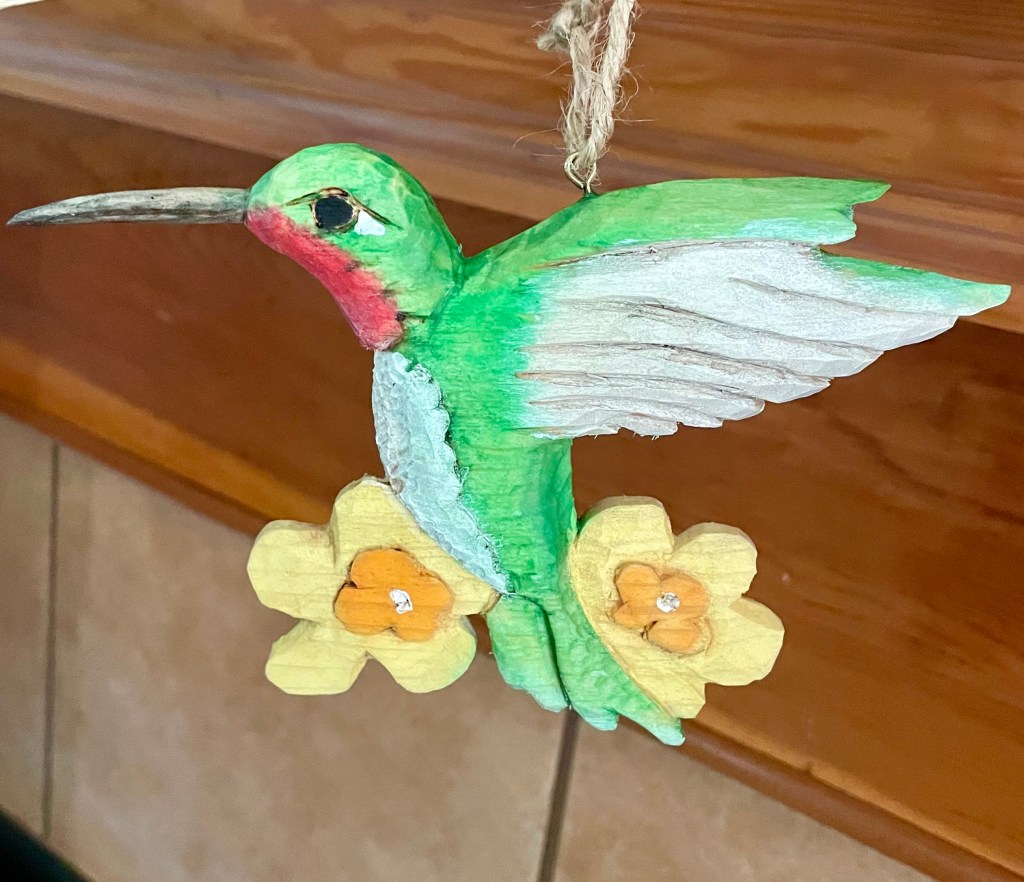
My good friend, Shannon Coker sent in a photo of a hummingbird ornament he carved for his wife:

“A hummer I carved this summer for my wife.”
Shannon’s Hummingbird

Thank you, as always, for the photo, Shannon!  Very nice job!  I like how you incorporated flowers into the design.

How do I create dynamic facial expressions that communicate anger, joy, or surprise?

Use eyebrows, the eyes, and the mouth to convey emotion. For anger, try lowering the eyebrows and pulling them closer together. Tense the mouth (corners pointing down). For joy, try raising the cheeks a bit and curving the mouth up into a wide smile.

Labrador “Max”

Teacher: Dwayne Gosnell

Dec 9,20   – 6PM Eastern

Twiitling Tuesday – 4 hours ( 2 sessions – 2 hours each day) 

Location: Online (Via Zoom) 

For details and to sign up  click on Dwayn’s website https://www.dgosnellwoodcarving.com/
Dwayne’s website

Teacher: Dave Stetson

Dates:  December 6,7, 13,14,20

Saturday & Sunday both weekends 9:30 am-11:30 Pacific / 10:30 am – 12:30 pm Mountain /
11:30 am- 1:30 pm Central / 12:30 pm – 2:30 pm Eastern

10 hours ( 5 sessions – 2 hours each day) 

Location: Online (Via Zoom)

For Details and to sign up contact Dave via his email address:  lcnmichele@aol.com

Contact Dave

Students will explore design, creation,  and painting of miniatures from cutouts.  We will explore the value of experimenting with smaller carvings before committing to larger works.

Teacher: Ryan Olsen

Dates: January  3,4,10,11  2026

Saturday & Sunday both weekends 1:30 pm-3:30 pm Pacific / 2:30 pm – 4:30 pm Mountain /
3:30 pm- 5:30 pm Central / 4:30 pm – 6:30 pm Eastern

8 hours

Location: Online (Via Zoom)

For details and to sign up contact Ryan ryanscaricatures@gmail.com

Contact Ryan

Online Classes With Chris Hammack

Teacher: Chris Hammack 

Chris Hammack is offering a new series of online classes to help students learn and sharpen their woodcarving skills.  Individual and Group Classes are available through his website, chrishammackart.com/groupclass
Twhitling Tuesdays

Teacher: Dwayne Gosnell  

Dates: Two – 2 hour classes each month on Tuesdays

Location: Online (Via Zoom)

To sign up, contact Dwayne Gosnell via email at dagwood_76@gmail.com

Woodcarving Academy

Established in 2020, the Woodcarving Academy offers dozens of videos and seminars created by some of the country’s top level instructors.  More videos are added regularly as they are created by the instructors.

With a paid subscription to the Woodcarving Academy you can view any videos you like for as many times as you like.

Subscription rates:  Monthly = $19.95   Quarterly = $49.95   Annual = $139.95

There is even a Free level which allows you to tour the website and watch the sample videos and content, and receive email updates as new content becomes available.

Check out the Woodcarving Academy and learn with the masters right in the comfort of your own home!  Go to: www.woodcarvingacademy.com or Email: support@woodcarvingacademy.com

The International Association of Woodcarvers has upcoming Zoom meetings on the following Saturdays at 3PM EST with special guest presenters.  Check them out…

Zoom:  310-460-3575

Presentation Schedule:

12/13 – Jonathan Creason

1/3 – Deep Holler Knives

1/10 – Windy Cape Studios

1/17 – Jerry Trzebiatowski

1/31 – Kathryn Overcash

INTERNATIONAL ASSOCIATION OF WOODCARVERS

COME JOIN US!!!

The Jersey Hills Wood Carvers (JHWC) club is a small but growing group of wood carvers sharing their time, knowledge and joy of woodcarving.  The JHWC generally meets from 7:00 PM EST to 9:00 PM EST on the 1st, 3rd and 5th Thursday of each month (when school is in session) at the Jefferson Township High School wood shop classroom.

Membership is “FREE” and open to anyone interested in woodcarving regardless of their ability.

JHWC’s Upcoming Meetings and Events

2025

December –   18th

2026

January:  15th, 29th

February:  5th, 19th

March:  5th, 19th

April:  16th, 30th

May:  14th, 28th

June:  6th

For more information contact:

Al Santucci  alsantucci4@gmail.com  President

Bill Brunner  billbrunnerdesign@gmail.com  newsletter/website editor

Or visit:

Website:  https://www.jerseyhillswoodcarver.com/ Facebook:  https://www.facebook.com/groups/736479646821641/

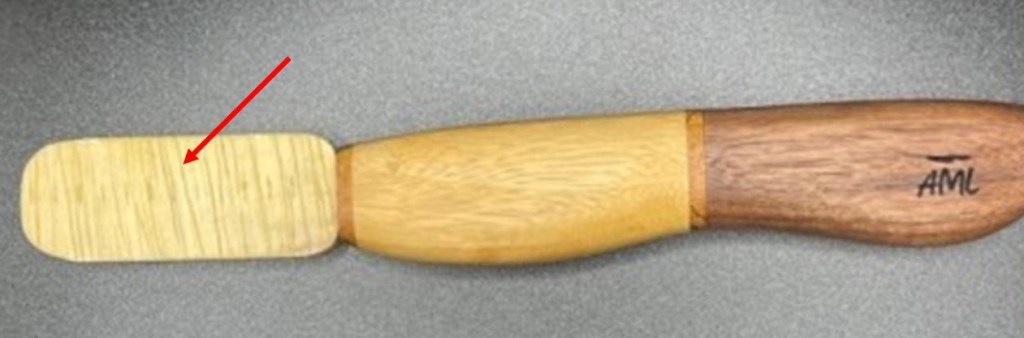
Complimentary Knife Sheath

Halloween, Jack-O-Lanterns & Wood Spirits

This month (October) is my annual Halloween Special issue where I’ll be telling some Halloween and Wood Spirit stories.  Long-time subscribers may have seen a couple of these but I’m posting them again for the benefit of all the new subscribers who just joined this year.  However, I’m sure you will all find something new and interesting.

The Story of Halloween

Most people think of Halloween as a night of dress up in ghostly or funny costumes, to have parties, or to go “trick-or-treating” and never consider why or how much a holiday evolved from a serious annual rite in ancient times.  What is actually being celebrated is two customs that have been combined into one.

The first tradition is the observance of a Catholic religious day set aside to honor saints.  Referred to as “All Hallows Day” or “All Saints Day,” this holy day is held on November 1st.  The night before  is known as “All Hallows Eve,” from which the name Halloween evolved.

The second celebration is from Northern France and the British Isles where the Celtic people celebrated the end of the Celtic year known as Samhain (pronounced sow-en) or “Summer’s End.”  This festival was a time set aside to honor the dead.  The Celts believed that the realm of the dead, or the spirit world, and the physical world were closest together during Samhain.

The traditional celebration of Samhain included carving jack-o-lanterns from gourds and turnips and lighting them with coals or candles to show the way for deceased loved ones.  At the same time, these lanterns were believed to ward off evil spirits.  Another version of the celebration indicates that the disembodied spirits of those who died during the year were intermingled with the living on that night.  They attempted to possess the living to hopes of being allowed to have an afterlife.  In an effort to frighten away the spirits, people would leave their houses unlit and cold, dress up in ghoulish costumes and parade around town being destructive as possible.  This tradition set the stage for today’s children’s refrain “trick or treat.”  When the Europeans arrived in the New World, they discovered a new fruit that was larger than the turnip and easier to carve: the pumpkin.  The pumpkin has been the symbol of Halloween ever since.

The Story of The Jack-O-Lantern

The story of the name Jack-o-lantern has a history of its own.  It derives from a folk tale about a disreputable drunkard by the name of Jack who, upon learning that the devil had come for his soul, tricked the devil into buying him one last drink.  Having no money, Jack convinced the devil to transform himself into coins so that Jack could buy his last drink.  Instead of buying the drink, Jack placed the coins in his pocket along with a silver cross, thus preventing the devil from returning to his common state.  To be released the devil agreed to leave Jack’s soul alone for ten years.

After ten years had passed, the devil appeared to Jack as he was walking down a country road.  The silver tongued Jack managed to talk the devil into climbing an apple tree before claiming his soul.  While the devil was in the tree, Jack pulled out his knife and carved a cross in the base of the tree, thus trapping the devil again.  Again he struck a bargain with the devil, this time extracting a promise that the devil would never take his soul.

When Jack finally died, he went to Heaven but was not allowed in because of his drinking and dastardly ways.  With no place to go, he went to Hell.  The devil, remembering Jack’s trickery, refused him entrance.  Jack then convinced the devil that the way back was so dark and windy that he needed a light to find his way.  The devil gave him an ember from Hell to get rid of Jack.  Jack placed the ember in a turnip he was eating to shield the flame from the wind and began to wander back into the darkness, forever doomed.

The Legend of the Wood Spirit

The Wood Spirit is a 15th Century European legend originating from villagers who made long journeys through the forest.  Most often glimpsed as a green man with leaves for his beard and hair, the Wood Spirit is said to be Lord of the forest and natural things.  Seeing one is said to be quite lucky, and European villagers used to go out on regular hunts, hoping to find a Wood Spirit to foretell the future of their village.

On calm days when the wind does not blow, there is a sense of peace and tranquility in the forest.  On days when storms are brewing and winds are blowing, though, the trees of the forest make sounds of moaning and sighing as though voices can be heard from spirits within.  For centuries the people believed the forests were filled with mystical evil spirits and that those who dared to enter would earn the spirits’ wrath.

During the 15th Century the villagers believed that when the men went into the woods to hunt and didn’t return, that they had been taken by the evil spirits.  They also believed that the tree spirits were the most powerful of all spirits and were good and wise.  Wood Spirits are extremely strong.  They can tear an opponent limb from limb and can tame any wild animal, including ferocious dragons and skittish unicorns.  At the same time, they are gentle with the maidens, children, and men of good heart.  They believed that the tree spirits would protect them from the evil spirits.  So before they would venture into the woods to hunt, they would knock on a tree to awaken the sleeping Wood Spirits to protect them.  This is where we get the saying ‘Knock on wood’.

Wise travelers assured their safety by carving Wood Spirit images on their walking sticks or pieces of wood and bark.  These carvings appeased the Wood Spirits, thus the traveler was allowed to enter and leave the forest without difficulty.

It is said that the forest will stand for as long as the Wood Spirit remains to keep order.  And if you’re lucky enough to see a Wood Spirit, health, happiness, and good fortune will be yours.  However, that does not happen often.  Wood Spirits would rather see than be seen.  Most sightings are by children or by the pure of heart.

Wood Spirits were carved to bring luck, ward off undesirable spirits, and keep the household safe.  Still today, Wood Spirits are being carved into pieces of wood and bark and are often given as gifts.  The Wood Spirit should be given a special place within the home for its presence to bring wisdom, prosperity, humor, good health, and good luck to all who live there.  Any house home to a Wood Spirit will stand protected and be blessed with good luck, health, and happiness.

“Photo Shop” is the section of Wood Chip Chatter where carvers can send in photos of their wood carvings for display. It’s your chance to show off your work…sort of a show and tell. The photos will only be displayed and no comments or critiques will be made.  For critiques on your carvings send them in to the “Carver’s Corner.”  Send your photos to: carverbobk@woodchipchatter.com

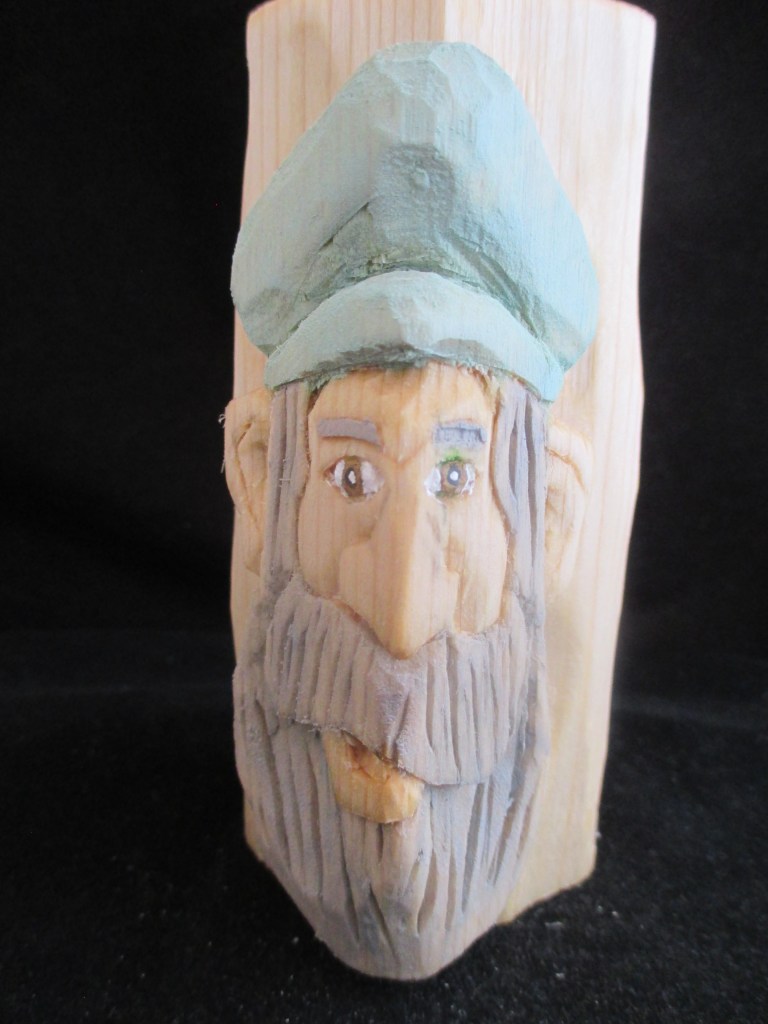
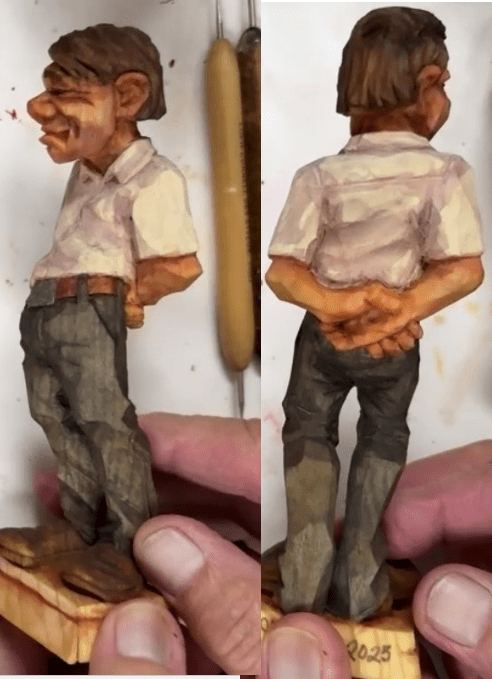
My good friend, Jim Babcock of Columbus, Indiana sent in a photo of a J Creason sea captain he recently carved.  Jim writes:

“Bob:

Just received the latest Wood Chip Chatter and enjoyed the feature on

birch.  I have carved birch a few times and sometimes struggled with the

grain and difficulty with using hand tools alone; a dremel -type unit can

come in handy.

Here is a recent carving of a sea captain; the pattern concept , J. Creason.

Northern basswood finished with walnut oil and heavily diluted acrylics.

Jim Babcock

Columbus, Indiana”

Jim’s Sea Captain

Nice job, Jim!  Thanks for the photo!

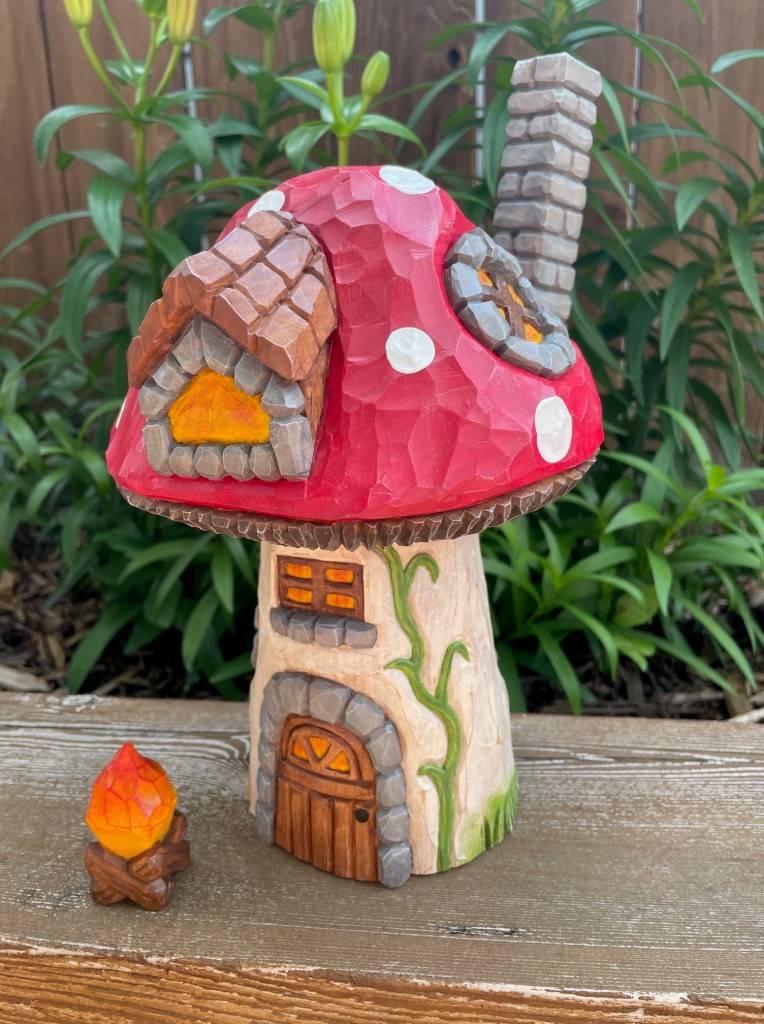
My good friend, Heath Paull sent in a photo of a terrific Mushroom House project he completed:

Heath’s Mushroom House

Excellent work, Heath!  I really like all the little details you added.  Thank you so much for the photo.

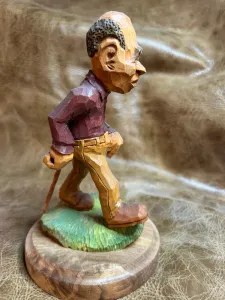
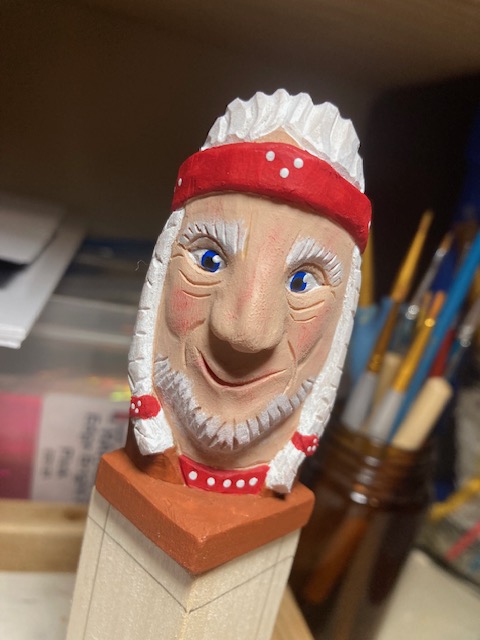
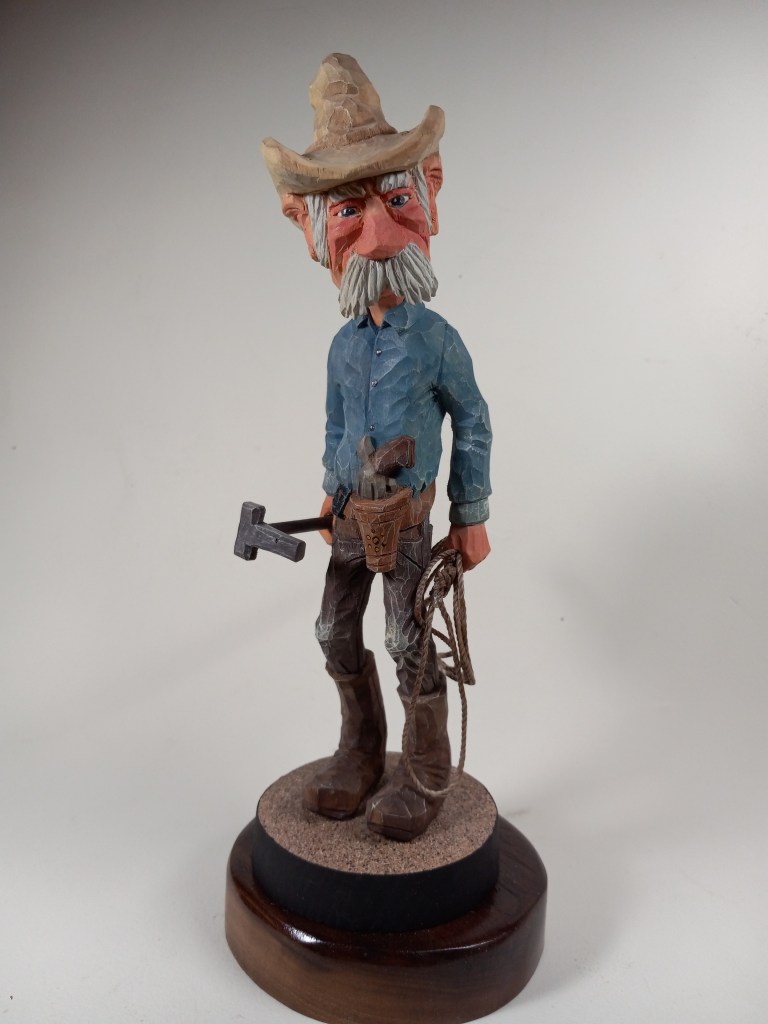
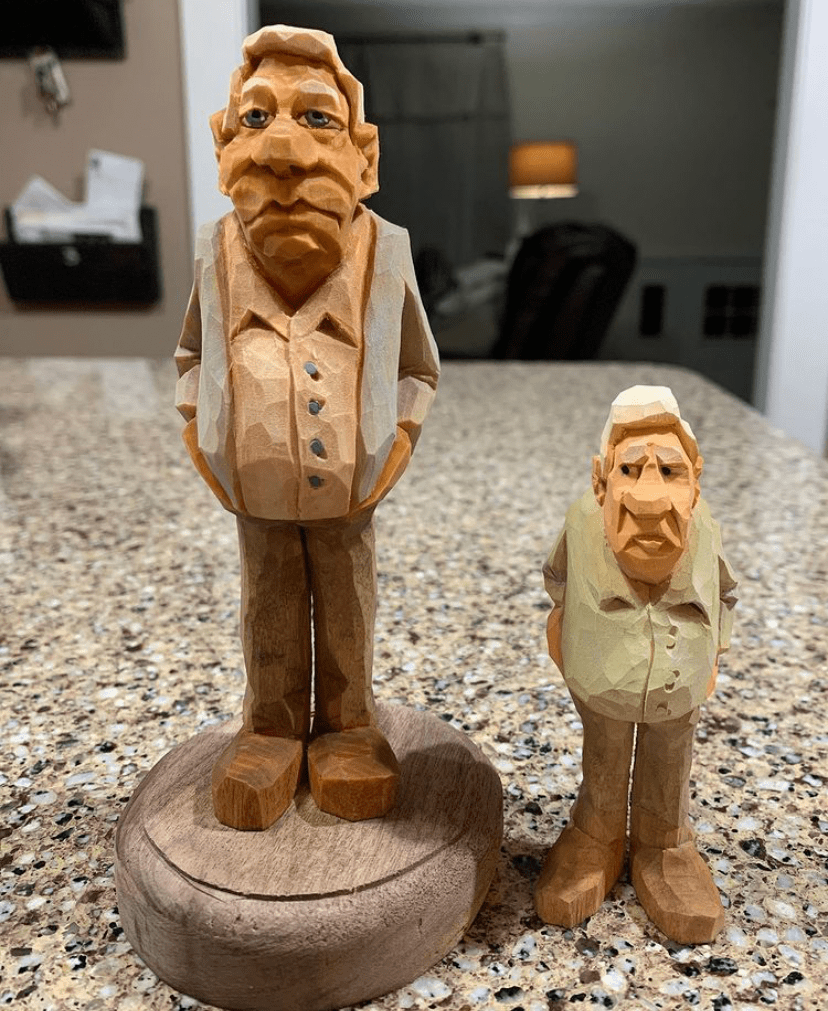
My good friend, Jim Wiggins carved a likeness of Willie Nelson’s brother, and named it Woody Nelson.  Jim writes:

“My latest carve!  Jim

Willie Nelson’s brother… Woody Nelson!”

Very good job, Jim!  Likenesses like that are generally very hard to capture.

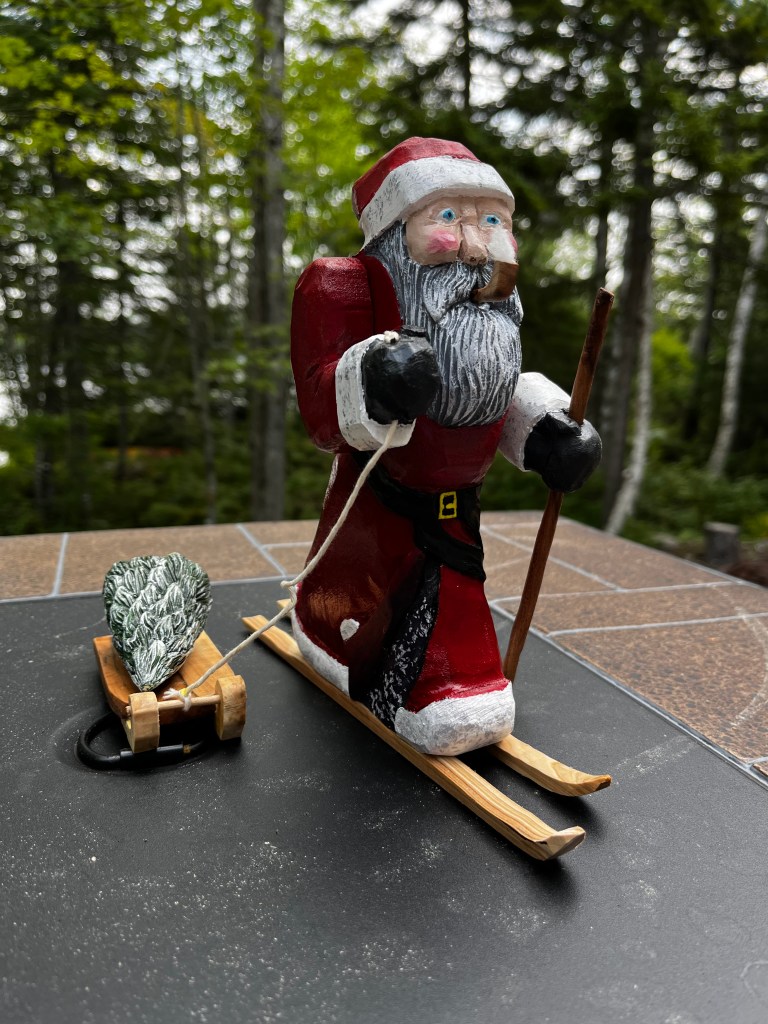
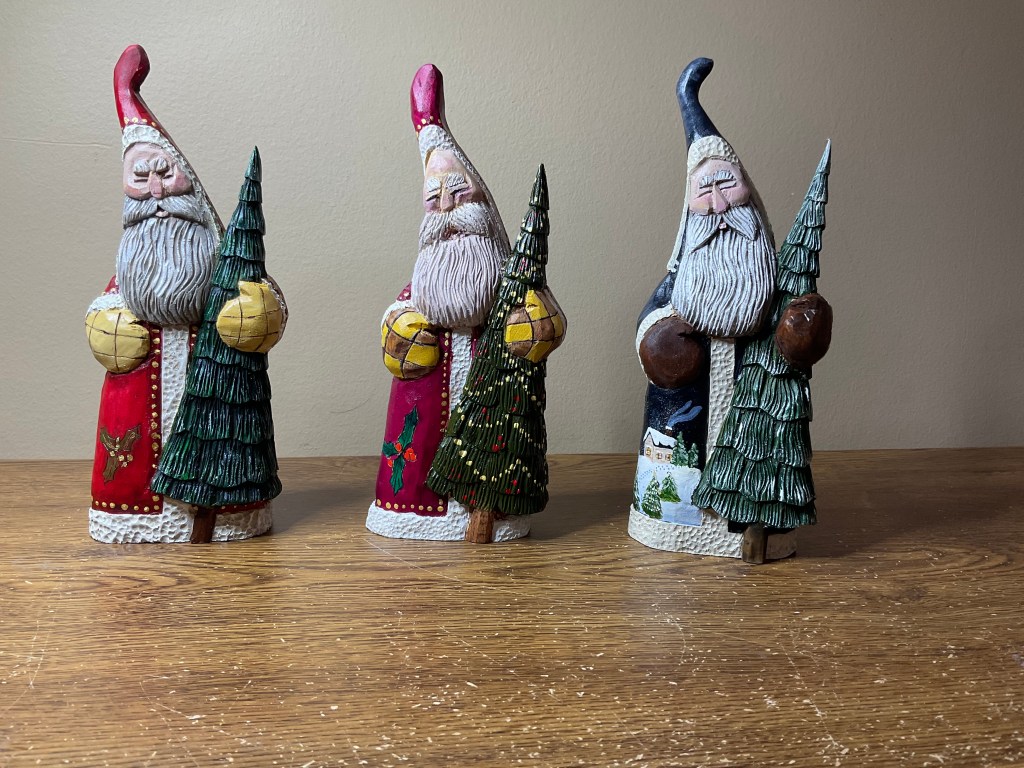
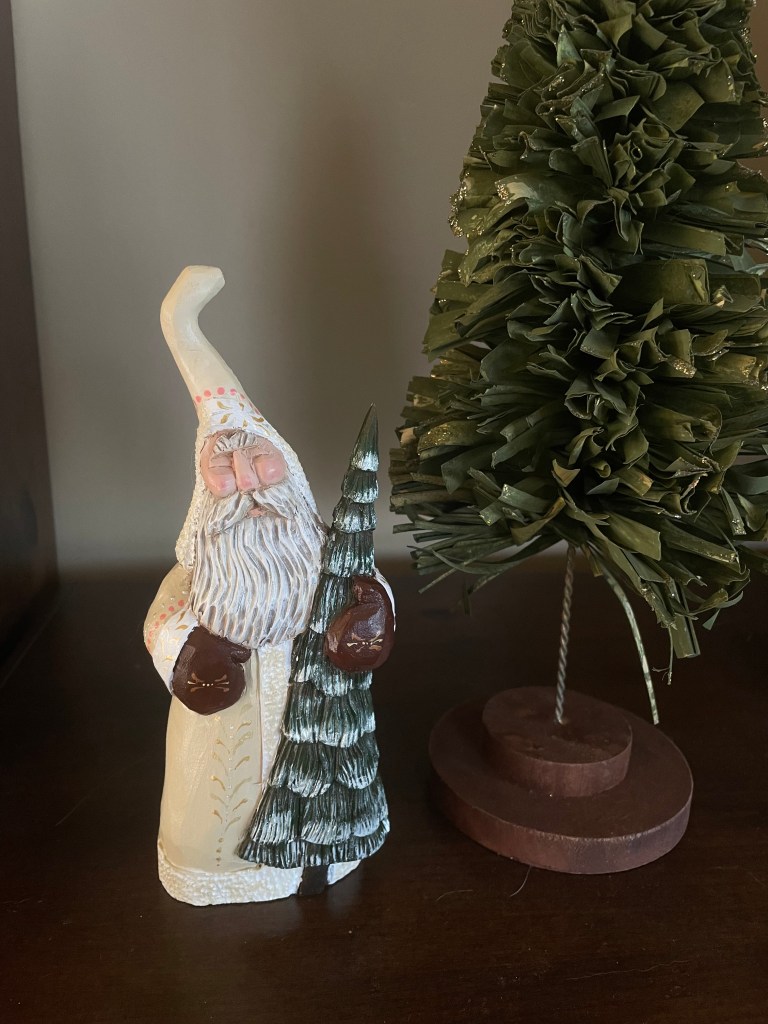
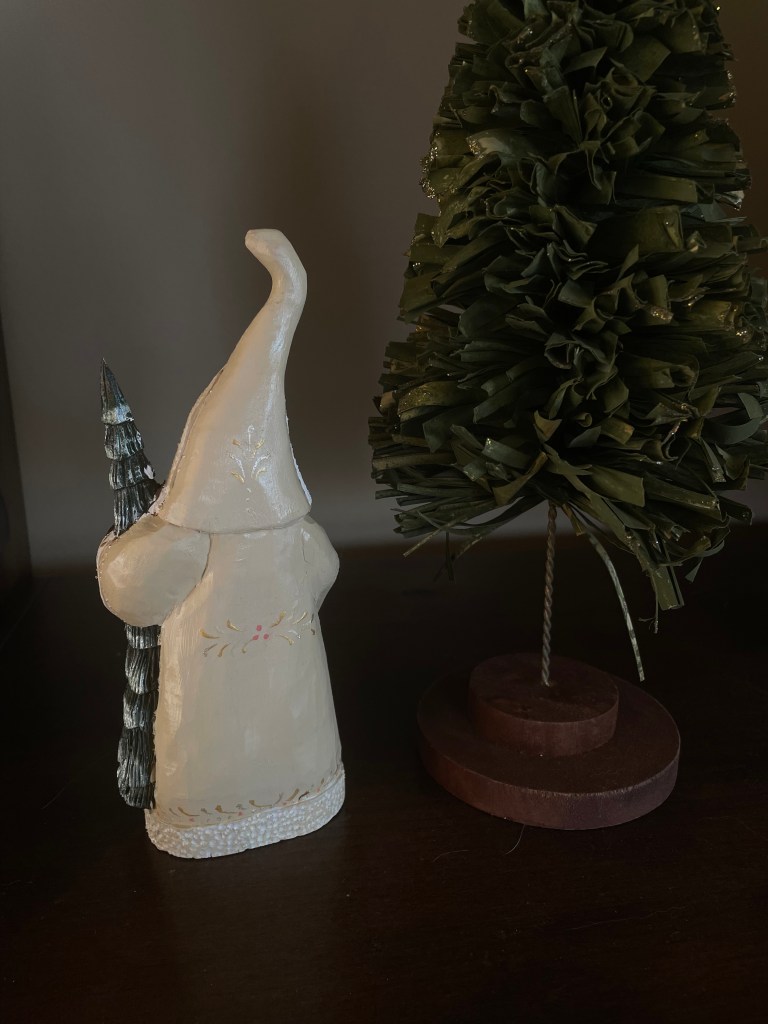
My good friend, Wayne Arrowsmith sent some photos of the Santas he carved and his family painted.  Wayne writes:

“Hi Bob,

Each summer I bring Xmas themed wood carvings to our cottage where my in-laws gather to paint and take there finished carving home with them. Their creativity and the effort they put into the painting makes it all worthwhile. Here are three of the finished Santa’s from this year.

The tree, skis and staff were all carved from wood salvaged from a maple tree taken down on my father-in-law’s property late last year”

Those are great Santas and your family did an impressive job in painting them.  It;s a wonderful family tradition you have going and using wood from the tree that was cut down in your father-in-law’s property gives the carvings extra meaning.

“Carver’s Corner” is the section where you can send in photos of your carvings to have me critique them and offer you my truthful opinions on what you did right and what you might improve on next time.  It’s an excellent opportunity to improve your carving skills!  Send your photos to: carverbobk@woodchipchatter.com

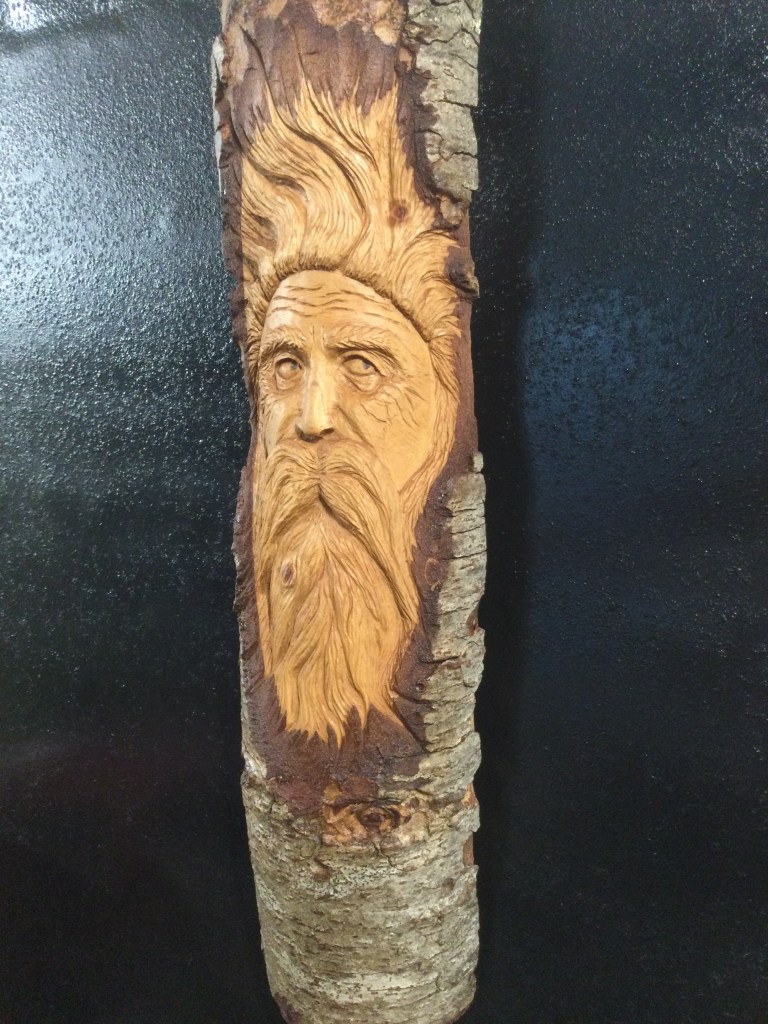
I‘m delighted to mention that this month we have our first entry to the Carver’s Corner that we have had in many months.  My good friend, Richard Dreja from Oliphant, Ontario, Canada submitted two photos of a wood spirit he recently carved and ask me for a critique.  Richard writes:

“Hello Bob, First, let me say that I enjoy your newsletter, and all the info you share, very much. Until now I’ve been very hesitant to send any of my work because, frankly, I’m not on a par with most of the carvers exhibiting. But I think I need some critiquing from those “in the know” to help me grow

So please have a look at this wood spirit, carved in chestnut, and let me know what I might do to improve him or his future cousins.

I appreciate any feedback you might provide.

Thanks very much, Richard in Oliphant, Ontario”

First of all, Richard, thank you for your kind words regarding Wood Chip Chatter.  They are much appreciated.  Secondly, don’t ever be concerned with how your work stacks up against other carvers.  Our wood carving journeys are all different, and we all carve on various levels.  There will always be someone better than you, as well as someone with lesser skills than you.  As long as you’re enjoying what you’re doing, that’s all that matters.

Your work is excellent, and you should be proud to display it.  The only comments I have are general.  Always be aware to make your cuts deep, especially with hair, beards, and mustaches.  Yours are fine, but some could be deeper.  And just as a tip, a good way to do eyes on a carving, especially if you’re not going to paint it, is to make the pupils by drilling holes for the pupils.  The shadow created by the hole gives a very life-like impression. 

Don’t be afraid to show your carvings, Richard,  I hope we get the opportunity to see more of more of them in the future.

Tiny Paint Mixers

To extend the life of your acrylic paints drop a couple of tiny, non-copper BB pellets, or tiny glass marbles, into your acrylic paint bottles.  You can even use clean tiny pebbles.

They make it more effective to evenly mix your paint when you shake the bottle.

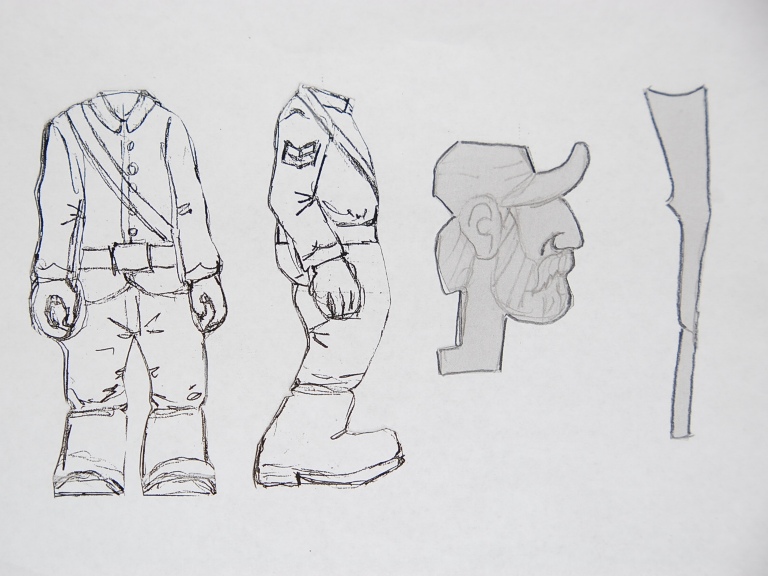
Civil War Soldier

Civil War Soldier

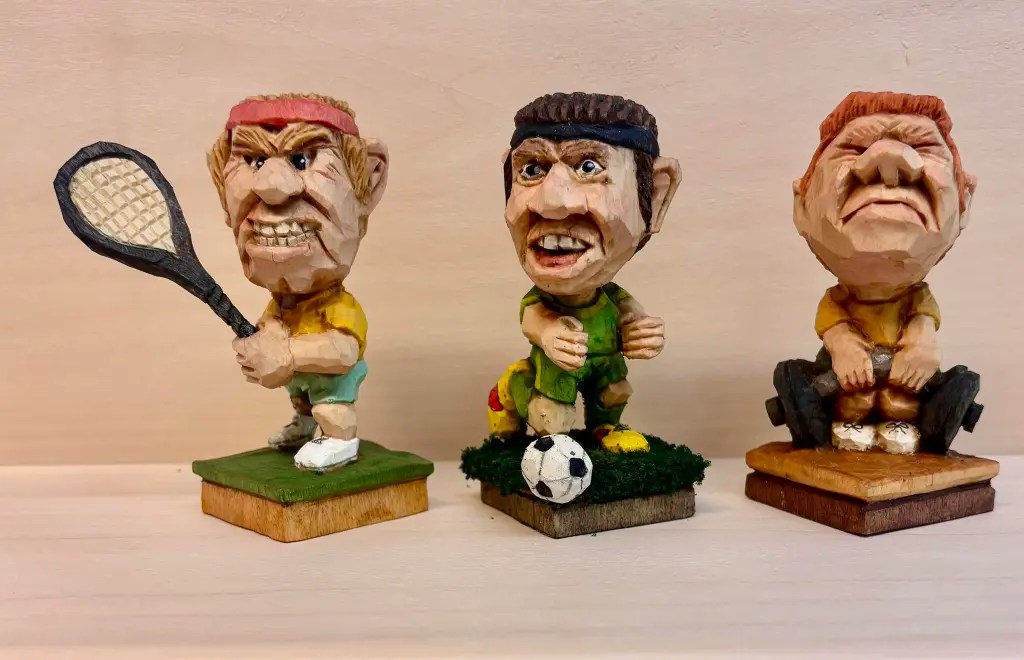
Sports & Holiday Shorties

Teacher: Dale Green

Dates:  October 4,5,11,12  2025

Saturday & Sunday both weekends 9:30 am-11:30 Pacific / 10:30 am – 12:30 pm Mountain /
11:30 am- 1:30 pm Central / 12:30 pm – 2:30 pm Eastern

8 hours ( 4 sessions – 2 hours each day) 

 Location: Online (Via Zoom)

Fee: $100 includes two 1 ½” x 1 ½” x 12” bass wood sticks, patterns and photos

For details and to sign up on Dale’s website: https://dalegreenwoodcarving.com/Woodcarving-Classes.htm

Dale’s Website

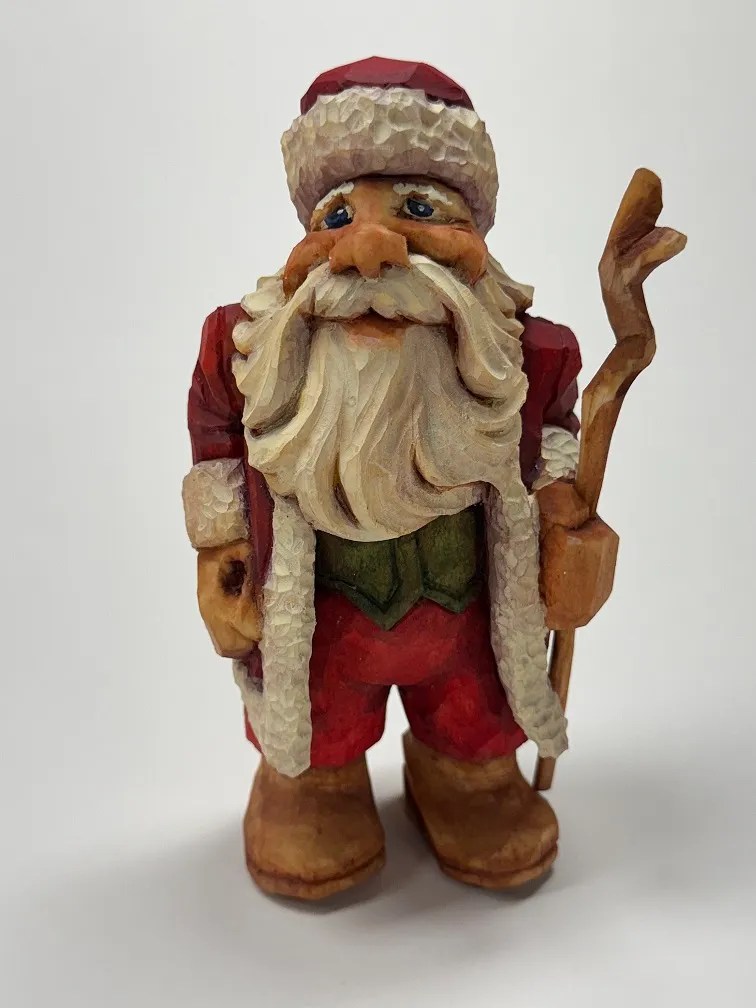
Santa 2025

Teacher: Dave Stetson

Dates:  October 18,19,25,26 November  1,2

Saturday & Sunday both weekends 9:30 am-11:30 Pacific / 10:30 am – 12:30 pm Mountain /
11:30 am- 1:30 pm Central / 12:30 pm – 2:30 pm Eastern

12 hours ( 6 sessions – 2 hours each day) 

 Location: Online (Via Zoom)

For Details and to sign up contact Dave via his email address:  lcnmichele@aol.com 

Online Classes With Chris Hammack

Teacher: Chris Hammack 

Chris Hammack is offering a new series of online classes to help students learn and sharpen their woodcarving skills.  Individual and Group Classes are available through his web site chrishammackart.com/groupclass

Twhitling Tuesdays

Teacher: Dwayne Gosnell  

Dates: Two – 2 hour classes each month on Tuesdays

Location: Online (Via Zoom)

To sign up contact Dwayne Gosnell via email dagwood_76@gmail.com

Woodcarving Academy

Established in 2020, the Woodcarving Academy offers dozens of videos and seminars created by some of the country’s top level instructors.  More videos are added regularly as they are created by the instructors.

With a paid subscription to the Woodcarving Academy you can view any videos you like for as many times as you like.

Subscription rates:  Monthly = $19.95   Quarterly = $49.95   Annual = $139.95

There is even a Free level which allows you to tour the website and watch the sample videos and content, and receive email updates as new content becomes available.

Check out the Woodcarving Academy and learn with the masters right in the comfort of your own home!  Go to: www.woodcarvingacademy.com or Email: support@woodcarvingacademy.com

Tri-State Woodcarvers Club 2025 “Show and Sell”.  October 25 and 26th 9am to 3pm daily.  Vanderburgh County 4-H Center 201 E. Booneville New Harmony Rd, Evansville In.  Exposition Hall in the activities Center Bldg.  contact Danny Conley 270-314-5895.

Complimentary Knife Sheath

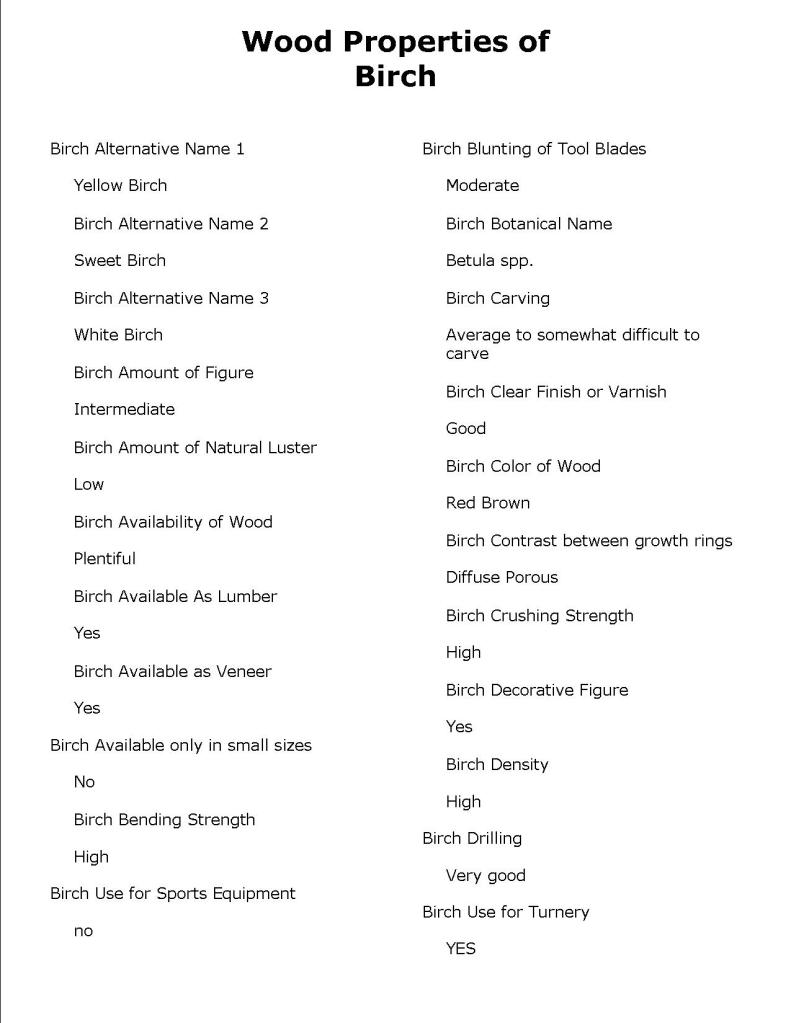
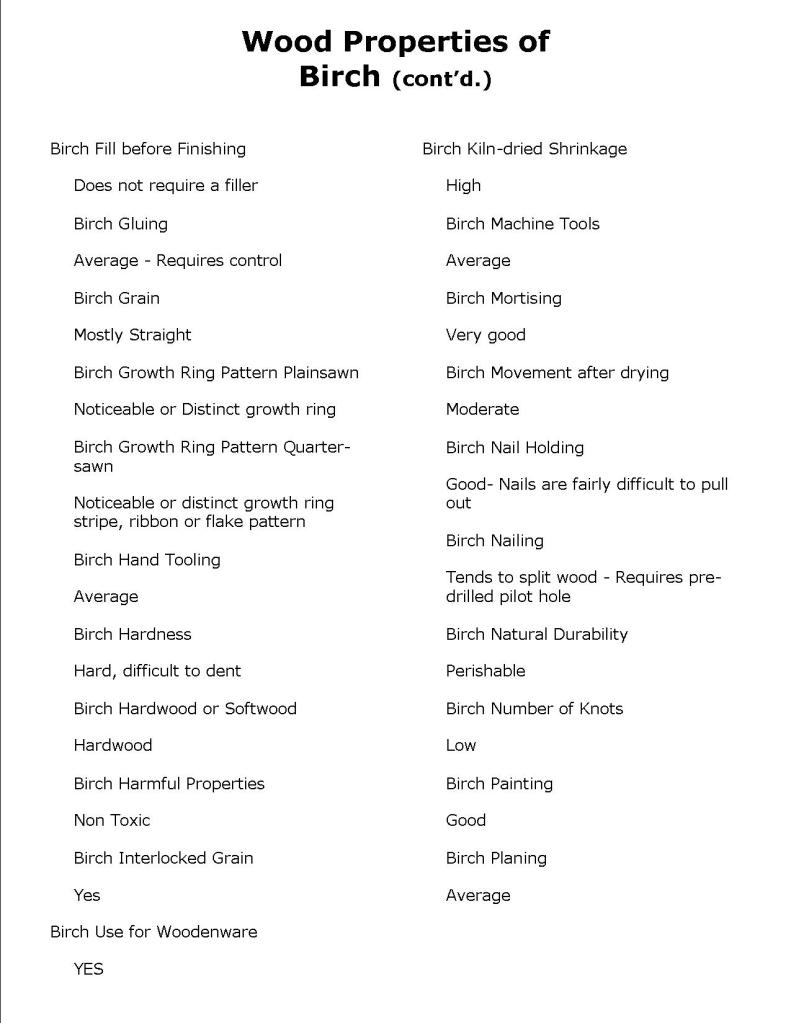
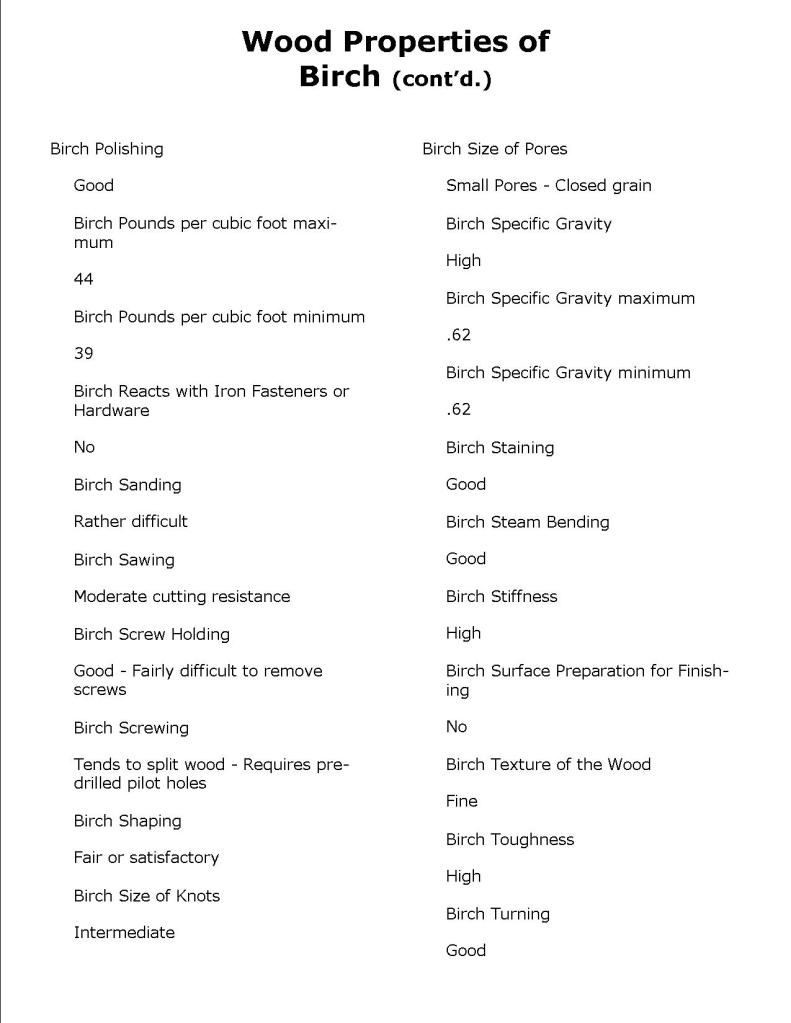
Wood Properties of Birch

birch is a thin-leaved deciduous hardwood tree of the genus Betula  in the family Betulaceae, which also includes alders, hazels, and hornbeams. It is closely related to the beech-oak family Fagaceae.

Birch species are generally small to medium-sized trees or shrubs, mostly of northern temperate and boreal climates. The simple leaves are alternate, singly or doubly serrate, feather-veined, petiolate and stipulate. They often appear in pairs, but these pairs are really borne on spur-like, two-leaved, lateral branchlets. The fruit is a small samara, although the wings may be obscure in some species. They differ from the alders (Alnus, another genus in the family) in that the female catkins are not woody and disintegrate at maturity, falling apart to release the seeds, unlike the woody, cone-like female alder catkins.

The bark of all birches is characteristically marked with long, horizontal lenticels, and often separates into thin, papery plates, especially upon the paper birch.  Distinctive colors give the common names gray, white, black, silver  and yellow birch to different species.

The buds, forming early and full-grown by midsummer, are all lateral, without a terminal bud forming; the branch is prolonged by the upper lateral bud. The wood of all the species is close-grained with a satiny texture and capable of taking a fine polish; its fuel value is fair.

“Photo Shop” is the section of Wood Chip Chatter where carvers can send in photos of their wood carvings for display. It’s your chance to show off your work…sort of a show and tell. The photos will only be displayed and no comments or critiques will be made.  For critiques on your carvings send them in to the “Carver’s Corner.”  Send your photos to: rwkoz51@gmail.com

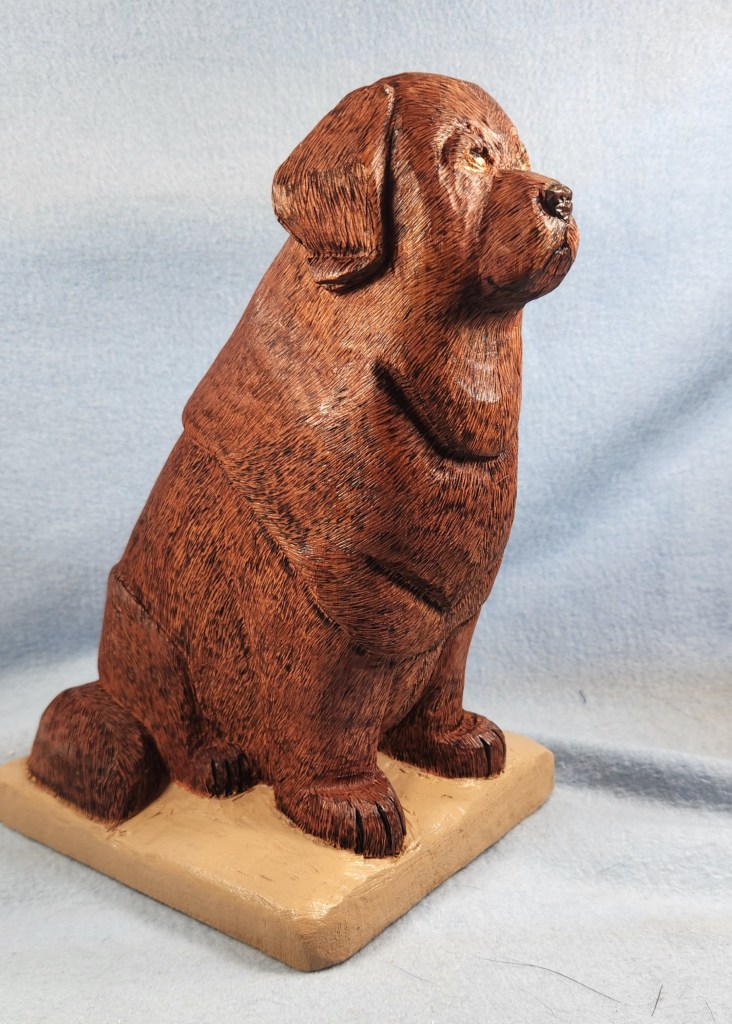
My good friend, Kathy Savage sent in some photos of a dog she recently carved as a commission.  Kathy writes:

“Greetings,  not sure if these photos went thru the 1st time.  This neuro was a request ( and a commission) by the owner of a doggie daycare care that our lab goes to.  It is  over 12 Inches high, carved then fur burnt in.

 thanks, kathy”

Terrific job, Kathy!  Thanks for the photos!

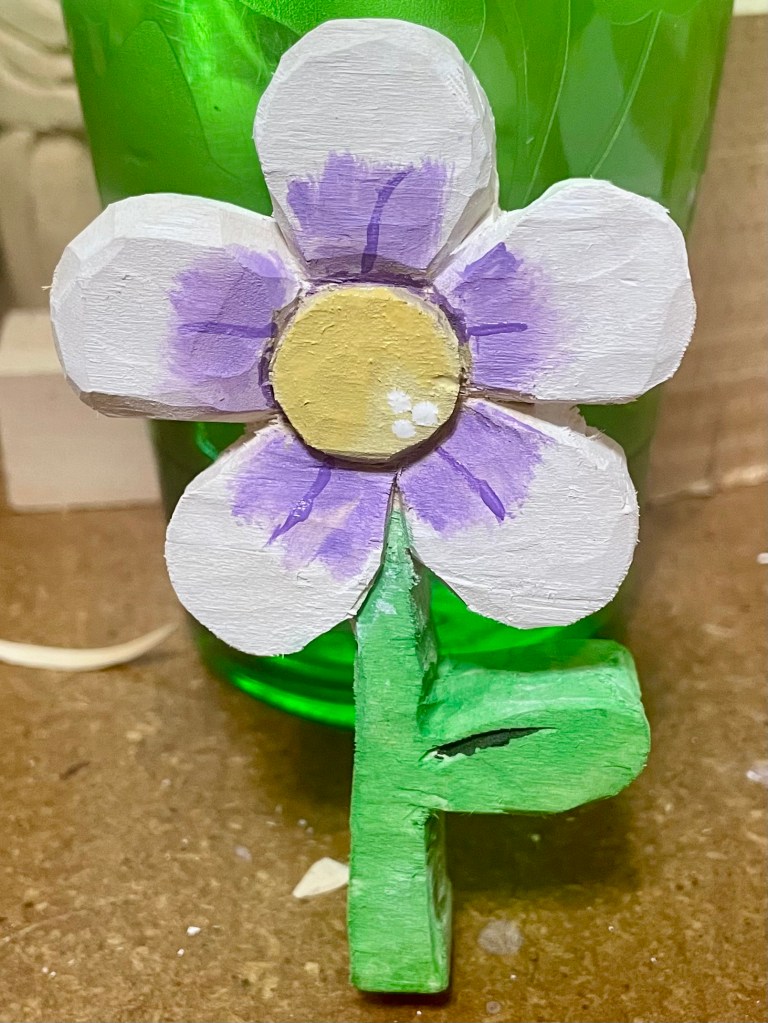
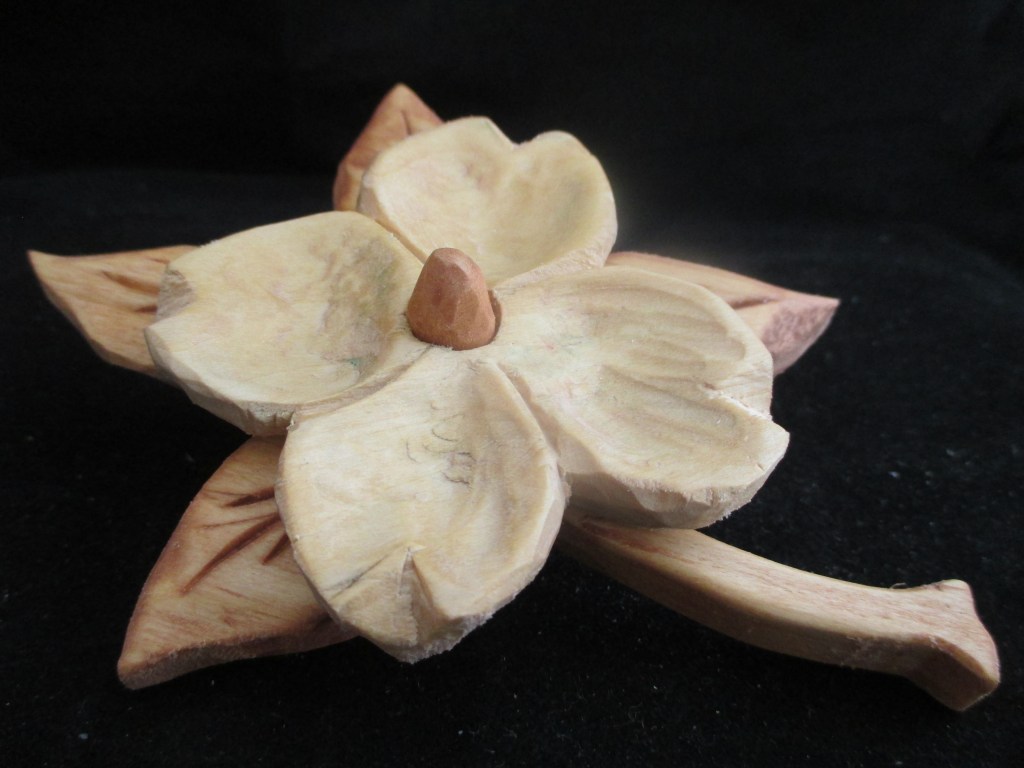
Here is a photo of a colorful flower carved by my good friend, Shannon Coker:

Shannon’s Flower

Very nice job, Shannon!  Thanks for the photo!

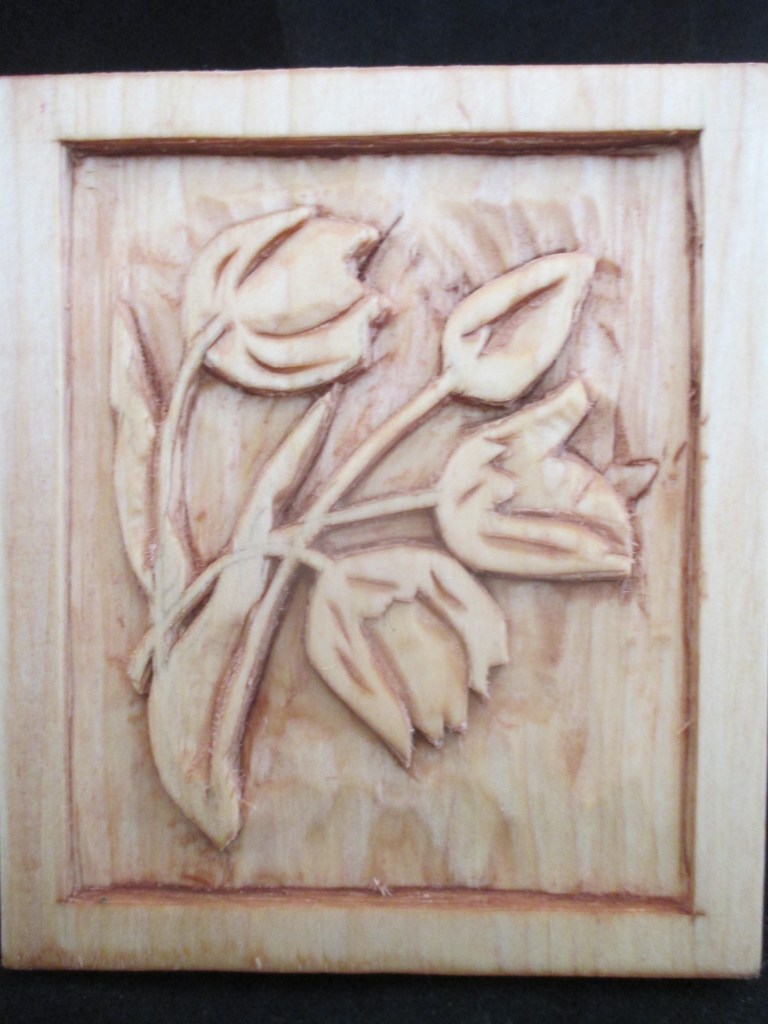
My very good friend, Jim Babcock sent in a photo of a relief carving he made.  Jim says:

“Bob:

This is a recent relief carving of some tulips.

Basswood, finished with an oil based stain.

It will have a satin polyurethane added.

Jim Babcock

Columbus, Indiana”

Jim’s Tulips

Very well done, Jim!  Thanks for the photo!

Puffy Eyebrows

Eyebrows can often be a challenge to carve, especially on smaller carving because the wood tends to splinter and break away.  One way around this problem is to just paint the eyebrows on, but next time instead of using your standard acrylic paint try using puff fabric paint.

You can apply the paint directly from the bottle through the nozzle that comes with it.

Puff fabric paints can be found on Amazon or at most any fabric or craft store.

Source: carvingjunkies.com

Frog Cane Topper

Take the next step in your caricature carving and learn to capture actual likenesses.

Teacher: Ryan Olsen

Dates: August 2,3,9,10  2025

Saturday & Sunday both weekends 11:00 am-1:00 pm Pacific / 12:00 pm – 2:00 pm Mountain /
1:00 pm- 3:00 pm Central / 2:00 pm – 4:00 pm Eastern

8 hours

Location: Online (Via Zoom)

For details and to sign up contact Ryan ryanscaricatures@gmail.com

Contact Ryan


Teacher: Dwayne Gosnell

Aug 5,19 – 6PM Eastern

Twiitling Tuesday – 4 hours ( 2 sessions – 2 hours each day) 

 Location: Online (Via Zoom)

4″×2″×6.5″ basswood block needed for pattern

For details and to sign up  click on Dwayn’s website https://www.dgosnellwoodcarving.com/

Teacher: Dwayne Gosnell

Sep 9,23 – 6PM Eastern

Twiitling Tuesday – 4 hours ( 2 sessions – 2 hours each day) 

 Location: Online (Via Zoom)

3.5×3×6.5″ basswood block needed for pattern

For details and to sign up  click on Dwayn’s website https://www.dgosnellwoodcarving.com/

Dwayne’s website

Teacher: Dale Green

Dates:  October 4,5,11,12  2025

Saturday & Sunday both weekends 9:30 am-11:30 Pacific / 10:30 am – 12:30 pm Mountain /11:30 am- 1:30 pm Central / 12:30 pm – 2:30 pm Eastern

8 hours ( 4 sessions – 2 hours each day) 

 Location: Online (Via Zoom)

For details and to sign up Contact Dale: dalecarves@gmail.com

Contact Dale

Online Classes With Chris Hammack

Teacher: Chris Hammack 

Chris Hammack is offering a new series of online classes to help students learn and sharpen their woodcarving skills.  Individual and Group Classes are available through his web site chrishammackart.com/groupclass

Twhitling Tuesdays

Teacher: Dwayne Gosnell  

Dates: Two – 2 hour classes each month on Tuesdays

Location: Online (Via Zoom)

To sign up contact Dwayne Gosnell via email dagwood_76@gmail.com

Woodcarving Academy

Established in 2020, the Woodcarving Academy offers dozens of videos and seminars created by some of the country’s top level instructors.  More videos are added regularly as they are created by the instructors.

With a paid subscription to the Woodcarving Academy you can view any videos you like for as many times as you like.

Subscription rates:  Monthly = $19.95   Quarterly = $49.95   Annual = $139.95

There is even a Free level which allows you to tour the website and watch the sample videos and content, and receive email updates as new content becomes available.

Check out the Woodcarving Academy and learn with the masters right in the comfort of your own home!  Go to: www.woodcarvingacademy.com or Email: support@woodcarvingacademy.com

Tri-State Woodcarvers Club 2025 “Show and Sell”.  October 25 and 26th 9am to 3pm daily.  Vanderburgh County 4-H Center 201 E. Booneville New Harmony Rd, Evansville In.  Exposition Hall in the activities Center Bldg.  contact Danny Conley 270-314-5895.

Complimentary Knife Shield

Funny Bone

A Lesson on Wood (How It Is Cut and Dried)

HARDWOODS VS. SOFTWOODS

Here are some benefits/negatives of Hardwoods and Softwoods:

  • Hardwoods: have a slower natural growth rate, making them denser and more fire resistant than most softwoods.  As such, hardwoods tend to be more expensive. Hardwoods are sometimes challenging to work with, but last for a great deal of time.  They are typically used in high quality furniture, desks, flooring as well as some construction that needs to last.  Consider using hardwoods in structural pieces such as apex beams where structural integrity is of high importance.  Scientifically, they have vessel elements that transport water throughout the wood.

Softwoods: have a faster natural growth rate, making them less dense and less fire resistant in comparison.  As such, softwoods tend to be less expensive and make up the bulk (80%) of all lumber used in the construction industry.  Softwoods are easier to work with and are typically used in windows, doors, furniture, paper, and medium-density fiberboard. Consider using softwoods in lumber scaffolding, such as non-load-bearing walls and roof rafters.  Scientifically, they have medullary rays that transport water and produce sap.

Cross Section of Butternut

LUMBER VOCABULARY

Now you might have chosen a hardwood or softwood, but how come pieces of the same species are different in color and price?  Understanding which parts of the tree the lumber comes from will help you understand these differences.  Let’s build up that vocabulary:

  • Heartwood: usually darker in complexion and more dense.  If your lumber comes from this part of the tree, you may see some increased price differences between pieces of the same species.  Heartwood is the part of the tree that is ‘dead’, meaning it has been matured and yields the hardest lumber.
  • Sapwood: usually lighter in complexion and less dense.  If your lumber comes from this part of the tree, you may see some decreased prices in comparison to heartwood pieces. Sapwood is the ‘living’ part of the tree, as layers from the outside gradually become the inner layers which die and turn into heartwood.
  • Cambium Layer: differing from tree to tree, this layer is the tree’s protective layer that produces the growth rings inside the tree.
  • Pith: is the centre of the tree which usually carries the tree’s nutrients.

KNOW WHAT CUTS YOU ARE GETTING

While the different cuts of timber may have no direct impact on lumber prices, when selecting lumber for decorative or structural purposes, the orientation of the grain becomes extremely important as some cuts are more likely to bend or contain more imperfections such as knots than others:

When choosing lumber for aesthetic qualities, the general rule is that knots and cracks tend to increase toward the center of tree.  So when a piece of lumber is labeled as:

  • Clear Cut: these pieces have the fewest knots and are ideal for projects where knots and cracks are unwanted.
  • Center Cut: these pieces tend to contain more knots and cracks, making them ideal for projects where a ‘rustic’ look is needed.

When choosing lumber for structural qualities, the general rule is that the growth rings which have a higher degree to the surface of the board, tend to warp more when affected by water:

  • Rift Sawn: these pieces have the growth rings 45 to 60 degrees to the surface of the board.  They are usually toward the center but differ from mill to mill, these pieces are usually cut thicker as thinner boards may bend under watery conditions.
  • Quarter Sawn: these pieces have the growth rings 60 to 90 degrees to the surface of the board.  These pieces have a tendency to warp under watery conditions, but are ideal for furniture making such as bookcases or shelving.
  • Flat Sawn: these pieces have the growth rings 45 degrees or parallel to the surface of the board.  These pieces produces an appealing aesthetic ‘flame-like’ effect where the growth rings radiate out from the center.

LUMBER DRYING TECHNIQUES

How lumber has been dried can have a big importance as some lumber later on in life starts to crack or bend. There are three types of drying techniques:

  • Greenwood: is lumber that has been recently cut and not had an opportunity to season (dry).  The benefit of using greenwood is it is extremely easy to work with and splits less when nailed or turned.  The negative is that greenwood has a tendency to crack and warp once fully dried.
  • Air-Dried: is lumber that has been stacked and placed on foundations and exposed to the air in a clean, cool, dry and shady place.  Air-dried lumber takes months, even years to dry which is why it is usually more expensive.  The benefit of using air-dried lumber includes increase moisture stability meaning it tends to bow, twist and crack less.
Air Drying

Kiln-Dried: is lumber that has been artificially dried, using a heat generator. Kiln-dried lumber dries much faster, thus sawmills can turn over lumber at a faster rate.  This results in a lower price.  Due to the nature of this fast-drying process, all insects and eggs living inside the wood are killed, but the wood tends to bow, twist, and crack more.

Wood Kiln

“Photo Shop” is the section of Wood Chip Chatter where carvers can send in photos of their wood carvings for display. It’s your chance to show off your work…sort of a show and tell. The photos will only be displayed and no comments or critiques will be made.  For critiques on your carvings send them in to the “Carver’s Corner.”  Send your photos to: rwkoz51@gmail.com

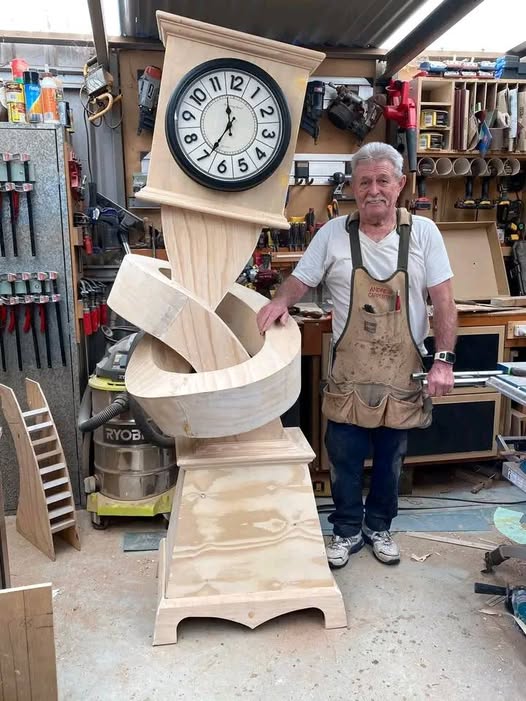
My good friend, Jack Proseilo carved three magnificent twisted grandfather clocks. Jack writes:

“Hi Bob, 

     Just finished reading your blog and enjoying as usual, thought I’ll bet Bob  would be  interested in my latest carve? 

     Back in 2021 the Australian Wood Review had featured a Grandfather Knot Clock built by George Andrews. At the time I saved the picture , then a couple of years ago  my neighbor saw the same article and forwarded the picture suggesting that I should do it as my next project? I knew I would never try building one that large , however the idea of a table top one sounded interesting. Well I carved the first one on the left of the three and Elaine was so pleased that she suggested that I  should carve two more for our Sons. 

      Each clock is hand carved from a 4 X 4 X11 piece of basswood . The finish is water base Saman Dark Walnut stain with two coats of Minwax Polycrylic Clear Matte. I was able to get the clock works from Amazon. 

    Hopefully these will hang around the Family for many years to come. Thanks for your time. 

    Jack Proseilo 

   West Kelowna, B.C. Canada”

Those are absolutely magnificent, Jack!  I’m sure they will be passed down within the family for many years to come.

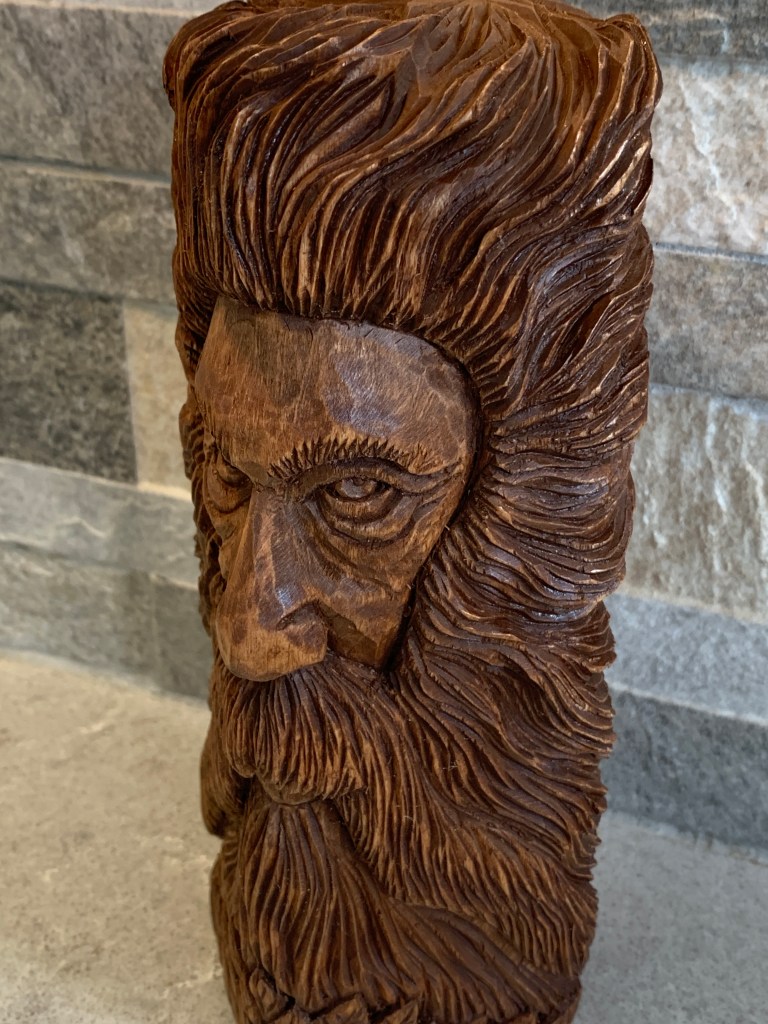
My good friend, Doug Philp carved a terrific tree spirit in basswood. Doug writes:

“Here is a Tree Spirit I recently carved, hand tools only.  Basswood approx 9” tall. 

Doug Philp

DCCP Creations 

Vancouver Island, BC, Canada”

Excellent job, Doug!  Thanks for the photos.

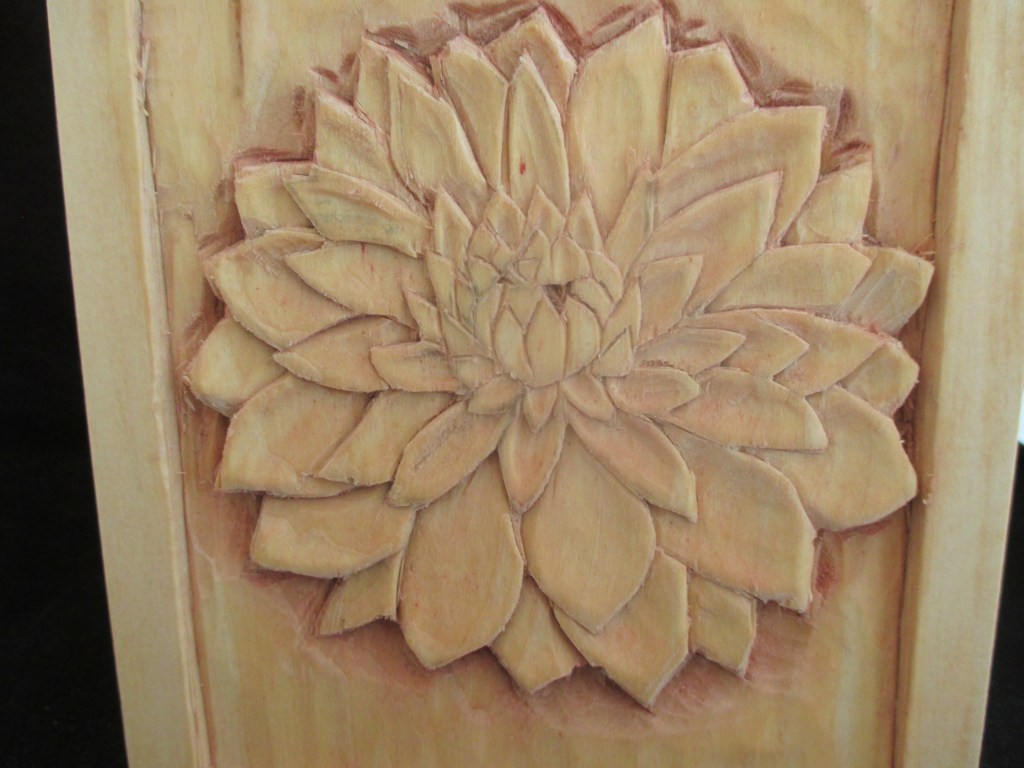
My good friend, Jim Babcock of Columbus, Indiana sent a photo of a Dahlia flower he relief carved in basswood.  Jim writes:

Bob:

Hope all is well with you as we get into Summer.   A recent carving

of a dahlia.  Northern basswood, finished with an oil based stain.

Jim Babcock

Columbus, Indiana

Jim’s Dahlia

Excellent carving, Jim!  I really like the detail.  Thanks for the photo, as always!

Wrinkles Matter

It’s easy to forget to add small details that can enhance the finished look of your caricature carvings—such as wrinkles and folds in clothing.

Use small gouges and V-tools along with your knife to create different kinds of wrinkles.

When carving wrinkles into clothing, focus on areas where fabric naturally bunches or folds. Some great places to add wrinkles are around joints—such as the elbows, knees, and armpits—where normal fabric tends to compress during movement.

You can also carve slight folds at the waistline, especially if your caricature carving is bending or twisting. Adding a few wrinkles around the neck and shoulders can give the appearance of loose or layered clothing.

Shoes or boots can also “pop” with small creases near the ankles.

Google stock photo images of people in various clothes for more inspiration!

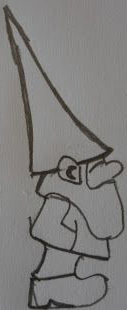
Gnome

Gnome


Teacher: Dwayne Gosnell

June  10,24 – 6PM Eastern

Twiitling Tuesday – 4 hours ( 2 sessions – 2 hours each day) 

 Location: Online (Via Zoom)

2.5×2.5×7.25 basswood block needed for pattern

For details and to sign up  click on Dwayne’s website https://www.dgosnellwoodcarving.com/

Dwayne’s website

Take the next step in your caricature carving and learn to capture actual likenesses.

Teacher: Ryan Olsen

Dates: August 2,3,9,10  2025

Saturday & Sunday both weekends 11:00 am-1:00 pm Pacific / 12:00 pm – 2:00 pm Mountain /
1:00 pm- 3:00 pm Central / 2:00 pm – 4:00 pm Eastern

8 hours

Location: Online (Via Zoom)

For details and to sign up contact Ryan ryanscaricatures@gmail.com

Contact Ryan

Teacher: Dale Green

Dates:  October 4,5,11,12  2025

Saturday & Sunday both weekends 9:30 am-11:30 Pacific / 10:30 am – 12:30 pm Mountain /11:30 am- 1:30 pm Central / 12:30 pm – 2:30 pm Eastern

8 hours ( 4 sessions – 2 hours each day) 

 Location: Online (Via Zoom)

For details and to sign up Contact Dale: dalecarves@gmail.com

Contact Dale

Online Classes With Chris Hammack

Teacher: Chris Hammack 

Chris Hammack is offering a new series of online classes to help students learn and sharpen their woodcarving skills.  Individual and Group Classes are available through his website chrishammackart.com/groupclass

Twhitling Tuesdays

Teacher: Dwayne Gosnell  

Dates: Two – 2 hour classes each month on Tuesdays

Location: Online (Via Zoom)

To sign up, contact Dwayne Gosnell via email at dagwood_76@gmail.com

Woodcarving Academy

Established in 2020, the Woodcarving Academy offers dozens of videos and seminars created by some of the country’s top level instructors.  More videos are added regularly as they are created by the instructors.

With a paid subscription to the Woodcarving Academy you can view any videos you like for as many times as you like.

Subscription rates:  Monthly = $19.95   Quarterly = $49.95   Annual = $139.95

There is even a Free level which allows you to tour the website and watch the sample videos and content, and receive email updates as new content becomes available.

Check out the Woodcarving Academy and learn with the masters right in the comfort of your own home!  Go to: www.woodcarvingacademy.com or Email: support@woodcarvingacademy.com

Some timely show information from my good friend, Jim Carlson from Boone, Iowa:

“Hi Bob, 

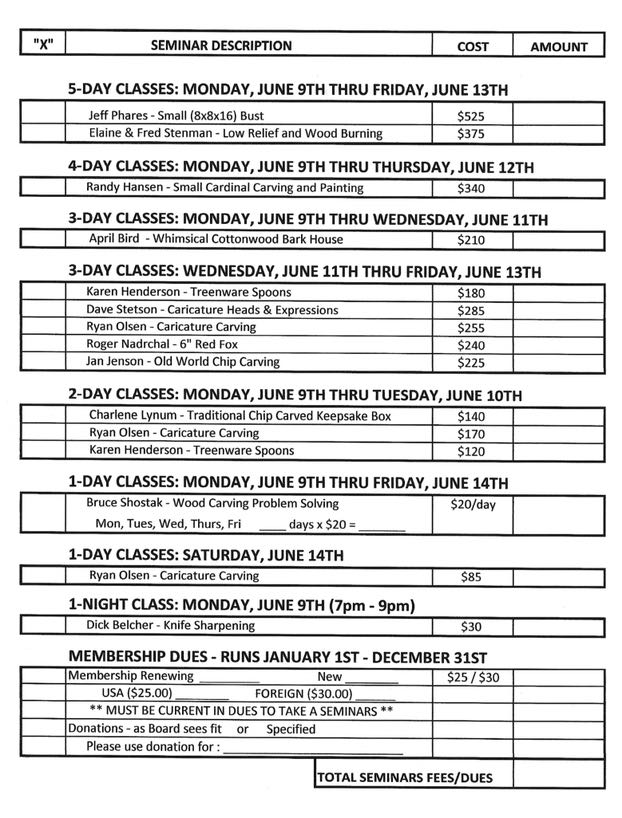
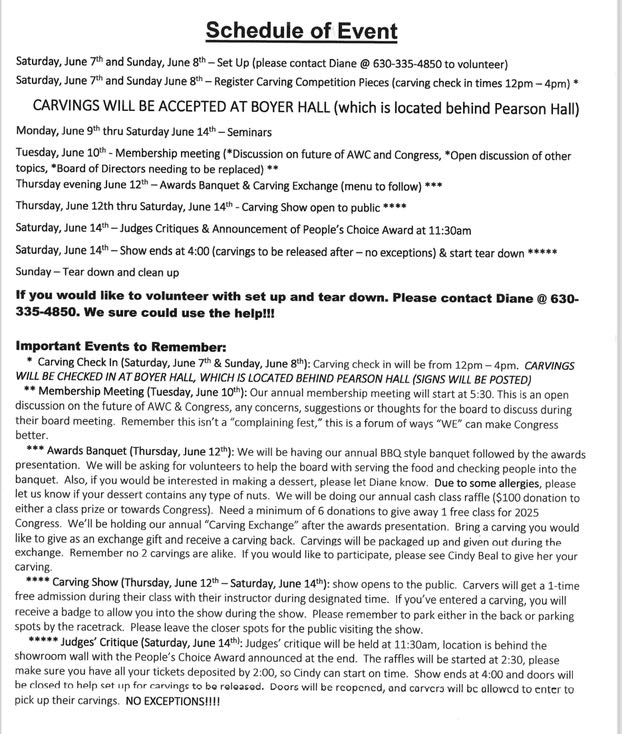
For anyone who is looking for some great in-person classes in combination with a competition and show, plus some great vendors, I would like to recommend the International Woodcarvers Congress. A wide variety of classes are available from one day to five days. Living in Iowa, I am fortunate to be within 3 hours of the quaint small town of Macquoketa, but instructors and students attend in June every year from all around the USA. If you have any room, I will attach some information and registration forms for the Congress.

Jim Carlson

Boone, Iowa”

Tri-State Woodcarvers Club 2025 “Show and Sell”.  October 25 and 26th, 9am to 3pm daily.  Vanderburgh County 4-H Center 201 E. Booneville New Harmony Rd, Evansville, IN.  Exposition Hall in the Activities Center Building.  Contact Danny Conley at 270-314-5895.

The International Association of Woodcarvers has upcoming Zoom meetings on the following Saturdays at 3PM EST with special guest presenters.  Check them out…

Zoom:  310-460-3575

Presentation Schedule:

6/7 – Dale Kirkpatrick

6/14 – Greg Wymer

INTERNATIONAL ASSOCIATION OF WOODCARVERS

COME JOIN US!!!

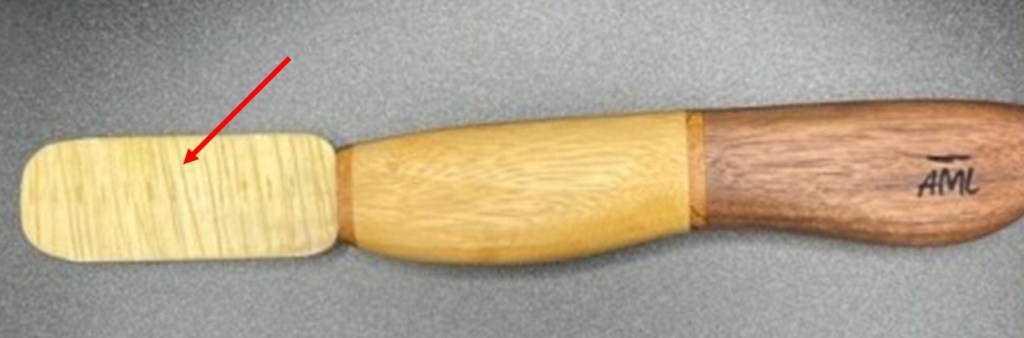
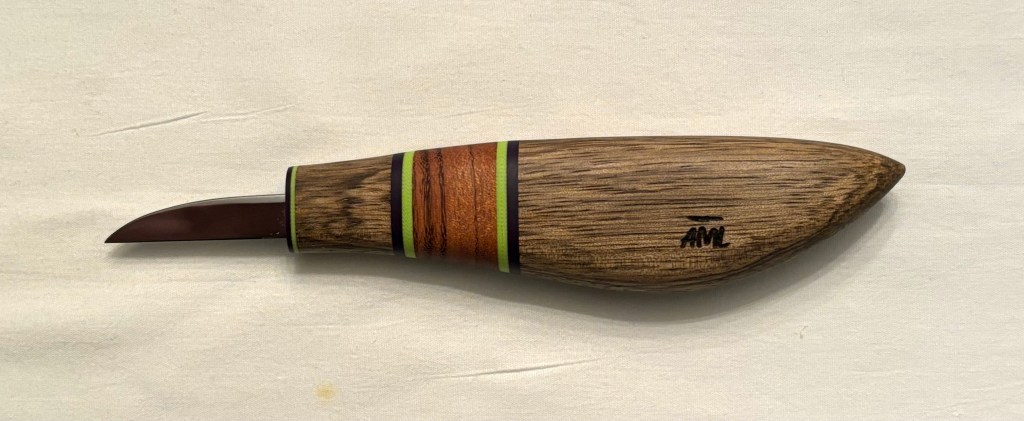
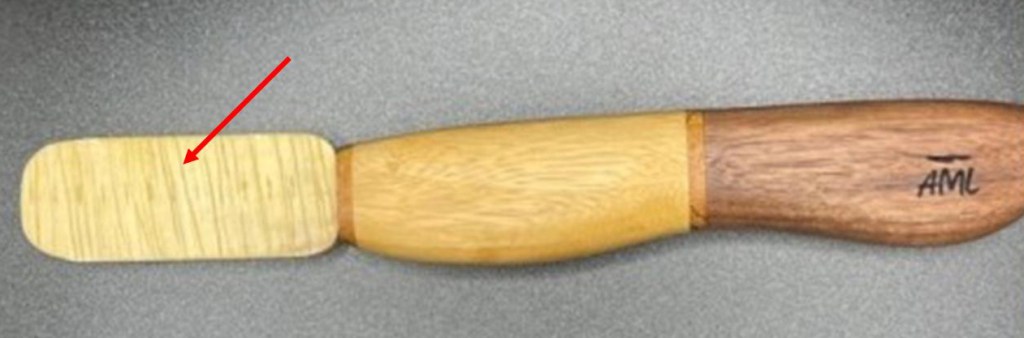
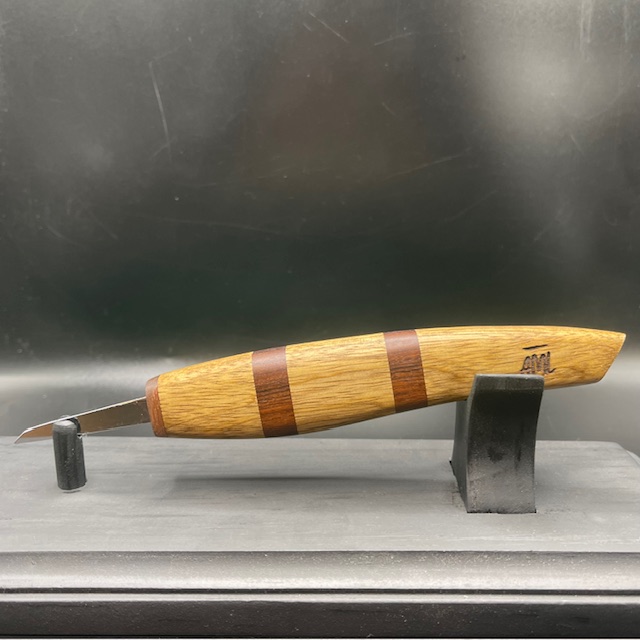
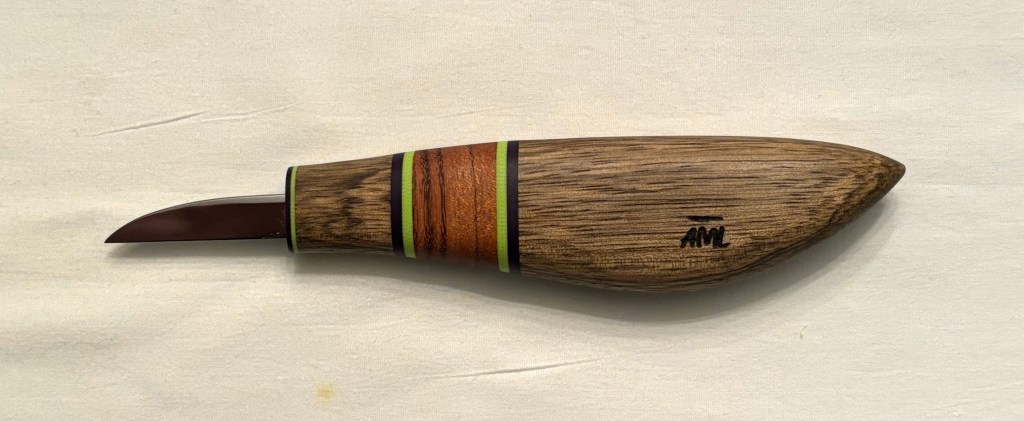
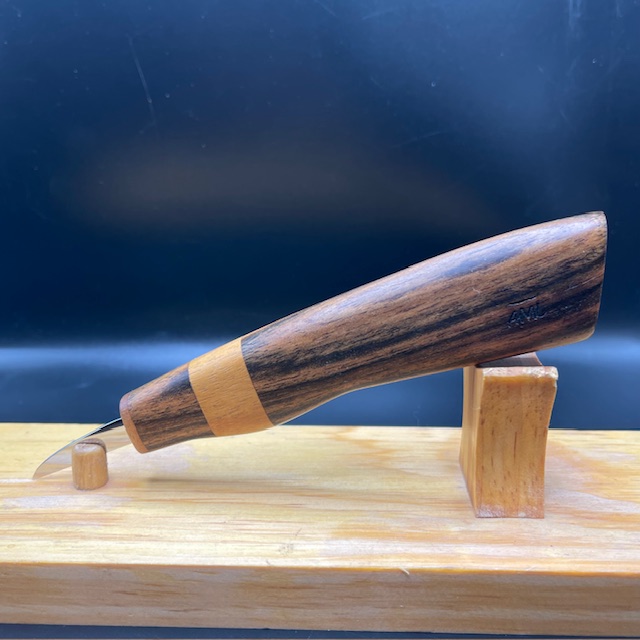
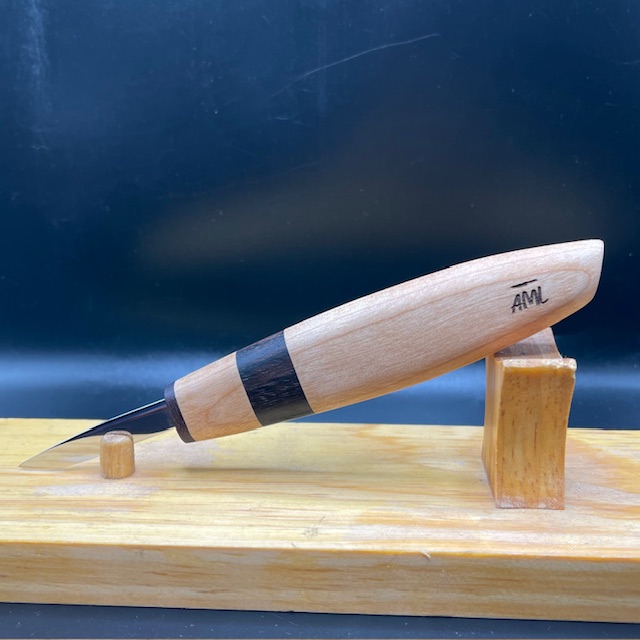
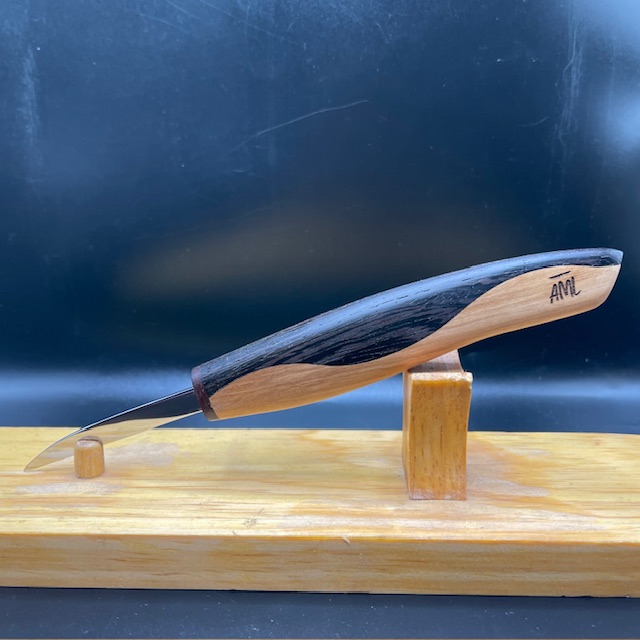
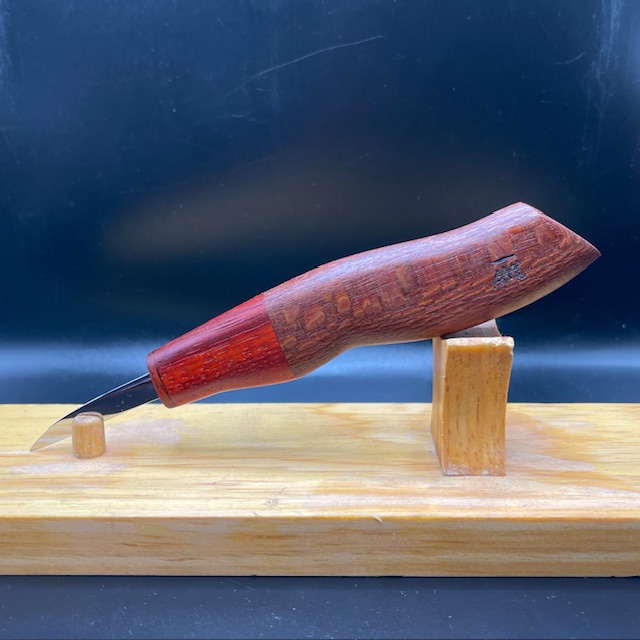
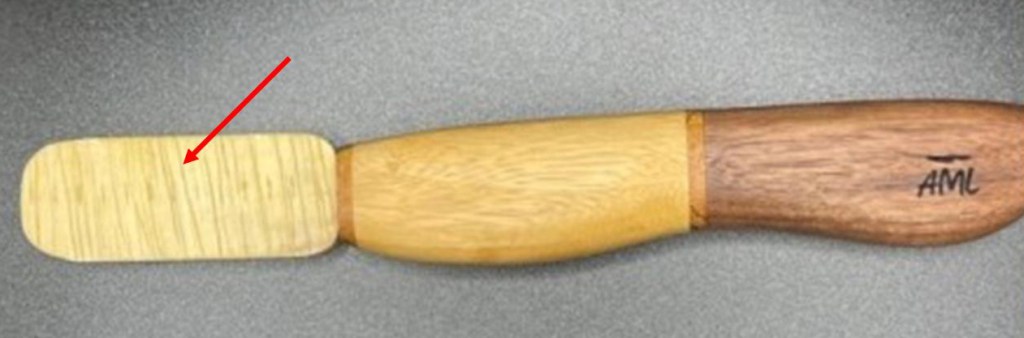
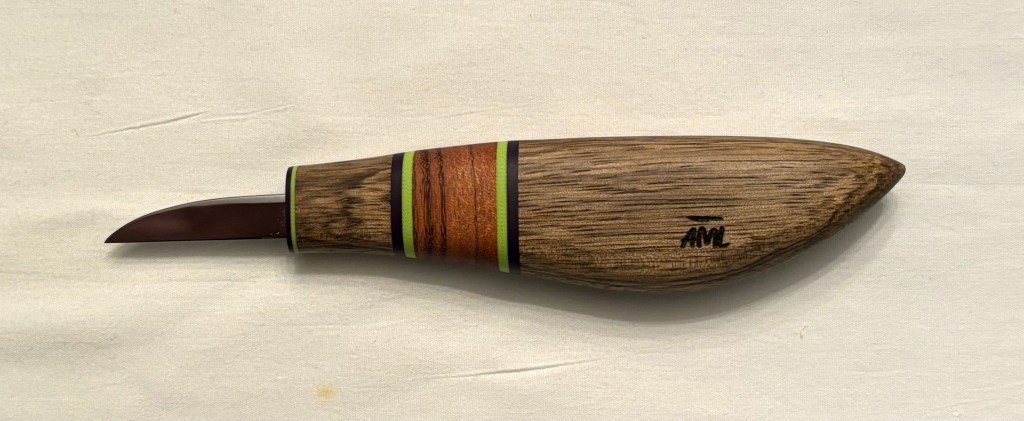
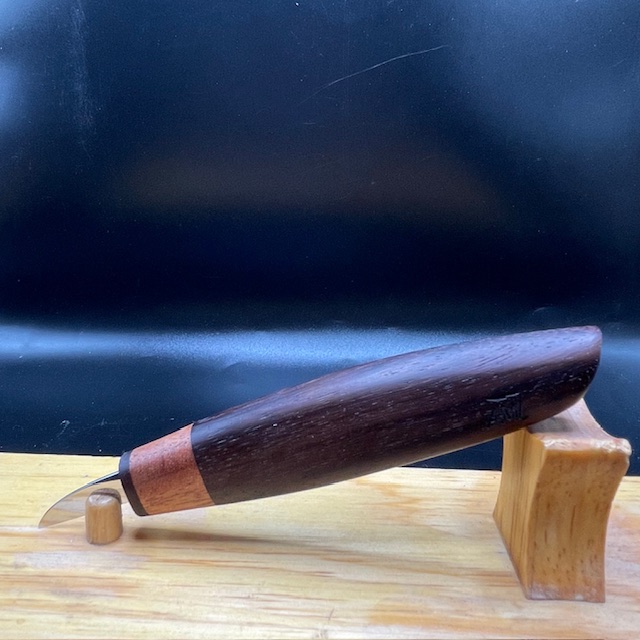
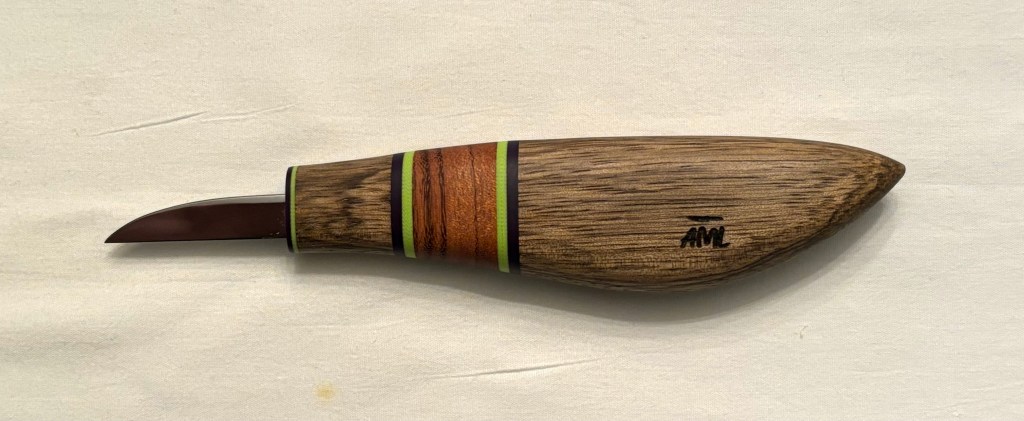
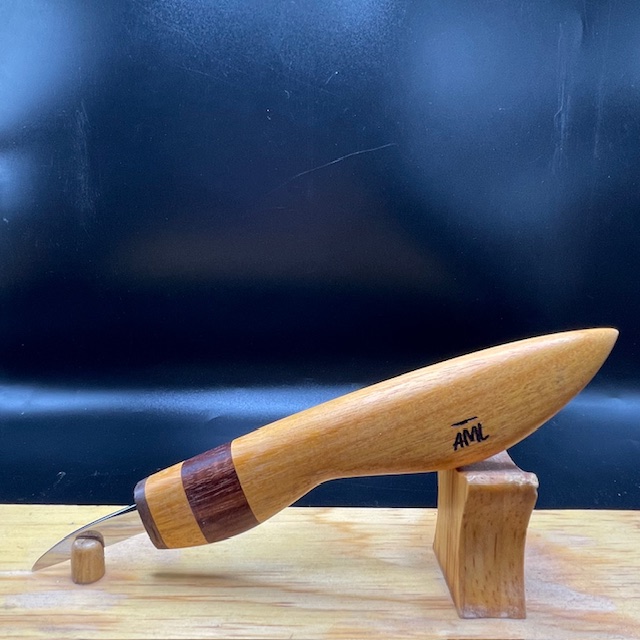
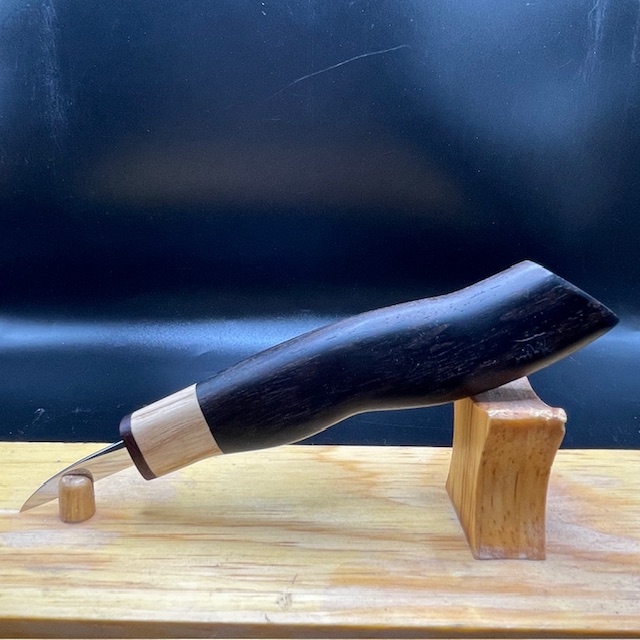
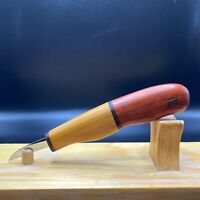
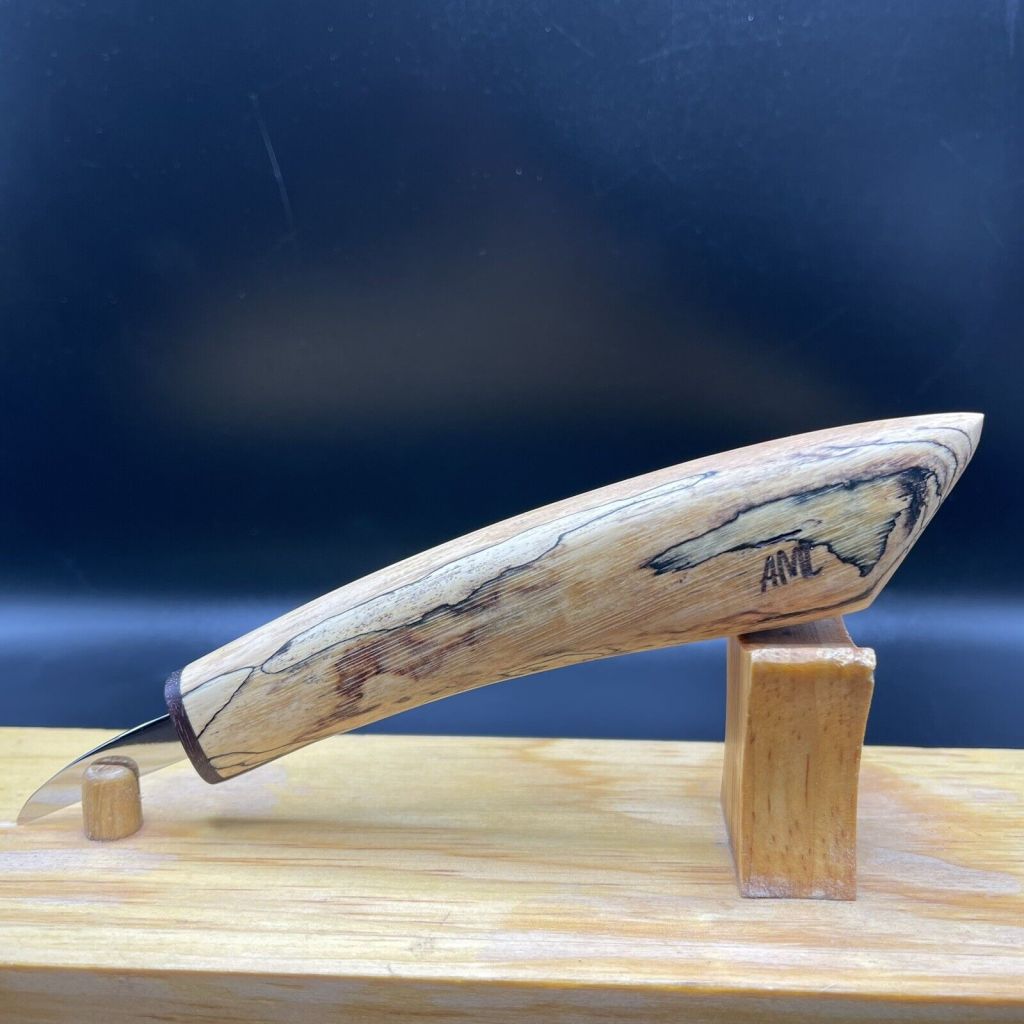
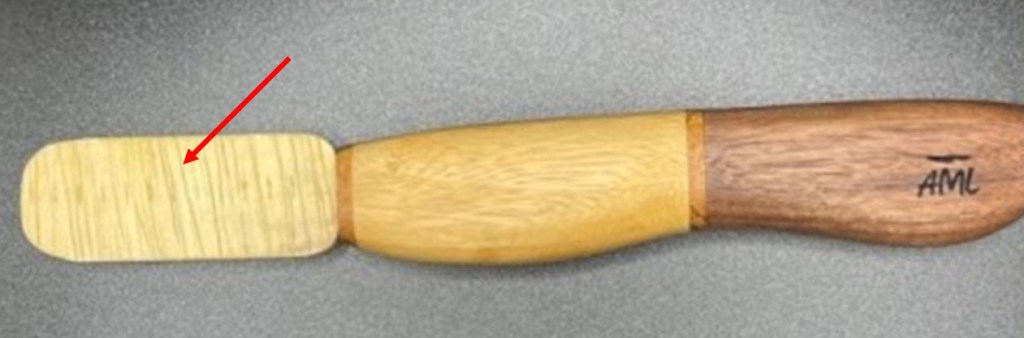
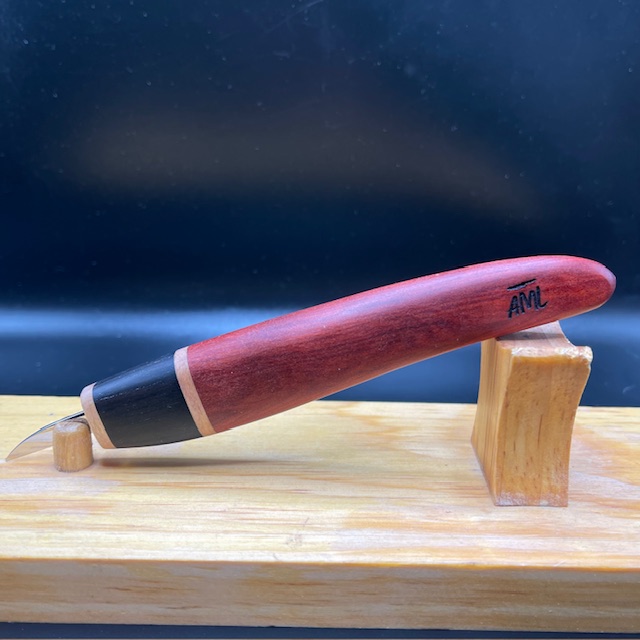
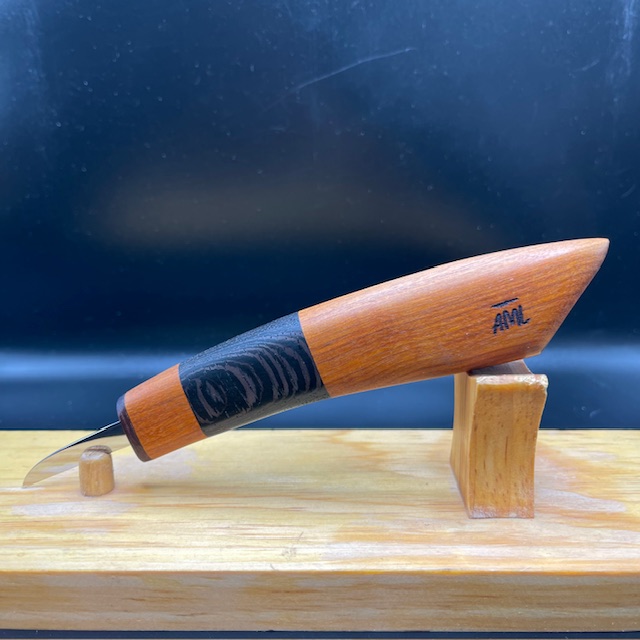
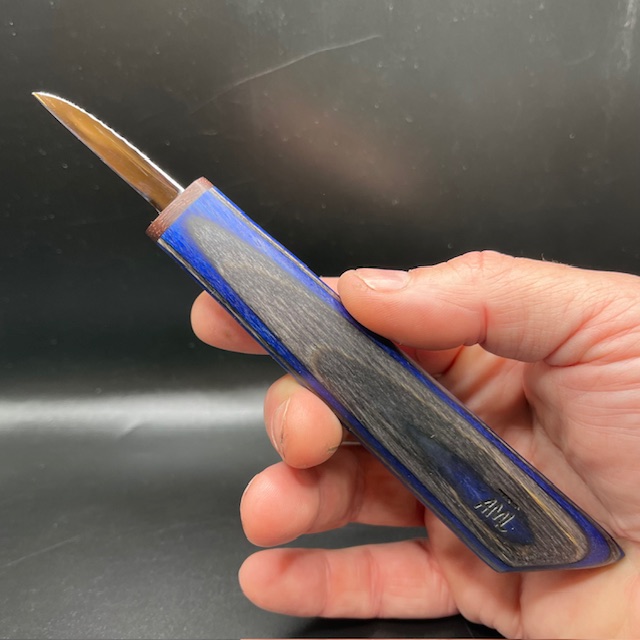
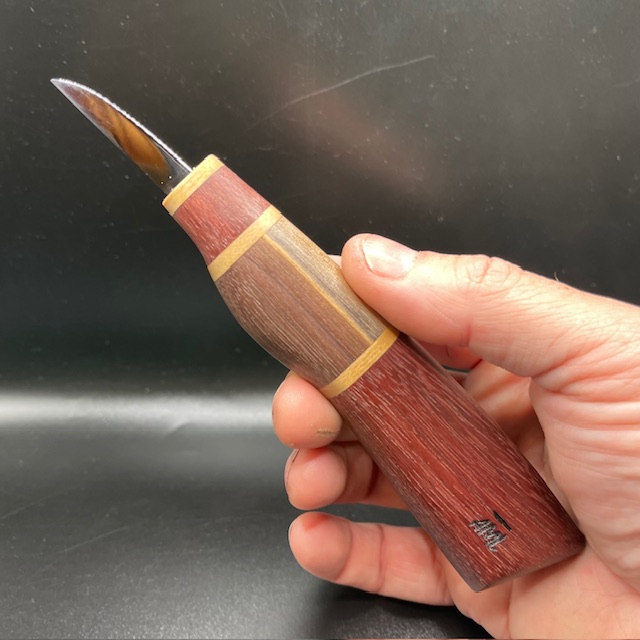
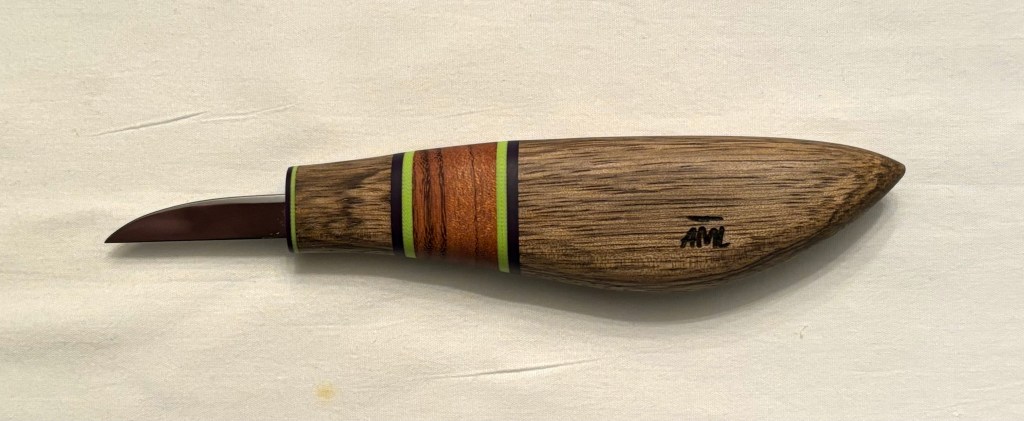
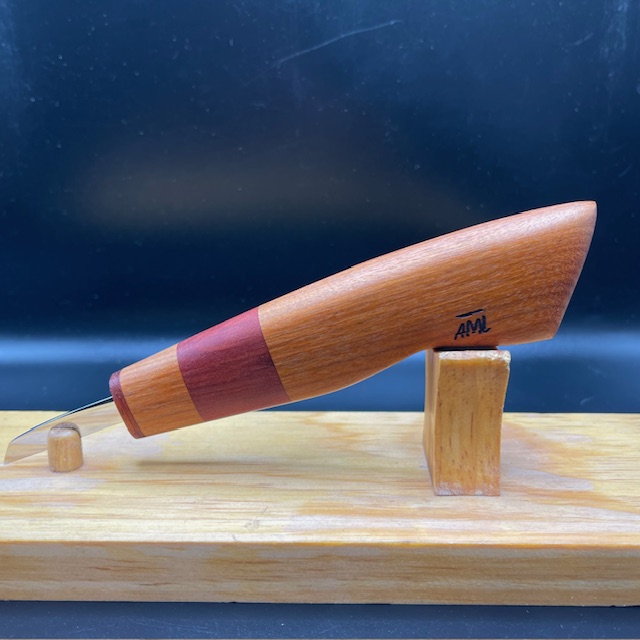
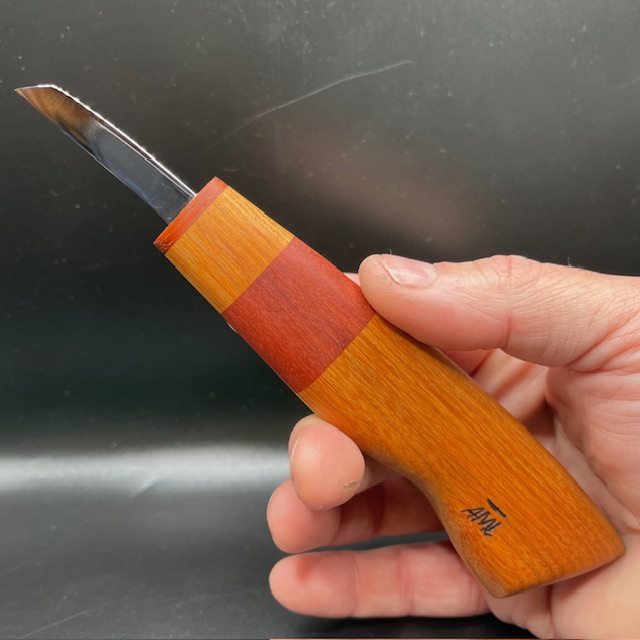
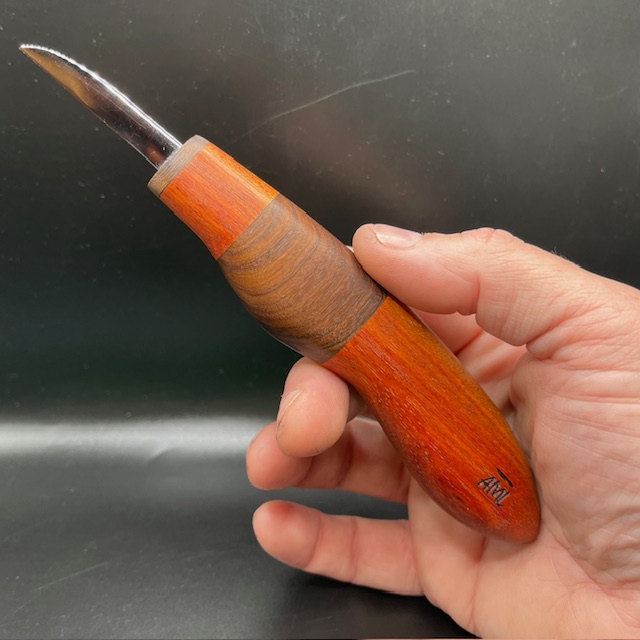
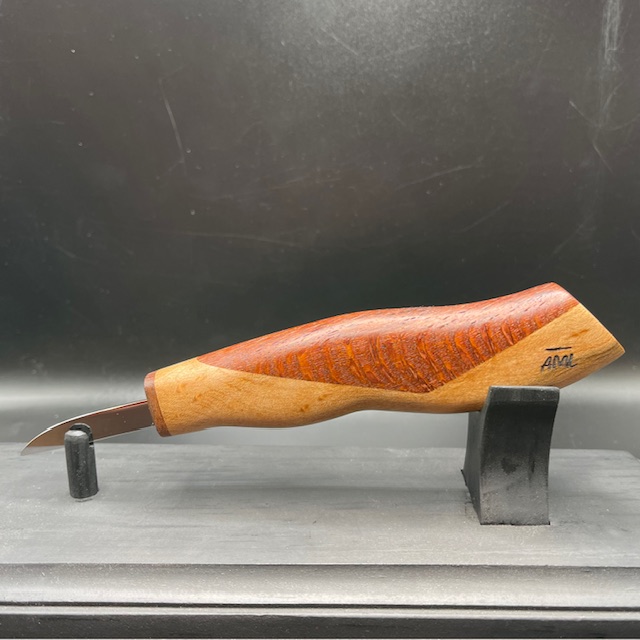
AML Wood Carving Knives

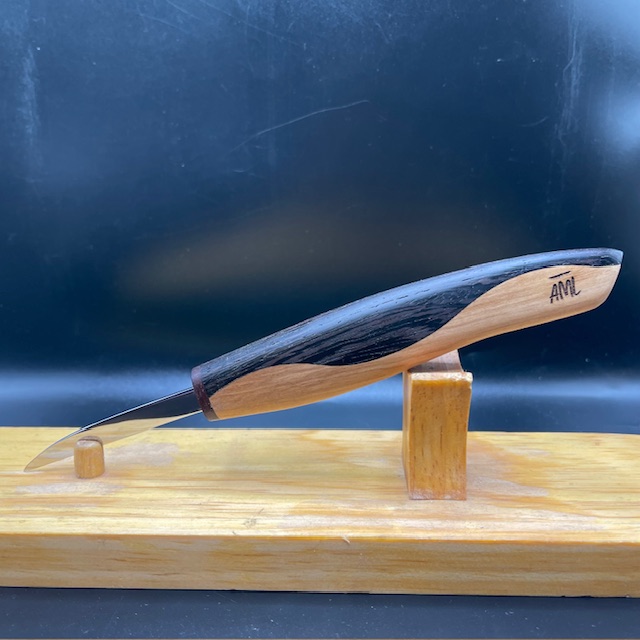
AML Wood Carving Knives are handmade by Andy Loughlin in Monroe, New York.

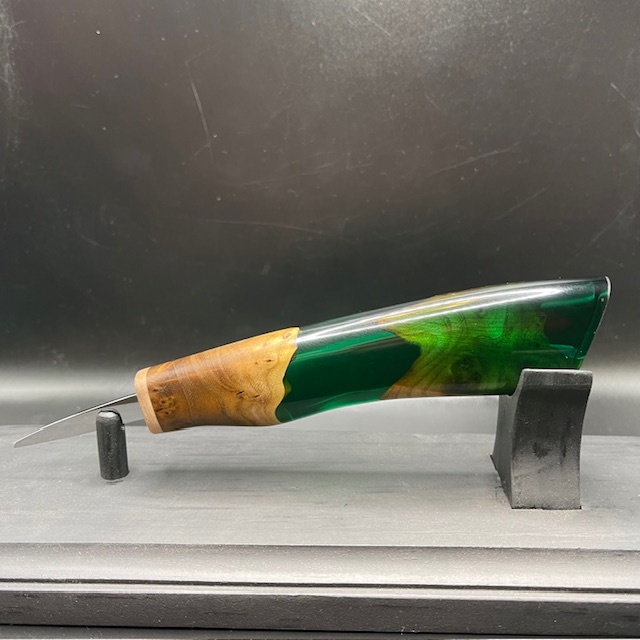
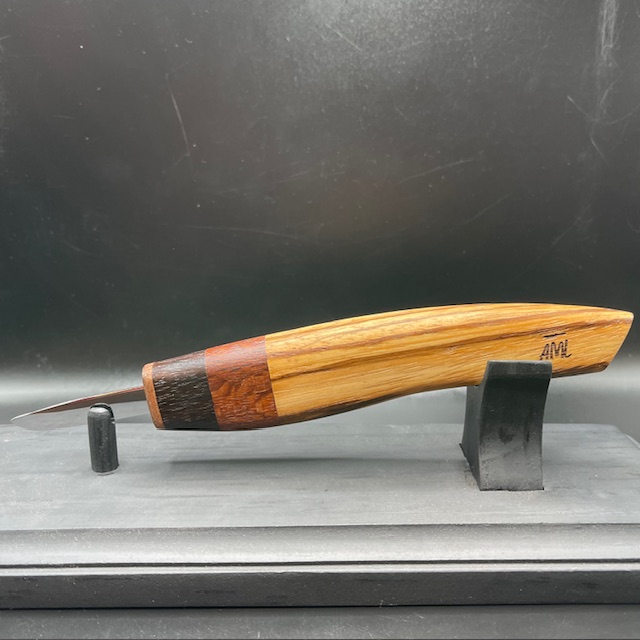
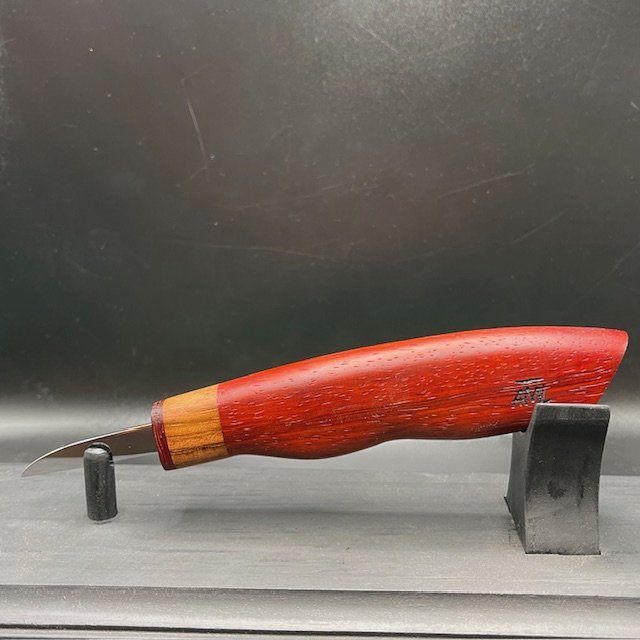
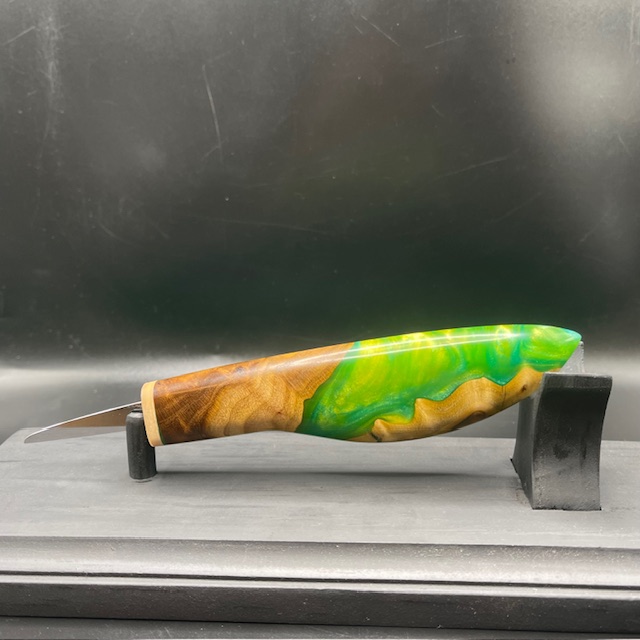
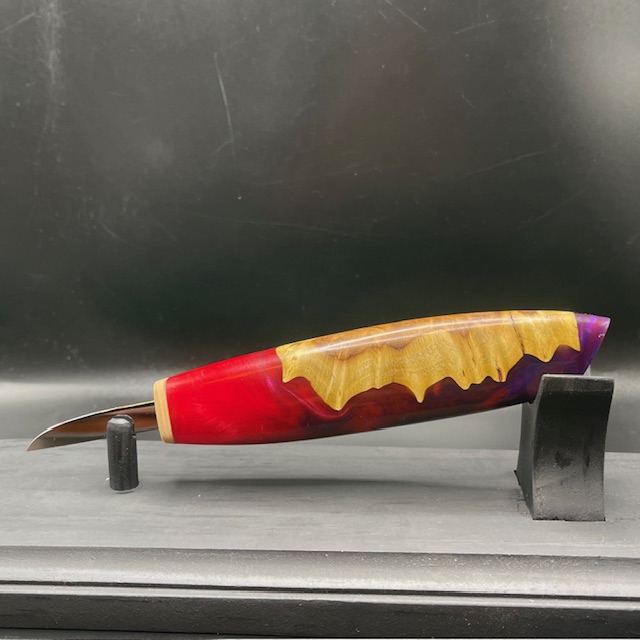
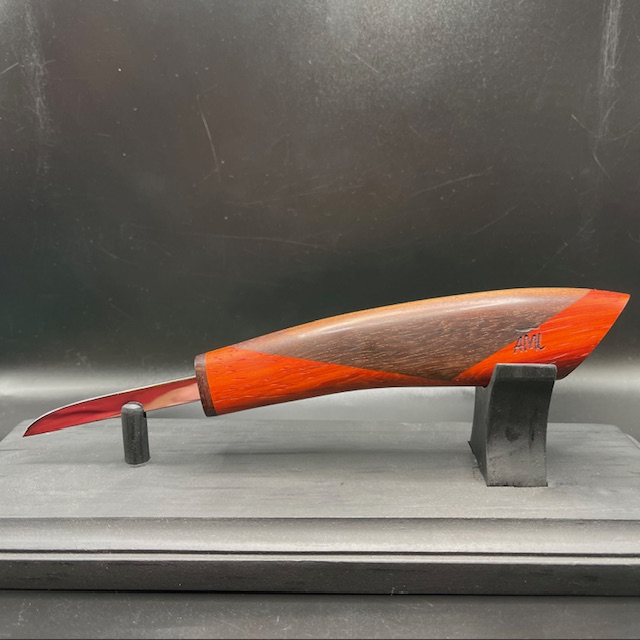
Each blade is meticulously crafted from 1095 high-carbon steel, ensuring easy sharpening and long-lasting edge retention. The diverse exotic woods used for the handle styles are sourced from around the world, adding a touch of elegance to these knives. You can find these exceptional knives for auction on eBay under ‘AML Knives,’  with bidding usually starting at $22 and most knives selling for between $40 and $100.

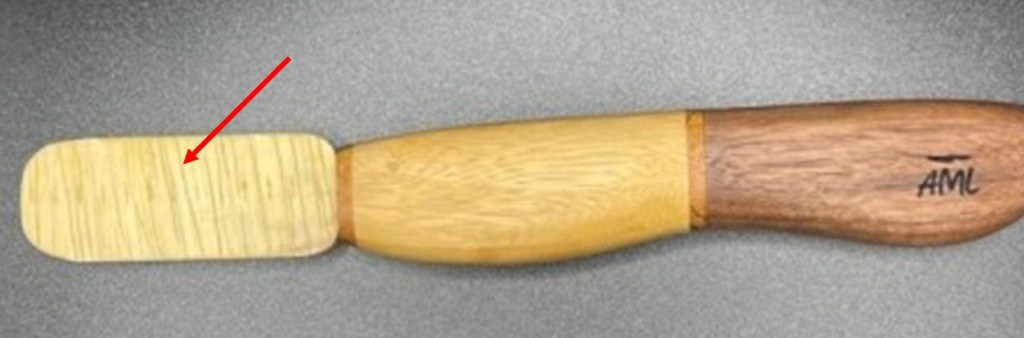
Unpack your AML Wood Carving Knife and experience its razor-sharpness right out of the package. Each knife comes with a custom-made magnetic wooden sheath, a thoughtful addition at no extra cost.

I now own three AML Knives and can speak personally about their quality.  These are not production knives. Each knife is handmade by Andy himself.  The knives are sturdy, well made, and will stack up to any other knife on the market.  These knives have quickly become quite popular and sell out fast, so check the site (“AML Carving Knives” on EBAY) often for availability.

Andy has recently begun making knives with handles crafted from exotic woods and colored epoxy, resulting in some stunning and unique handle designs.  Below are examples of some knives currently available or which have recently sold:

Complimentary Knife Sheath

IMPORTANT NOTICE!

Email address change

It has recently come to my attention that my Wood Chip Chatter email address (carverbobk@woodchipchatter.com) has become unreliable, and I may not have received all of your emails.  If you have sent me emails but have not seen your messages published in my blog, it’s purely because I never received them.  As a result, I have decided to stop using that email address and ask you to send all future correspondence (messages, comments, photos, etc.) to my personal email address, which is rwkoz51@gmail.com

I appreciate your patience and understanding.

Due to the holiday, Wood Chip Chatter will not be published on July 4, 2025

The next issue of Wood Chip Chatter will be posted on August 1, 2025.

Keep a sharp eye out for it.

The Legend of the Wood Spirit

The Legend Of The Wood Spirit

The Wood Spirit is a European legend originating from villagers who made long journeys through the forest. On calm days when the wind lays low, there is a sense of peace and tranquility in the forest. On days when storms are brewing and winds are blowing, the trees of the forest make sounds of moaning and sighing as though voices can be heard from spirits within. For centuries people believed the forests to be filled with mystical spirits and that those who dared to enter would earn the spirit’s wrath.

During the 15th century they believed that when the men went into the woods to hunt and didn’t return, that they had been taken by the evil spirits. They also believed that the tree spirits were the most powerful of all spirits and were good and wise. They believed that the tree spirits would protect them from evil. So before they would venture into the woods to hunt, they would knock on the tree to awaken the sleeping spirit to protect them. This is where we get the saying ‘Knock on Wood’ or ‘Touch Wood’.

Wise travelers assured their safety by carving wood spirit images on walking sticks or pieces of wood and bark. These carvings appeased the spirits, thus the traveler was allowed to enter and leave the forest without difficulty.

Catching a glimpse of one of these elusive creatures is said to be a lucky thing, for if you are fortunate enough to actually see one, your health, happiness and good fortune are guaranteed.

Wood spirits are still being carved into pieces of wood and are often given as gifts. The wood spirit should be given a special place within the home in order for its presence to bring wisdom, prosperity, humor, good health and good luck to all that live there.

Any house which is home to a wood spirit will stand protected and be blessed.

The Wood Spirit has always been a symbol of good luck and good fortune to those he travels with on the path of life. Nobody knows when the Wood Spirit Legend began because it was near the beginning of time but the old ones believe it began right here in the Great Northwest Forest. Some however, claim it started in Europe where it is called Green Man, Wildman, Savage Man, or Woodwose.

The ancient legends of the Wood Spirit continue to emerge with each new generation of Storyteller. Most of the people in tribal groups and cultures of the world believed in Wood Spirits in one form or another. Many still do. The people believed they lived in the trees that nourish life in the wilderness.

The Wood Spirit is said to be Lord of the Forest and Natural Things. Seeing one is said to be quite a lucky thing, and European villagers used to go out on regular hunts, hoping to find a Wood Spirit to foretell the future of their village.

It is said that the forest will stand for as long as the Wood Spirit remains to keep order. And if you’re lucky enough to see a Wood Spirit, health, happiness, and good fortune will be yours. However, that does not happen often. Wood Spirits would rather see than be seen. Most sightings are by children or by the pure of heart.

Wood Spirits were carved to bring luck to a household, ward off undesirable spirits and keep the household safe. Any house which is home to a Wood Spirit will stand protected and be blessed with good luck, health and happiness.

“Photo Shop” is the section of Wood Chip Chatter where carvers can send in photos of their wood carvings for display. It’s your chance to show off your work…sort of a show and tell. The photos will only be displayed and no comments or critiques will be made.  For critiques on your carvings send them in to the “Carver’s Corner.”  Send your photos to: rwkoz51@gmail.com

My first entry to the Photo Shop this month comes from my very good friend, Dick Bonewitz of Carmel, Indiana who writes:

"Here is a hummingbird in a nest I recently carved with instructor Josh Guge at the Ozark Woodcarving seminar in Springfield Mo.  
The bird and nest are power carved from one piece of Tupelo. The beak is a piece of bamboo skewer.  It was challenging as it is so small, but was a rewarding experience.   
 
Dick Bonewitz 
Carmel,In"
Dick’s Hummingbird

Excellent job on your hummingbird, Dick!  Very life-like looking.

Dick Bonewitz also send in a photo of a Pronghorn he recently carved:

Dick’s Pronghorn

Another life-like carving, Dick, great job!  The fur texture is spot-on.  Was this also power carved?

My very good friend, Jim Babcock send in a photo of a terrific flower he recently carved.  Jim writes:

“Bob:

Hope all is well with you.  It has been a long Winter for most of us, but there are

a few signs that Spring may soon arrive.

Northern basswood, finished with an oil based stain.

Jim Babcock

Columbus, Indiana”

Jim’s Flower

Thanks for the photo, as always, Jim!  You did an outstanding job on your flower.

Deep Cuts

Deep cuts create dark shadows, which make your carvings really stand out.  Don’t be afraid to cut deep.  There is usually more wood there than you think.  Also, wherever there is a corner, cut a deep triangle into it to create a nice dark shadow and make it stand out.

Biscuit

Ellender’s Window 10.5″

Teacher: Janet Cordell

Dates: May 5, 9, 12, 16, 19, 23, 2025

Times: 2-4 p.m.   Pacific Time  //  3-5 p.m.  Mountain Time // 4-6 p.m.  Central Time // 5-7  p.m.  Eastern Time

12 hours ( 6 sessions – 2 hours each day) 

 Location: Online (Via Zoom)

Cost: $175 (includes one large roughout)

For details and to sign up email Janet  janet_cordell@yahoo.com

 Teacher: Dwayne Gosnell

May  13,27 – 6PM Eastern

Twiitling Tuesday – 4 hours ( 2 sessions – 2 hours each day) 

 Location: Online (Via Zoom)

2.5×2.5×7.25 basswood block needed for pattern

For details and to sign up  click on Dwayne’s website https://www.dgosnellwoodcarving.com/

Dwayne’s website


Teacher: Dwayne Gosnell

June  10,24 – 6PM Eastern

Twiitling Tuesday – 4 hours ( 2 sessions – 2 hours each day) 

 Location: Online (Via Zoom)

2.5×2.5×7.25 basswood block needed for pattern

For details and to sign up  click on Dwayne’s website https://www.dgosnellwoodcarving.com/

Dwayne’s website

Online Classes With Chris Hammack

Teacher: Chris Hammack 

Chris Hammack is offering a new series of online classes to help students learn and sharpen their woodcarving skills.  Individual and Group Classes are available through his web site chrishammackart.com/groupclass

Twhitling Tuesdays

Teacher: Dwayne Gosnell  

Dates: Two – 2 hour classes each month on Tuesdays

Location: Online (Via Zoom)

To sign up contact Dwayne Gosnell via email dagwood_76@gmail.com

Woodcarving Academy

Established in 2020, the Woodcarving Academy offers dozens of videos and seminars created by some of the country’s top level instructors.  More videos are added regularly as they are created by the instructors.

With a paid subscription to the Woodcarving Academy you can view any videos you like for as many times as you like.

Subscription rates:  Monthly = $19.95   Quarterly = $49.95   Annual = $139.95

There is even a Free level which allows you to tour the website and watch the sample videos and content, and receive email updates as new content becomes available.

Check out the Woodcarving Academy and learn with the masters right in the comfort of your own home!  Go to: www.woodcarvingacademy.com or Email: support@woodcarvingacademy.com

Some timely show information from my good friend, Jim Carlson from Boone, Iowa:

“Hi Bob, 

For anyone who is looking for some great in-person classes in combination with a competition and show, plus some great vendors, I would like to recommend the International Woodcarvers Congress. A wide variety of classes are available from one day to five days. Living in Iowa, I am fortunate to be within 3 hours of the quaint small town of Macquoketa, but instructors and students attend in June every year from all around the USA. If you have any room, I will attach some information and registration forms for the Congress.

Jim Carlson

Boone, Iowa”

Cottonwood Bark Class

The Pennsylvania Delaware Valley Woodcarvers will be hosting Cottonwood Bark Carver Harold Kaltenbach, May 3rd & 4th in Suburban Philadelphia. If interested contact Wade Huggins 215-531-0238.

Tri-State Woodcarvers Club 2025 “Show and Sell”.  October 25 and 26th 9am to 3pm daily.  Vanderburgh County 4-H Center 201 E. Booneville New Harmony Rd, Evansville In.  Exposition Hall in the activities Center Bldg.  contact Danny Conley 270-314-5895.

The International Association of Woodcarvers has upcoming Zoom meetings on the following Saturdays at 3PM EST with special guest presenters.  Check them out…

Zoom:  310-460-3575

Presentation Schedule:

5/3 – Joe Savarese

5/10 – Joshua Walters

5/31 – Karla Harman

6/7 – Dale Kirkpatrick

6/14 – Greg Wymer

INTERNATIONAL ASSOCIATION OF WOODCARVERS

COME JOIN US!!!

The Jersey Hills Wood Carvers (JHWC) club is a small but growing group of wood carvers sharing their time, knowledge and joy of woodcarving.  The JHWC generally meets from 7:00 PM EST to 9:00 PM EST on the 1st, 3rd and 5th Thursday of each month (when school is in session) at the Jefferson Township High School wood shop classroom.

Membership is “FREE” and open to anyone interested in woodcarving regardless of their ability.

JHWC’s Upcoming Meetings and Events

2025

May – 15th, 29th

June – 5th

For more information contact:

Al Santucci  alsantucci4@gmail.com  President

Bill Brunner  billbrunnerdesign@gmail.com  newsletter/website editor

Or visit:

Website:  https://www.jerseyhillswoodcarver.com/

Facebook:  https://www.facebook.com/groups/736479646821641/

AML Wood Carving Knives

AML Wood Carving Knives are handmade by Andy Loughlin in Monroe, New York.

Each blade is meticulously crafted from 1095 high-carbon steel, ensuring easy sharpening and long-lasting edge retention. The diverse exotic woods used for the handle styles are sourced from around the world, adding a touch of elegance to these knives. You can find these exceptional knives for auction on eBay under ‘AML Knives,’  with bidding usually starting at $22 and most knives selling for between $40 and $100.

Unpack your AML Wood Carving Knife and experience its razor-sharpness right out of the package. Each knife comes with a custom-made magnetic wooden sheath, a thoughtful addition at no extra cost.

I now own three AML Knives and can speak personally about their quality.  These are not production knives. Each knife is handmade by Andy himself.  The knives are sturdy, well made, and will stack up to any other knife on the market.  These knives have quickly become quite popular and sell out fast, so check the site (“AML Carving Knives” on EBAY) often for availability.

Andy has recently begun making knives with handles made from exotic woods and colored epoxy, creating some stunning and unique handle designs.  Below are examples of some knives currently available or which have recently sold:
Complimentary Knife Sheath

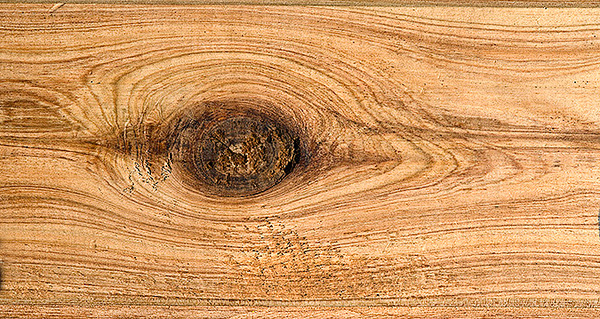
Wood Knots

As a tree grows, lower branches often die, and their bases may become overgrown and enclosed by subsequent layers of trunk wood, forming a type of imperfection known as a knot.  The dead branch may not be attached to the trunk wood except at its base, and can drop out after the tree has been sawn into boards.  Knots affect the technical properties of the wood, usually reducing the local strength and increasing the tendency for splitting along the wood grain, but may be exploited for visual effect.  In a longitudinally sawn plank, a knot will appear as a roughly circular “solid” (usually darker) piece of wood around which the grain of the rest of the wood “flows” (parts and rejoins).  Within a knot, the direction of the wood (grain direction) can be up to 90 degrees different from the grain direction of the regular wood.

In the tree a knot is either the base of a side branch or a dormant bud.  A knot (when the base of a side branch) is conical in shape (hence the roughly circular cross-section) with the inner tip at the point in stem diameter at which the plant’s vascular cambium was located when the branch formed as a bud.

In grading structural lumber and lumber in general, knots are classified according to their form, size, soundness, and the firmness with which they are held in place.  This firmness is affected by, among other factors, the length of time for which the branch was dead while the attaching stem continued to grow.

In some decorative applications, wood with knots may be desirable to add visual interest. In applications where wood is painted, such as skirting boards, fascia boards, door frames and furniture, resins present in the timber may continue to ‘bleed’ through to the surface of a knot for months or even years after manufacture and show as a yellow or brownish stain. A knot primer paint or solution, correctly applied during preparation, may do much to reduce this problem but it is difficult to control completely, especially when using mass-produced kiln-dried lumber stocks.

Wood knots are sought after today for carving ornamental wood spirits.

“Photo Shop” is the section of Wood Chip Chatter where carvers can send in photos of their wood carvings for display. It’s your chance to show off your work…sort of a show and tell. The photos will only be displayed and no comments or critiques will be made.  For critiques on your carvings send them in to the “Carver’s Corner.”  Send your photos to: carverbobk@woodchipchatter.com

My first entries to the Photo Shop come from my good friend, Ray Steinhart.  Ray writes:

“Hey Bob, really happy how these turned out . It’s amazing what you can do one chip at a time .

Thanks”

Looks like you’ve been busy, Ray.  Very nice work.  Thanks for the photos.

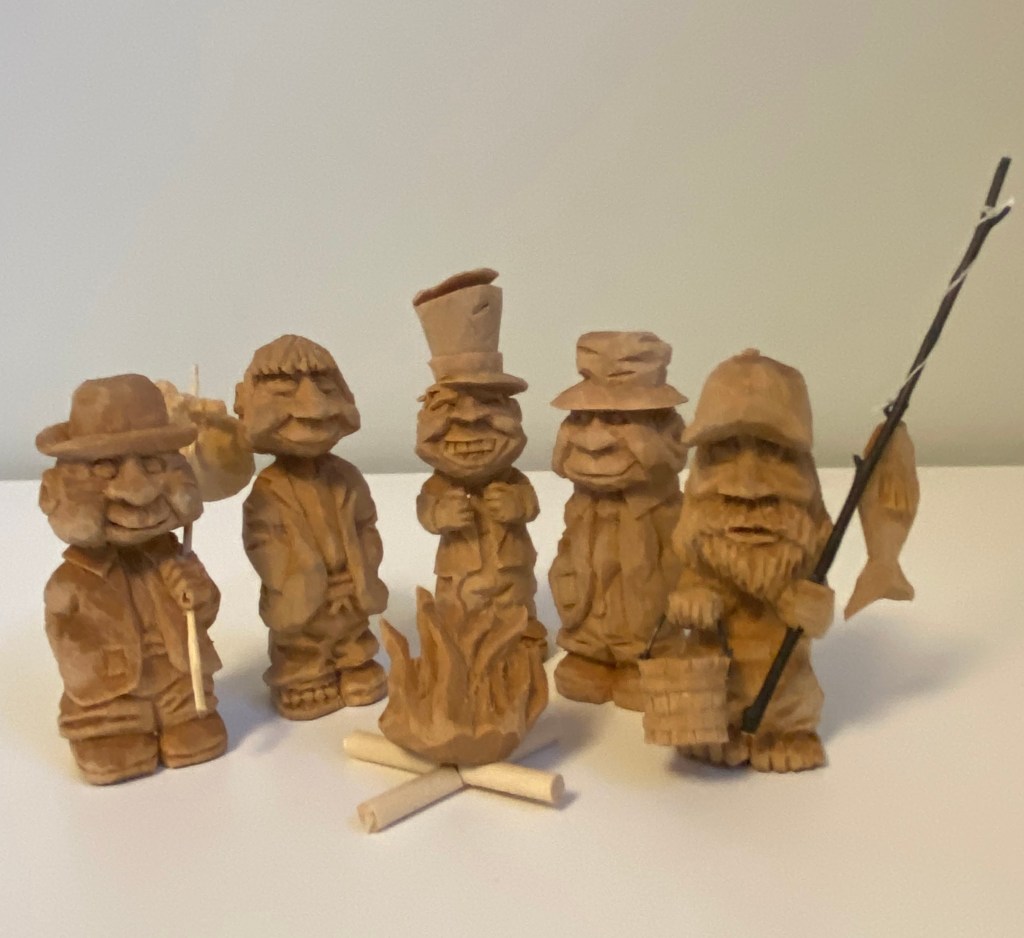
My next entries to the Photo Shop were submitted by my good friend Kerem Kozak.

Very nice work, Kerem.  The surfer is very original and I really like the campfire scene with the various characters!  Keep ’em coming!

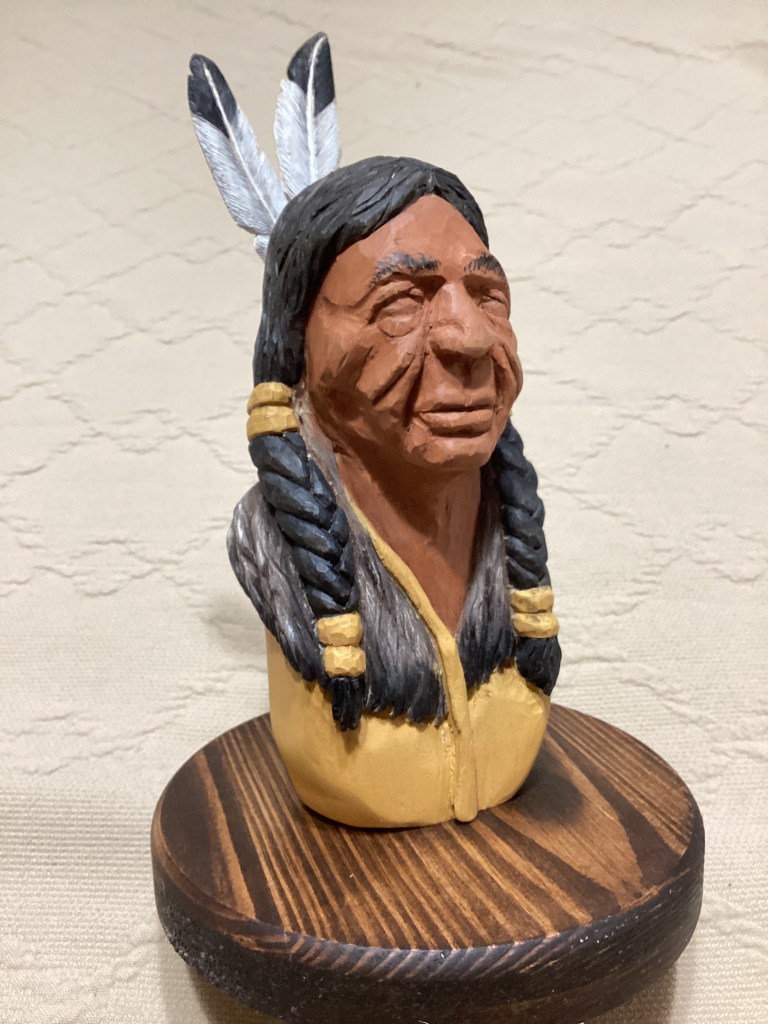
Next, we have an amazing bust carved by my very good friend, Dean Stewart.  Dean writes:

"Bob,
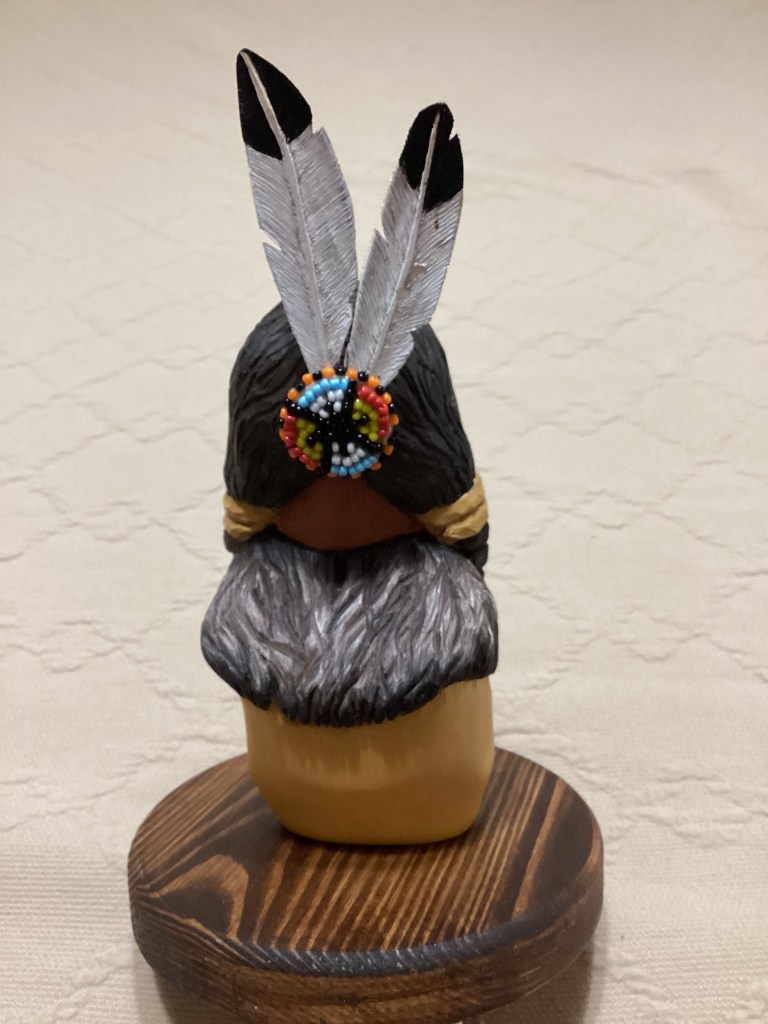
I wanted to share my recent carving.  My carving group took this one as a group project.  One expert carver guided us through the journey.  We started last April and I just completed it this month.  My wife liked it so much she helped with the paint and the beaded feather holder.  It’s basswood on a pine base about 6 inches tall. Painted with acrylic paint and finished with clear wax."

Outstanding job, Dean!  I really like it!  Great detail and painting!

Next, we have a terrific corner carving done by my very good friend, Jim Babcock.  Jim writes:

“Bob:

The image is Kevin Applegate’s.   Carved in the corner carving style; basswood

finished with walnut oil and diluted acrylics.

Jim Babcock

Columbus, Indiana”

Nice job, Jim!  Very clean work.  I love the hair!

My very good friend, Todd Martin, of Huntington, Indiana sent in a photo of some excellent carvings he recently finished.  Todd experimented with the antique finish on these carvings and writes:

“Hi Bob, 

I always enjoy look forward to getting Wood Chip Chatter, and I appreciate all the work you put into that, and all the advice you offer.

Here are a few smaller pieces I’ve done recently,  each 4″ tall. 

I tried a new finish, Howard’s Feed n Wax mixed with burnt sienna oil paint (after spraying with a polycrylic) . I usually use burnt umber. I’m not sure I like the reddish tint that has resulted, rather than a the brown, antiquing effect of the burnt umber.

What do you think? Any and all feedback always welcomed.

Best,

Todd”

Todd’s Carvings

Thank you for your kind words, Todd!  Terrific carvings.  Excellent carving work, and I really like the detail and finish on them.  Perhaps you can share how you mixed the paint and wax, and what proportions you used.

Just a side thought about paint colors.  I always thought burnt sienna has more red in it than burnt umber.  Any thoughts?

Carving Faces 

Carving faces can be a fun challenge… unless it becomes frustrating. Here are some quick facial proportion suggestions from Carving Woodspirits: Beyond the Basics by Hendrix and Peery:

Keep eye lines halfway between the top of the head and the bottom of the chin.

Make ears nearly 2 times longer than their width.

Line up ear bottoms with the bottom of the nose.

Line up ear tops with the top of the eyebrows.

Half of the mouth should be visible in the profile.

The back corner of the jaw line is nearly straight down from the front of the ear and lines up with the bottom part of the lower lip.

Source: carvingjunkies.com

Hillbilly by Kevin Applegate

 Teacher: Dwayne Gosnell

April  15,29 – 6PM Eastern

Twiitling Tuesday – 4 hours ( 2 sessions – 2 hours each day) 

 Location: Online (Via Zoom)

2.5×2.5×7.25 basswood block needed for pattern

For details and to sign up  click on Dwayne’s website https://www.dgosnellwoodcarving.com/

Dwayne’s website

Teacher: Janet Cordell

Dates: May 5, 9, 12, 16, 19, 23, 2025

Times: 2-4 p.m.   Pacific Time  //  3-5 p.m.  Mountain Time // 4-6 p.m.  Central Time // 5-7  p.m.  Eastern Time

12 hours ( 6 sessions – 2 hours each day) 

 Location: Online (Via Zoom)

Cost: $175 (includes one large roughout)

For details and to sign up email Janet  janet_cordell@yahoo.com

 Teacher: Dwayne Gosnell

May  13,27 – 6PM Eastern

Twiitling Tuesday – 4 hours ( 2 sessions – 2 hours each day) 

 Location: Online (Via Zoom)

2.5×2.5×7.25 basswood block needed for pattern

For details and to sign up  click on Dwayne’s website https://www.dgosnellwoodcarving.com/

Dwayne’s website

 Teacher: Dwayne Gosnell

June  10,24 – 6PM Eastern

Twiitling Tuesday – 4 hours ( 2 sessions – 2 hours each day) 

 Location: Online (Via Zoom)

2.5×2.5×7.25 basswood block needed for pattern

For details and to sign up  click on Dwayne’s website https://www.dgosnellwoodcarving.com/

Dwayne’s website

Online Classes With Chris Hammack

Teacher: Chris Hammack 

Chris Hammack is offering a new series of online classes to help students learn and sharpen their woodcarving skills.  Individual and Group Classes are available through his web site chrishammackart.com/groupclass

Twhitling Tuesdays

Teacher: Dwayne Gosnell  

Dates: Two – 2 hour classes each month on Tuesdays

Location: Online (Via Zoom)

To sign up contact Dwayne Gosnell via email dagwood_76@gmail.com

Woodcarving Academy

Established in 2020, the Woodcarving Academy offers dozens of videos and seminars created by some of the country’s top level instructors.  More videos are added regularly as they are created by the instructors.

With a paid subscription to the Woodcarving Academy you can view any videos you like for as many times as you like.

Subscription rates:  Monthly = $19.95   Quarterly = $49.95   Annual = $139.95

There is even a Free level which allows you to tour the website and watch the sample videos and content, and receive email updates as new content becomes available.

Check out the Woodcarving Academy and learn with the masters right in the comfort of your own home!  Go to: www.woodcarvingacademy.com or Email: support@woodcarvingacademy.com

Some timely show information from my good friend, Jim Carlson from Boone, Iowa:

“Hi Bob, 

For anyone who is looking for some great in-person classes in combination with a competition and show, plus some great vendors, I would like to recommend the International Woodcarvers Congress. A wide variety of classes are available from one day to five days. Living in Iowa, I am fortunate to be within 3 hours of the quaint small town of Macquoketa, but instructors and students attend in June every year from all around the USA. If you have any room, I will attach some information and registration forms for the Congress.

Jim Carlson

Boone, Iowa”

Cottonwood Bark Class

The Pennsylvania Delaware Valley Woodcarvers will be hosting Cottonwood Bark Carver Harold Kaltenbach, May 3rd & 4th in Suburban Philadelphia. If interested contact Wade Huggins 215-531-0238.

The International Association of Woodcarvers has upcoming Zoom meetings on the following Saturdays at 3PM EST with special guest presenters.  Check them out…

Zoom:  310-460-3575

Presentation Schedule:

4/19 – Chris Gardea

4/26 – Tyler Borg

5/3 – Joe Savarese

5/10 – Joshua Walters

5/31 – Karla Harman

6/14 – Greg Wymer

INTERNATIONAL ASSOCIATION OF WOODCARVERS

COME JOIN US!!!

The Jersey Hills Wood Carvers (JHWC) club is a small but growing group of wood carvers sharing their time, knowledge and joy of woodcarving.  The JHWC generally meets from 7:00 PM EST to 9:00 PM EST on the 1st, 3rd and 5th Thursday of each month (when school is in session) at the Jefferson Township High School wood shop classroom.

Membership is “FREE” and open to anyone interested in woodcarving regardless of their ability.

JHWC’s Upcoming Meetings and Events

2025

April – 24th

May – 1st, 15th, 29th

June – 5th

For more information contact:

Al Santucci  alsantucci4@gmail.com  President

Bill Brunner  billbrunnerdesign@gmail.com  newsletter/website editor

Or visit:

Website:  https://www.jerseyhillswoodcarver.com/

Facebook:  https://www.facebook.com/groups/736479646821641/

Complimentary Knife Sheath

Woodcarving Safety

Woodcarving is a rewarding craft, but it requires attention to safety to prevent injuries.  Here are some key tips for woodcarvers.

1. Tools and Equipment Safety

  • Sharp tools or safer:

          Dull blades require more force and can slip.  Keep all tools sharp and well       maintained.

  • Use the Right Tool for the Job:

          Avoid improvising with tools not designed for a specific task.

  • Inspect Tools Regularly:

          Check for damage or wear, bent or chipped blades, cracked handles or loose parts.

2. Protective Gear

  • Carving Gloves:

          Wear cut-resistant gloves, especially on your non-dominant hand, to protect against accidental slips.

  • Thumb Guards:

          Use leather or rubber guards, or safety tape to shield your thumb.

  • Eye Protection:

          Safety goggles or glasses protect your eyes from flying wood chips and dust.

  • Dust Mask:

          When power carving, sanding or working with wood that produces fine          particles, use a dust mask to avoid inhaling dust.

3. Work Environment

  • Proper Lighting:

          Ensure your workspace is well-lit to clearly see your work piece and tools.

  • Stable Surface:

          Work on a steady table or bench to avoid instability while carving.

  • Clear Workspace:

          Keep your area free of clutter to reduce tripping or knocking over tools.

4. Safe Carving Techniques

  • Carve Away From Your Body:

          Carve in a direction that moves the blade away from your hands and body.

  • Secure the Wood:

          If the object is too large to hold securely in your hands, use a bench hook,    clamp, or carving vice to stabilize the wood.

  • Small, Controlled Cuts:

          Avoid deep or aggressive cuts to maintain control of the tool.

5. Wood Selection

  • Avoid Hazardous Woods:

          Some woods, like yew or certain exotic varieties, can be toxic.  Know the      types of wood you’re working with.

  • Check for Defects:

          Look for knots, cracks, or embedded debris like nails that could cause the    tool to slip or break.

6. Health Considerations

  • Take Breaks:

          Avoid fatigue, as it can lead to mistakes.  Stretch your hands and fingers to          prevent cramps.  Stand up and stretch or take a little walk.

  • Ventilation:

          Work in a well-ventilated area to reduce exposure to dust, and fumes from   finishes and adhesives.

7. Emergency Preparedness

  • First Aid Kit:

          Keep a first aid kit nearby, with bandages, antiseptic, and medical tape for minor cuts.

  • Know Emergency Contacts:

          Be ready to seek professional help for serious injuries.

By following these safety guidelines, you can enjoy woodcarving while minimizing risks.

My good friend, Jim Babcock, of Columbus, Indiana shared some helpful tips for new carvers.  Jim writes:

“Bob:

As always, enjoy seeing each Wood Chip Chatter when they arrive. Your feature on why new carvers often quit is spot on and important to address. If they can find a mentor, that can be very helpful in learning tips and suggestions. Seems that there are less carving shows post covid, but an excellent way to find local clubs and meet good vendors. Online sources are endless and Wood Chip Chatter, of course. I always suggest to new carvers that they take an early carving and carve it again a year down the road, they see progress and can boost their confidence.

Jim Babcock Columbus, Indiana”

Those are excellent suggestions, Jim!  Thank you for sharing!

I also received this great tip for new carvers from an unknown reader:

“Can’t agree more on the reasons for quitting. Folks ask me often about learning and always point them to chains, ball in a box, etc. Pick something that doesn’t need to look like a person or animal. Build those skills, make some mistakes, but also get some early wins on relatively easy yet complex looking projects.”

That’s a very good idea.  Thanks for sharing!

“Photo Shop” is the section of Wood Chip Chatter where carvers can send in photos of their wood carvings for display. It’s your chance to show off your work…sort of a show and tell. The photos will only be displayed and no comments or critiques will be made.  For critiques on your carvings send them in to the “Carver’s Corner.”  Send your photos to: carverbobk@woodchipchatter.com

My first entries to the Photo Shop come from my good friend, Kerem Kozak.  Kerem writes:

“Hi Bob, here are a few carvings for you. I will send some more in subsequent weeks  . Let me know if there is anything i else you need  . Feel free to pick and use whichever pictures you like 

Kind regards, 

Kerem”

Great work, Kerem, and thanks for the photos!  I like how your Polar Bear Swimmer can be displayed in two positions.  Very cool idea.

My next Photo Shop entry comes from my good friend, Terry Grimm who writes:

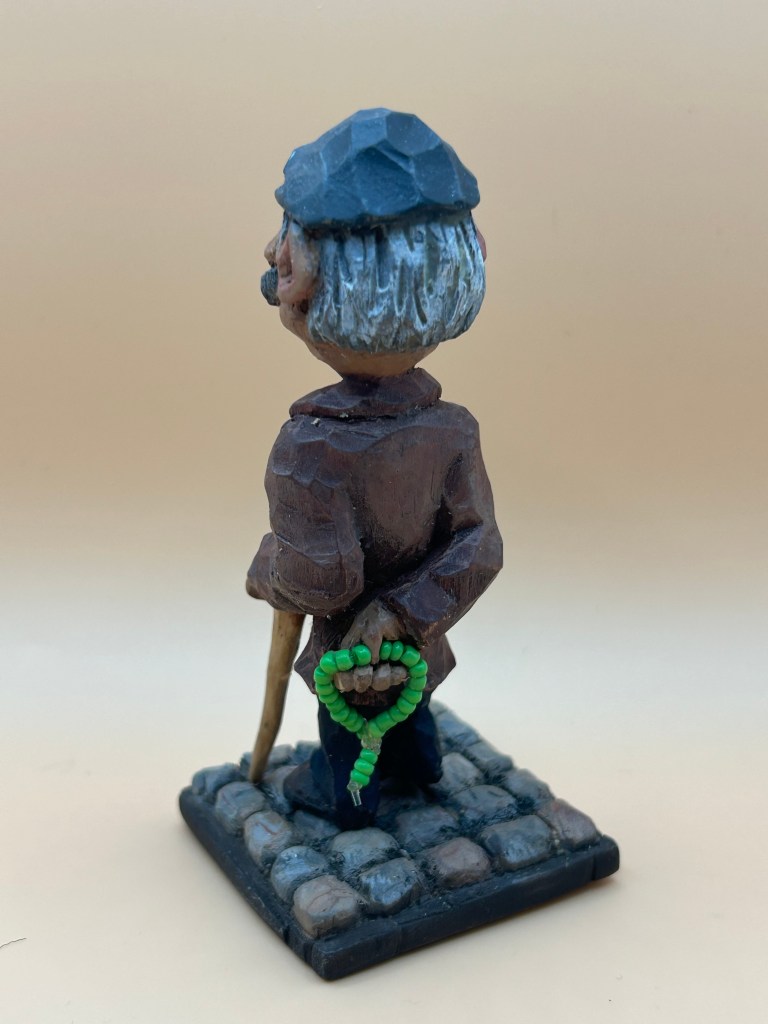
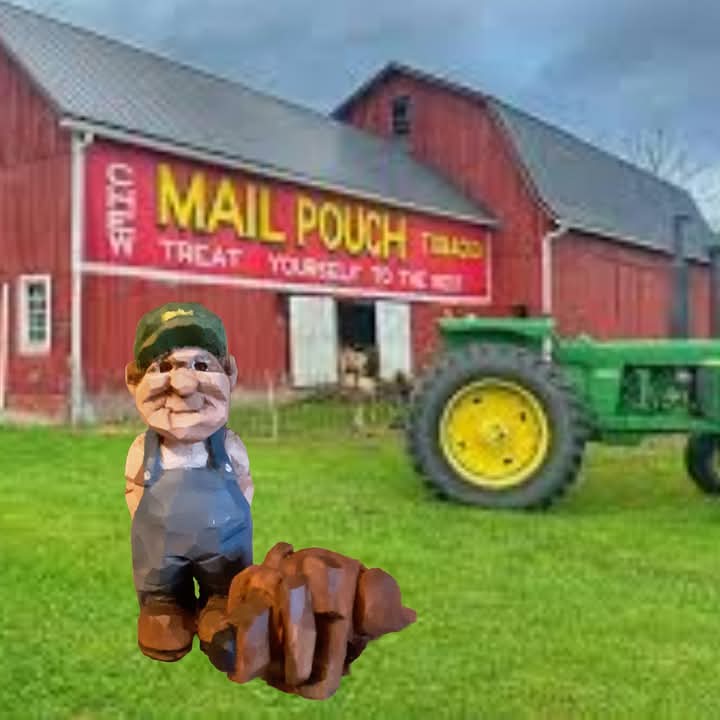
“I started out whittling Billy Bob I saw in Mike Shipley’s “Whittling Country Folk” and the more I whittled the more he started to look like a farmer I knew, named Danny. 

I added a hound that Gene Messer was so kind to share his pattern with me.”

Farmer Danny

Very nice work, Terry!  Thank you for the photo.

I got a last minute entry from my good friend Laura Jane Aungst.  Laura writes:

“Hey Bob 

Here is the leprechaun I just carved up.

Laura Jane Aungst” 

Laura’s Leprechaun

Nice job, Laura.  Thank you for the photo.  Always appreciated.

Safe Disposal Tip

If you use boiled linseed oil, polyurethane, stains, lacquers, or other varnishes on your wood carvings, their flammability hazard can be a problem.  Used paper towels and rags need to be disposed of properly and safely.

Whether you live in an apartment, condo, or even a house and just don’t feel like running outside to the trash, put the used materials into a Ziploc bag filled with a bit of water until you’re ready to throw them away outside.

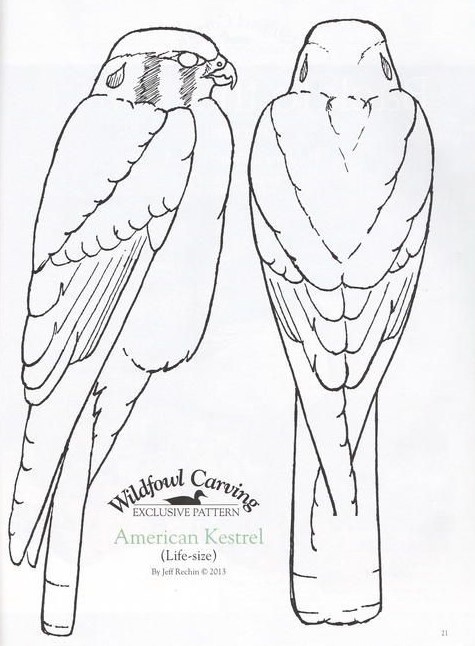
American Kestrel

 Teacher: Dave Stetson

Dates:    March 1,2,8,9,15,16 2025

Times:  Sat, Sun – 9:30am-11:30 Pacific /11:30am-01:30pm Central / 12:30pm – 2:30pm Eastern

12 hours (6 sessions – 2 hours each day)

Location: Online (Via Zoom)

For details and to sign up email Dave lcnmichele@aol.com

Contact Dave

Teacher: Janet Cordell

Dates: May 5, 9, 12, 16, 19, 23, 2025

Times: 2-4 p.m.   Pacific Time  //  3-5 p.m.  Mountain Time // 4-6 p.m.  Central Time // 5-7  p.m.  Eastern Time

12 hours ( 6 sessions – 2 hours each day) 

 Location: Online (Via Zoom)

Cost: $175 (includes one large roughout)

For details and to sign up email Janet  janet_cordell@yahoo.com

Contact Janet

Online Classes With Chris Hammack

Teacher: Chris Hammack 

Chris Hammack is offering a new series of online classes to help students learn and sharpen their woodcarving skills.  Individual and Group Classes are available through his web site chrisham, mackart.com/groupclass

Twhitling Tuesdays

Teacher: Dwayne Gosnell  

Dates: Two – 2 hour classes each month on Tuesdays

Location: Online (Via Zoom)

To sign up contact Dwayne Gosnell via email dagwood_76@gmail.com

Woodcarving Academy

Established in 2020, the Woodcarving Academy offers dozens of videos and seminars created by some of the country’s top level instructors.  More videos are added regularly as they are created by the instructors.

With a paid subscription to the Woodcarving Academy you can view any videos you like for as many times as you like.

Subscription rates:  Monthly = $19.95   Quarterly = $49.95   Annual = $139.95

There is even a Free level which allows you to tour the website and watch the sample videos and content, and receive email updates as new content becomes available.

Check out the Woodcarving Academy and learn with the masters right in the comfort of your own home!  Go to: www.woodcarvingacademy.com or Email: support@woodcarvingacademy.com

Some timely show information from my good friend, Jim Carlson from Boone, Iowa:

“Hi Bob, 

For anyone who is looking for some great in-person classes in combination with a competition and show, plus some great vendors, I would like to recommend the International Woodcarvers Congress. A wide variety of classes are available from one day to five days. Living in Iowa, I am fortunate to be within 3 hours of the quaint small town of Macquoketa, but instructors and students attend in June every year from all around the USA. If you have any room, I will attach some information and registration forms for the Congress.

Jim Carlson

Boone, Iowa”

Cottonwood Bark Class

The Pennsylvania Delaware Valley Woodcarvers will be hosting Cottonwood Bark Carver Harold Kaltenbachon May 3rd and 4th in Suburban Philadelphia. If interested, contact Wade Huggins at 215-531-0238.

The International Association of Woodcarvers has upcoming Zoom meetings on the following Saturdays at 3PM EST with special guest presenters.  Check them out…

Zoom:  310-460-3575

Presentation Schedule:

3/8 – Rod Gatlin

3/15 – Lancaster, PA Show (Live)

3/22 – Mike Bloomquist

INTERNATIONAL ASSOCIATION OF WOODCARVERS

COME JOIN US!!!

The Jersey Hills Wood Carvers (JHWC) club is a small but growing group of wood carvers sharing their time, knowledge and joy of woodcarving.  The JHWC generally meets from 7:00 PM EST to 9:00 PM EST on the 1st, 3rd and 5th Thursday of each month (when school is in session) at the Jefferson Township High School wood shop classroom.

Membership is “FREE” and open to anyone interested in woodcarving regardless of their ability.

JHWC’s Upcoming Meetings and Events

2025

March – 20th

April – 3rd, 24th

May – 1st, 15th, 29th

June – 5th

For more information contact:

Al Santucci  alsantucci4@gmail.com  President

Bill Brunner  billbrunnerdesign@gmail.com  newsletter/website editor

Or visit:

Website:  https://www.jerseyhillswoodcarver.com/

Facebook:  https://www.facebook.com/groups/736479646821641/

5 Fast Questions

I encourage everyone to check out the new podcast series called “5 Fast Questions”, by Uncle Jack Carves (Jack Loring).  In this series Jack presents a short (15 minute) interview with various (prominent) wood carvers where he asks 5 questions.  These interviews are a great way to learn something about these carvers that you probably never knew.  Go to Uncle Jack Carves and click on the “Live” tab.  Thank you, Jack, for creating such an enlightening feature.

AML Wood Carving Knives

AML Wood Carving Knives are handmade by Andy Loughlin in Monroe, New York.

Each blade is meticulously crafted from 1095 high-carbon steel, ensuring easy sharpening and long-lasting edge retention. The diverse exotic woods used for the handle styles are sourced from around the world, adding a touch of elegance to these knives. You can find these exceptional knives for auction on eBay under ‘AML Knives,’  with bidding usually starting at $22 and most knives selling for between $40 and $100.

Unpack your AML Wood Carving Knife and experience its razor-sharpness right out of the package. Each knife comes with a custom-made magnetic wooden sheath, a thoughtful addition at no extra cost.

I now own three AML Knives and can speak personally about their quality.  These are not production knives. Each knife is handmade by Andy himself.  The knives are sturdy, well made, and will stack up to any other knife on the market.  These knives have quickly become quite popular and sell out fast, so check the site (“AML Carving Knives” on EBAY) often for availability.

Andy has recently begun making knives with handles made from exotic woods and colored epoxy, creating some stunning and unique handle designs.  Below are examples of some knives currently available or which have recently sold:

Complimentary Knife Sheath

Six Reasons Why New Carvers Quit

Six Reasons Why New Carvers Quit

1. Using dull tools

          Working with dull tools is one of the most common mistakes new wood carvers make.  Using a dull carving tool can not only be frustrating, but it can also be dangerous.  Dull tools require more pressure to be applied to them, which can cause them to slip, resulting in a damaged project or, more importantly, severe injury to the wood carver.  Identifying a dull tool is relatively simple.  If the tool is not cutting well or if you have to apply excess pressure to it, then the tool is dull and requires attention.  Using dull tools is the quickest way to become frustrated and possibly give up.  Keep your carving tools sharp at all times with frequent stopping.

2. Using the wrong (hard to carve) type of wood

          Using the wrong type of wood is the second most common mistake new wood carvers make.  Basswood is probably the best and most popular wood for typical wood carving projects.  It is soft, easy to carve, and holds detail very well.  So many new woodcarvers pick up whatever piece of wood is available, only to eventually become frustrated with how poorly it carves.  Wood types such as pine, spruce, and poplar are not good choices as these woods have irregular grain configurations and often contain a lot of sap.

          That said, there are two different types of basswood: southern and northern.  Northern basswood tends to be soft and easy to carve because of the climates in the areas where these woods are grown, whereas southern basswood is hard and challenging.  Only carve northern basswood from a reputable supplier and avoid southern basswood often obtained in hobby and craft stores.

3. Starting with a complicated project

           When you want to climb a ladder, you must start at the bottom and work your way up.  Learn to crawl before you learn to walk.  It’s the same thing with woodcarving.  New carvers need to start with simple, uncomplicated projects and work up to carving more complex pieces as their skill level improves.  Beginning with a highly detailed project will often lead to frustration and failure.   

 4. Can’t see their progress

          Today, we live in a world of instant gratification.  Everyone wants to see results immediately.  Be patient when beginning your woodcarving journey.  It may take a little time, but trust me, you will see results.  My best advice here is to try to carve something every day, even if only for half an hour.  Like everything else, practice makes perfect; the more you carve, the faster you will see your progress.  However, be patient and take your time when you carve.  There are no prizes for being a fast carver; enjoy what you are doing.  Remember, like I always say, when it comes to woodcarving, “It’s about the journey, not the destination.”

5. Give up when they get stuck or make a mistake

           Many new carvers give up when they get stuck or make mistakes and need help figuring out what to do next.  Don’t quit; that’s the time to become creative and improvise.  For example, if you cut off a part of a mustache, change the style/shape or eliminate it altogether.  If you mess up on a hat, change the shape of the hat.  There’s nothing saying your carving has to look like the pattern you’re working from.  Change things around and make the carving your own.  Sometimes, it helps to set the carving aside and return to it later, and in the worst case, if you feel it can’t be corrected, toss it in the firewood box and start over.  Remember, it’s not the world’s end; it’s just a piece of wood. 

6. Don’t know where to get help

          Starting in woodcarving can be daunting.  There’s a lot more to woodcarving than meets the eye, and many new carvers don’t know where to start.  Fortunately, today, there are many resources new carvers can access to help get them started and keep them going along the way.  Thousands of woodcarving books have been written over the years by some of the world’s most accomplished carvers, which are excellent instructional tools, and nowadays, there are also videos for wood carvers to explore.  YouTube, for example, is loaded with free videos made by leading experts on almost every aspect of woodcarving imaginable.

Look to join a local woodcarving club.  Being a club member is one of the best ways to obtain personal advice and answer all your questions.

My good friend, Andy from Michigan wrote with a question about the Second Mate pattern I posted last month.  Andy writes:

“Greetings from Michigan! Thanks for the latest Wood Chip Chatter. On the second mate pattern, would this best be done as a corner carve or just straight on? I seem to have an issue with faces.

Regards,

Andy”

Hi Andy,

I provided a front and side view of the Second Mate, if you have a means (band saw) to do it. cut out both views.  That will greatly help you get started on the face.  If not, I suggest you work this pattern from the flat side.  I hope this helps. 

My very good friend, Eric Owens from Boise, Idaho sent in some photos of two excellent carvings he recently finished.  Eric Writes:

“Hey, Bob, Eric Owens here. I apologize for not sending submissions of photos and information. I will make a commitment to sending things on a regular basis..

The first picture  I attached is a blacksmith I carved this year.It is made of several pieces, with a separate head, hammer, horseshoes, anvil and stand. He was a lot of fun to carve,

The 2nd picture is a cowboy I donated to our annual show, the Idaho Artistry in Wood. He drew a lot of attention. On the body is a separate head, rope and branding iron. Attaching pieces to a body can be quite tricky, but can draw a lot of interest from those who want to carve one or buy one. He had a good expression on his face that looks like a lot of stories and memories.

Thanks. I will try to send some tips and tricks I use, as well as just carving information for others to read. I get really busy during some parts of the year, due to shows, classes and commissions, so you might need to prod me for a submission, 

Thanks for all you do! You are awesome!”

Thanks, Eric!  I would greatly appreciate that, it’s just the kind of thing I was hoping for when I started this blog.  Your input will be a tremendous help to me and a benefit to others.  Your cowboys are fantastic!

My good friend, Jim Carlson from Boone, Iowa sent in an excellent tip in response to last month’s article on band saw safety.  Jim writes:

“Hi Bob,

I appreciated your January comments on band saw safety. One of the best safety investments I have made is this $12 foot control for my band saw. With it, I can keep a firm grip on my wood piece with both hands from before the blade starts until after it stops. And if I need to stop and back out the blade, I can maintain control without having to take one hand off to flip a switch on the saw. 

Jim Carlson 

Iowa”

That’s a great idea, Jim!  Thanks for sharing.

I received the following question from an unknown reader wanting to know about drying time for walnut oil:

“Hi Bob,

If I were to use refined walnut oil to season a wooden mug, how long should I let it cure before using it?”

I worry about using refined oils on food-grade items. Generally, when oils are refined, other ingredients (some potentially toxic) are added. Try to find an oil that has been made through a natural process.

Oil drying times will always vary with the air’s humidity. The higher the humidity, the longer the drying time.

“Photo Shop” is the section of Wood Chip Chatter where carvers can send in photos of their wood carvings for display. It’s your chance to show off your work…sort of a show and tell. The photos will only be displayed and no comments or critiques will be made.  For critiques on your carvings send them in to the “Carver’s Corner.”  Send your photos to: carverbobk@woodchipchatter.com

My good friend, Wayne Arrowsmith sent in some photos of the great Santas he carved and his family members painted.  Wayne writes:
 
"Hi Bob,
 For the past 10 or 12 years I have carved a few Christmas ornaments or figures and invited my children to paint the carvings. The group has grown over the years to include their partners, a few close friends and this year my sister. It is one of my favourite days of the year and it’s  a joy to watch everyone paint a carving which they can then take home to enjoy. Here’s a few from this years group. The carving pattern is from Sean Cipa’s book. 
I really enjoy your newsletter each month! Thank you!!"

That’s some great work there, Wayne!  I can see there’s a lot of artistic talent in your family, and what a terrific annual tradition you have.

My good friend Shannon Coker sent in a photo of a Christmas Moon she recently finished:

“This was a project I completed. Van Kelly inspired pattern 

Shannon”

Shannon’s Christmas Moon

Thank you for the photo, Shannon!  Very nice work.

Add Wrinkles for Realism

Clothing wrinkles add realism to your carvings.  Try to add wrinkles to your carvings for a more realistic look.  Use various sized gouges along with your carving knife to make cuts that go in different directions to simulate clothing wrinkles.  Study pictures or actual clothing for guidance on how it drapes and wrinkles on the body as it moves, twists and turns.  There are also some excellent artist’s books on clothing drapery and wrinkles you may want to consider purchasing for reference.

Generic pattern from Ryan Olsen

Teacher: Dale Green

Dates:  February 1,2,8,9  2025

Saturday & Sunday both weekends 9:30 am-11:30 Pacific / 10:30 am – 12:30 pm Mountain /
11:30 am- 1:30 pm Central / 12:30 pm – 2:30 pm Eastern

8 hours ( 4 sessions – 2 hours each day) 

 Location: Online (Via Zoom)

Contact Dale: dalecarves@gmail.com

Sign up on Dale’s website

 Teacher: Dwayne Gosnell

Feb 4,18  – 6PM Eastern

Twiitling Tuesday – 4 hours ( 2 sessions – 2 hours each day) 

 Location: Online (Via Zoom)

2.5×3.5×7.25 basswood block needed for pattern

For details and to sign up  click on Dwayne’s website https://www.dgosnellwoodcarving.com/

Dwayne’s website

 Teacher: Dave Stetson

Dates:    March 1,2,8,9,15,16 2025

Times:  Sat, Sun – 9:30am-11:30 Pacific /11:30am-01:30pm Central / 12:30pm – 2:30pm Eastern

12 hours (6 sessions – 2 hours each day)

Location: Online (Via Zoom)

For details and to sign up email Dave lcnmichele@aol.com

Contact Dave

Online Classes With Chris Hammack

Teacher: Chris Hammack 

Chris Hammack is offering a new series of online classes to help students learn and sharpen their woodcarving skills.  Individual and Group Classes are available through his web site chrishammackart.com/groupclass

Twhitling Tuesdays

Teacher: Dwayne Gosnell  

Dates: Two – 2 hour classes each month on Tuesdays

Location: Online (Via Zoom)

To sign up contact Dwayne Gosnell via email dagwood_76@gmail.com

Woodcarving Academy

Established in 2020, the Woodcarving Academy offers dozens of videos and seminars created by some of the country’s top level instructors.  More videos are added regularly as they are created by the instructors.

With a paid subscription to the Woodcarving Academy you can view any videos you like for as many times as you like.

Subscription rates:  Monthly = $19.95   Quarterly = $49.95   Annual = $139.95

There is even a Free level which allows you to tour the website and watch the sample videos and content, and receive email updates as new content becomes available.

Check out the Woodcarving Academy and learn with the masters right in the comfort of your own home!  Go to: www.woodcarvingacademy.com or Email: support@woodcarvingacademy.com

Some timely show information from my good friend, Jim Carlson from Boone, Iowa:

“Hi Bob, 

For anyone who is looking for some great in-person classes in combination with a competition and show, plus some great vendors, I would like to recommend the International Woodcarvers Congress. A wide variety of classes are available from one day to five days. Living in Iowa, I am fortunate to be within 3 hours of the quaint small town of Macquoketa, but instructors and students attend in June every year from all around the USA. If you have any room, I will attach some information and registration forms for the Congress.

Jim Carlson

Boone, Iowa”

The International Association of Woodcarvers has upcoming Zoom meetings on the following Saturdays at 3PM EST with special guest presenters.  Check them out…

Zoom:  310-460-3575

Presentation Schedule:

2/8 – Off

2/15 – Mike Pounders

2/22 – Bruce Ankeny

3/1 – Josh Walters

3/8 – Rod Gatlin

3/15 – Lancaster, PA Show

INTERNATIONAL ASSOCIATION OF WOODCARVERS

COME JOIN US!!!

The Jersey Hills Wood Carvers (JHWC) club is a small but growing group of wood carvers sharing their time, knowledge and joy of woodcarving.  The JHWC generally meets from 7:00 PM EST to 9:00 PM EST on the 1st, 3rd and 5th Thursday of each month (when school is in session) at the Jefferson Township High School wood shop classroom.

Membership is “FREE” and open to anyone interested in woodcarving regardless of their ability.

JHWC’s Upcoming Meetings and Events

2025

February – 20th

March – 6th, 20th

April – 3rd, 24th

May – 1st, 15th, 29th

June – 5th

For more information contact:

Al Santucci  alsantucci4@gmail.com  President

Bill Brunner  billbrunnerdesign@gmail.com  newsletter/website editor

Or visit:

Website:  https://www.jerseyhillswoodcarver.com/

Facebook:  https://www.facebook.com/groups/736479646821641/

Complimentary Knife Sheath

A big Thank You to everyone who contributed to this newsletter!

Band Saw Safety and Repairs

Band Saw Safety

Twelve tips to help make working with your band saw safer

1. Make all adjustments while the saw is at rest.  Set the saw guide so that it is about 1/4″ above the work.

2. People who might be watching the work should not be allowed to stand at the right of the saw.  In case of a broken blade this is the only direction in which the blade can escape the guards covering the wheels.

3. Avoid backing out of a cut as you may pull the blade off the wheels.  Turn and saw out through the waste wood, or stop the machine.

4. Do not saw cylindrical stock, as it may roll as the saw bites into the wood.

5. Pieces to be cut should always lie flat on the table.

6. A rhythmic click with impact on the wood may indicate a cracked blade.  Cut the switch, and stand back until the saw stops, then inspect for breaks.

7. If the blade breaks, shut off the power and stay away until the coasting wheels stop.  Do not attempt to handle any part of the blade while the wheels are still in motion.

8. Do not operate with the arm or fingers across the line of the saw.

9. Use a narrow blade for a short radius and wider blades for heavier work.

10. If help is required to handle a long board, the help should be instructed to support the weight only.  The operator does all the pushing and guiding of the work. 

11. Never pull work through the saw.

12. Always wear gloves when handling a saw blade.  Carving gloves work well.

Bandsaw Repairs

The “tires” on bandsaw wheels can be critical for proper tracking. Have you changed them in recent years? There should be a slight crown to the tire which draws the blade toward the center of the crown. If you back off all the blade guides (side blocks, backing wheels) so that there is no contact with the blade, the blade should track near the center of both wheels. If not, you have an alignment problem. If the blade tracks okay, you may need to adjust the guides better.

The tires should fit snuggly on the wheels. Mine wore out a couple of months ago and I couldn’t keep the blades or tires properly on the wheels. Start by loosening the blocks or guides that contact the sides of the blade. Should be a pair for the top and a pair for the bottom. Then there is a bearing that is behind the blade on top and one on the bottom. Loosen all these and then place the blade back on the wheels and tighten it up just enough to keep it in place., The top wheel should have an adjustment on the side, that moves the bottom of that wheel in/out which is what adjusts the tracking of the blade. Moving the bottom of that wheel in one direction should make the blade move toward the inside of the wheel and vice versa. Turn the wheels by hand until you can get it to ride in the center. then try it momentarily with the power on and see if it tracks ok. If all that works, then you can start by tightening the blade until it doesn’t flutter. Then you adjust the different blocks/bearings so that the blade tracks properly through the cuts. If you still can’t get it to track properly, then check and see if there is any damage to the mountings for the wheels. It is recommended to release tension on the blades when they are not being used. Leaving them under tension can cause tires to get out of round and even broke one of the castings holding my upper wheel in place! Hope this helps!

One would think the start would be to open the cover (as you did to change the blade), then place a straight edge (yard stick?) across the edges of the wheels. Maybe not! I just did that on my 12″ Craftsman (that presently tracks fine). and the wheels are NOT aligned. So much for logic! Somewhere (perhaps on the back side) is a screw that adjusts to camber (the angle of the upper wheel relative to the machine). I would start by adjusting the camber until the blade will stay on while turning the wheels by hand. Then try power and adjust the camber until the blade tracks near the center of the upper wheel. All guides should be out of the way during this process.

The camber adjustment for the upper wheel is a setscrew with locknut in the hub. Loosen the locknut with a wrench, then you can turn the setscrew to change the camber of the wheel. When it tracks fairly well, tighten the locknut.

My good friend, Connie Teeters wrote to let everyone know about the show her carving club is holding this month:

“I do love wood chip chatter. Would like to let you all know that Friends Carving Club in Port Orange Florida is having a show on January the 12th. 2025. Come and join us.

Connie Teeters”

Thank you, Connie!  Best of luck with the show!

“Photo Shop” is the section of Wood Chip Chatter where carvers can send photos of their wood carvings for display. It’s your chance to show off your work…sort of a show and tell. The photos will only be displayed, and no comments or critiques will be made.  For critiques on your carvings, send them to the “Carver’s Corner.”  Send your photos to carverbobk@woodchipchatter.com

My friend, Jim Wiggins sent in a photo of a carving he calls “Cats Christmas.”

Jim’s Cat’s Christmas

Thank you for the photo, Jim!  Very well done carving.

My good friend, Jim Babcock from Columbus, Indiana sent in two photos of a wizard he recently carved:

“Bob:

Best wishes for the new year.  Attached is a recent carving of a wizard; northern basswood, finished in walnut oil and acrylics.

Jim Babcock

Columbus, Indiana”

Very nice work, Jim!  Thanks for sharing!

Join a Carving Club

Joining a wood carving club is one of the best and quickest way to advance your carving skills.  Just by associating with other wood carvers and watching what they do you will gain a wealth of knowledge.  Ask questions and see how other carvers solve the same problems you may be up against.  Share your wood carvings with other members of the club.  Their feedback will be invaluable.  Wood carvers are always willing to help other wood carvers.  To find a club start by Googling “wood carving clubs in your area.”

Joining club Zoom meetings is another great way to pick up tips and tricks of the trade.  Many wood carving clubs are now conducting club Zoom meetings which are usually open to anyone who wants to join in (you don’t have to be a club member).  The Lancaster County Wood Carvers conduct such a Zoom meeting on the second Tuesday of every month at 7pm EST (Zoom: 417-966-8402) .  Probably the largest one is the International Association of Wood Carvers Zoom meeting held every Saturday at 3pm EST (Zoom: 310-460-3575).  I highly recommend looking into both of these meetings.  They are particularly advantageous because you never have to leave your home to attend the meeting.

Join a wood carving forum.  Forums are yet other useful sources to socialize with other carvers and pick up wood carving information.  Forums are ongoing conversations with some very knowledgeable carvers about anything wood carving related you want to discuss.  A good one to join is the Woodcarving Illustrated forum which you can access by just going to www.woodcarvingillustrated.com and searching “Forums.”  Highly recommended.

Teacher: Janet Cordell

Dates: January  6,10,13,17,20,24     2025

Times: 2-4 p.m.   Pacific Time  //  3-5 p.m.  Mountain Time // 4-6 p.m.  Central Time // 5-7  p.m.  Eastern Time

12 hours ( 6 sessions – 2 hours each day) 

 Location: Online (Via Zoom)

to sign up contact Janet Cordell janet_cordell@yahoo.com

Teacher: Dwayne Gosnell

January 7,21 – 6PM Eastern

Twiitling Tuesday – 4 hours ( 2 sessions – 2 hours each day) 

 Location: Online (Via Zoom)

2.5×2.5×7.25 basswood block needed for pattern

For details and to sign up  click on Dwayne’s website https://www.dgosnellwoodcarving.com/

Dwayne’s website

Teacher: Ryan Olsen

Dates: January 11,12,18,19 (PM Sessions) 2025

Time: Sat, Sun – 1:30pm-3:30 Pacific /3:30pm-05:30pm Central / 4:30pm – 6:30pm Eastern

8 hours ( 4 sessions – 2 hours each day)

To sign up Contact Ryan Olsen ryanscaricatures@gmail.com

Contact Ryan

Teacher: Dale Green

Dates:  February 1,2,8,9  2025

Saturday & Sunday both weekends 9:30 am-11:30 Pacific / 10:30 am – 12:30 pm Mountain /
11:30 am- 1:30 pm Central / 12:30 pm – 2:30 pm Eastern

8 hours ( 4 sessions – 2 hours each day) 

 Location: Online (Via Zoom)

Contact Dale: dalecarves@gmail.com

Sign up on Dale’s website

 Teacher: Dwayne Gosnell

Feb 4,18  – 6PM Eastern

Twiitling Tuesday – 4 hours ( 2 sessions – 2 hours each day) 

 Location: Online (Via Zoom)

2.5×3.5×7.25 basswood block needed for pattern

For details and to sign up  click on Dwayne’s website https://www.dgosnellwoodcarving.com/

Dwayne’s website

 Teacher: Dave Stetson

Dates:    March 1,2,8,9,15,16 2025

Times:  Sat, Sun – 9:30am-11:30 Pacific /11:30am-01:30pm Central / 12:30pm – 2:30pm Eastern

12 hours (6 sessions – 2 hours each day)

Location: Online (Via Zoom)

For details and to sign up email Dave lcnmichele@aol.com

Contact Dave

Online Classes With Chris Hammack

Teacher: Chris Hammack 

Chris Hammack is offering a new series of online classes to help students learn and sharpen their woodcarving skills.  Individual and Group Classes are available through his web site chrishammackart.com/groupclass

Twhitling Tuesdays

Teacher: Dwayne Gosnell  

Dates: Two – 2 hour classes each month on Tuesdays

Location: Online (Via Zoom)

To sign up contact Dwayne Gosnell via email dagwood_76@gmail.com

Woodcarving Academy

Established in 2020, the Woodcarving Academy offers dozens of videos and seminars created by some of the country’s top level instructors.  More videos are added regularly as they are created by the instructors.

With a paid subscription to the Woodcarving Academy you can view any videos you like for as many times as you like.

Subscription rates:  Monthly = $19.95   Quarterly = $49.95   Annual = $139.95

There is even a Free level which allows you to tour the website and watch the sample videos and content, and receive email updates as new content becomes available.

Check out the Woodcarving Academy and learn with the masters right in the comfort of your own home!  Go to: www.woodcarvingacademy.com or Email: support@woodcarvingacademy.com

The Jersey Hills Wood Carvers (JHWC) club is a small but growing group of wood carvers sharing their time, knowledge and joy of woodcarving.  The JHWC generally meets from 7:00 PM EST to 9:00 PM EST on the 1st, 3rd and 5th Thursday of each month (when school is in session) at the Jefferson Township High School wood shop classroom.

Membership is “FREE” and open to anyone interested in woodcarving regardless of their ability.

JHWC’s Upcoming Meetings and Events

2025

January – 16th, 30th

February – 6th, 20th

March – 6th, 20th

April – 3rd, 24th

May – 1st, 15th, 29th

June – 5th

For more information contact:

Al Santucci  alsantucci4@gmail.com  President

Bill Brunner  billbrunnerdesign@gmail.com  newsletter/website editor

Or visit:

Website:  https://www.jerseyhillswoodcarver.com/

Facebook:  https://www.facebook.com/groups/736479646821641/

Complimentary Knife Sheath

Concerned

Reader’s contributions to Wood Chip Chatter are vital to making it the blog it is, and I can’t continue to maintain its high quality without your support.  There are over 1,100 subscribers to Wood Chip Chatter, worldwide, yet I struggle every month to find content for its pages.

Your questions and comments help to keep this blog active and going!  Effective discussions are one of the best ways to learn about the topics that interest you.  Remember, there’s no such thing as a dumb question.  Plus we would all love to know about the unique tips, techniques, and products YOU use in your wood carving process. 

More photo contributions are also needed for the “Carver’s Corner” and “Photo Shop” sections.  My “Carver’s Corner” is a great way to get constructive critiques on your carvings so you can learn where to improve on your next ones, and I’m sure you all have some terrific carvings to share in my “Photo Shop” section.  Photos of your carvings liven up the blog’s appearance and make it more interesting. 

Please send your questions, comments, and photos to carverbobk@woodchipchatter.com.  They are always greatly appreciated.

Five Best Oil Finishes

Five Best Oil Finishes

Oil finishes are commonly used on wood furniture and kitchen utensils. Generally speaking, oil finishes are eco-friendly, food-safe, and non-toxic. They’re also easy to repair and produce a more textured grain pattern than many alternatives. They tend to be considered a more traditional finish, as oils have been used as wood finishes for thousands of years.

However, oil finishes generally don’t offer the same level of protection and durability that you’d find with a lacquer or varnish.

Here are five of the most commonly used oil finishes:

1. Linseed Oil

Linseed oil, also known as flaxseed oil, is one of the most popular wood finishes in the world. Like other hand-rubbed oil finishes, linseed oil saturates deep into the wood grain to protect against scratches and changes in humidity. It is easy to care for, eco-friendly, and produces a satin finish that really brings out the color and grain of the wood underneath.

Raw, polymerized, and boiled linseed oil are all derived from the flaxseed plant, but have been processed differently and to varying degrees. Raw linseed oil is the purest form, but is sometimes impractical as a furniture finish due to the extended drying times- it can take several weeks for each coat of raw linseed oil to cure. Boiled linseed oil is common as a wood finish, but contains some potentially hazardous drying compounds. Polymerized linseed oil is the best of both worlds: pure and non-toxic with quick drying times.

2. Tung Oil

Tung oil is a plant-based oil used as a wood finish. It is clear, quick-drying, and penetrates the grain to enhance and protect the wood. It’s one of the oldest and most popular wood finishes in the world and is derived from the seeds of the tung tree in Eastern Asia. Tung oil has become a staple among fine furniture craftsmen in the United States and beyond. It is eco-friendly, non-toxic, and food-safe.

Tung oil is derived from pressing the seeds of the tung tree, which is native to Eastern Asia. The oil has been cultivated and used in China as a wood finish for at least 2,500 years.

Similarly to linseed oil, it is difficult to find furniture that is made with raw or 100% pure tung oil. Many craftsmen will use boiled or polymerized tung oil, and it’s also common for manufacturers to mislabel products as tung oil when they’re not. If you’re interested in a tung oil finish, it’s worth doing a bit of digging to understand exactly what finish is being used and what it’s comprised of. You can find pure tung oil from Real Milk Paint.

There are many reasons a craftsman might consider using tung oil to finish wood furniture. It’s all natural, non-toxic, and eco-friendly, and it doesn’t yellow as much over time as common finishes like linseed oil, nitrocellulose lacquer, or varnishes like polyurethane.

3. Mineral Oil

Mineral oil is a broadly used term to describe a clear, odorless oil. Most often, mineral oil refers to a derivative of petroleum. Despite this, mineral oil is generally seen as non-toxic and food safe. In fact, it’s especially common on cutting boards, wood kitchen utensils, wood bowls, and any other wood products that frequently come into contact with food. It’s also a common ingredient in baby oil, as it’s been tested and approved for dermatological use.

Although mineral oil is non-toxic and food safe, it is not used often as a finish for wood furniture, as other oils on this list offer more desirable traits.

4. Walnut Oil

Walnut oil is derived from the nuts of the juglans regia tree, a relative of juglans nigra (which produces the black walnut wood used in our furniture). Walnut oil, like mineral oil, is often used on cutting boards and kitchen utensils due to it’s food-safe properties. Raw walnut oil, like linseed oil and tung oil, possesses a fairly long drying time, so it’s not uncommon for walnut oil to be cut with mineral spirits (boiling) or heated (polymerized) to speed up the time it takes for the oil to cure.

5. Danish Oil

Danish oil is a super common finish among woodworkers, although it isn’t clearly defined. Similarly to mineral oil, the term Danish oil can apply to many different substances. In fact, the ambiguity with danish oil is even more severe. The term “Danish Oil” is basically a catch all term for any oil-based wood finish.

Danish oil often contains tung oil or linseed oil along with several other ingredients– thickeners, thinners, drying agents, binding compounds, and more. Usually, dDanish oil is a super common finish among woodworkers, although it isn’t clearly defined. Similarly to mineral oil, the term Danish oil can apply to many different substances. In fact, the ambiguity with Danish oil is even more severe. The term “Danish Oil” is basically a catch all term for any oil-based wood finish.

Danish oil often contains tung oil or linseed oil along with several other ingredients– thickeners, thinners, drying agents, binding compounds, and more. Usually, Danish oil finishes are a mixture of some type of varnish with either tung oil or linseed oil, but not always.

For example, Tried & True sells a polymerized linseed oil under the trade name of “Danish Oil.” 

Source: Vermont Woods Studios

My first comment comes from my very good friend, Jim Babcock from Columbus, Indiana.  Jim is trying to find information on a carving he has had for many years.  Jim writes:

“Bob:

Just looked at your latest blog and as always, both interesting and helpful.  Also enjoy

seeing what some of the other carvers are doing.

I am attaching an image of a carving that I did not carve or paint, but wish i could say I did.

Have had it for 20 – 25 years .  It’s about 3 1/2 inches long and has no markings or date on it.

From what I have been able to research, It seemed to be done in the Zapotec  tradition style.

The paint detail, especially on a carving this small, continues to amaze me.

Any thoughts or information you or other bloggers can shed on this would be much appreciated.

Jim Babcock

Columbus, Indiana”

That’s a very interesting carving, Jim, and the painting is what makes it special.  At first glance it reminds me of a Scandinavian style carving, but that’s about all I can say.  Perhaps some of our readers can tell us more about it.  Can anyone help?

Next is a comment from my very good friend, Jon Gledhill who enjoyed my latest book review.  Jon writes:

“Thank you for the book review!

I’m excited to order my copy after reading your comments.

These compilations of projects of various carving levels and different projects (e.i., not just all Santas) is the type of books I enjoy collecting.

Happy Holidays! Jon Gledhill”

I‘m glad you liked my book review, Jon.  The How-To Book of Christmas Carving is an excellent book with loads of fun Christmas carving projects.  You will be glad you ordered it.

My very good friend, who prefers to remain nameless sent in an excellent suggestion this month.  It’s in regards to something I have often wondered about.  He writes:

“Bob, 

As always, I can tell you I enjoyed reading through the current Wood Chip Chatter.  In the past you have asked me if I had any suggestions, and I think I now have two.  

First, after seeing the Santa’s carved by Todd Martin, I am left wondering how big they are.  My instinct tells me they might be carved from one inch stock.  Awesome.  As you and many others know, I am very much at home with one inch stock.  My point here is, perhaps you could add a dimension or two so readers can equate the size of the carvings.  Just how large is that nicely carved Dogwood flower?

I love what you are doing, Bob.  Keep up the great work promoting carving.

P.S.  I’m thinking about putting together a basic primer on getting started carving figures.  Kind of how I started myself.  Maybe it will help some get started doing what I love with those huge one inch blocks.  I’ll keep you updated on how it goes.”

Thanks for the suggestion, my friend!  I agree, it’s very difficult to tell the size of a carving just from the photo.  In the future, it will be helpful if we all add the size and/or dimension of the carving in our photos.

The primer you mentioned sounds like it will be quite helpful.  I’m anxious to see what you come up with and certainly welcome any contribution(s) you may have.

Cathy, a new subscriber who is also new to wood carving wrote in asking for some recommendations on tools for beginners.  Here is what she had to say:

“Hello, I just joined. I have two knives that I bought at a gun/knife shop in TN. Two basic wood carving tools. One cuts at a V and the other, I suppose, is a gouge. Both are fairly large being as they are for beginners. Do you have a suggestion on what tools I could buy as a beginner?

Thank you!

Cathy”

Hi Cathy, Thank you for writing and welcome to the world of woodcarving. There’s a lot to learn and I want you to get off on the right foot. If you would send me an email at rwkoz51@gmail.com I can send you a list of essential items you should get first, and I can also answer any other questions you might have. 

My good friend, Jon Gledhill was kind enough to assemble a series of photos illustrating the various staining methods he uses on his chip carving projects.  Here is his explanation:

“Hello Bob!

Back in April, you shared the photo of a stain sample board I had sent, and you invited me to share some additional information about finishing projects with stain.  Sorry it’s taken so long, but I’ve never forgotten the invitation.

Here are photos of a commissioned project I just completed, making (10) 3″x3″ fridge magnets for a customer.  It was a perfect time to try various finishes on the extra pieces I’d carved. If additional information would be helpful, please let me know.

Each of these pieces was sprayed once with a lacquer sealer to prep them for finishing.

The three that have a lighter surface and darker pattern show the difference between one, two, and three coats of Lacquer Matte spray finish, applied before adding stain to them.  I brushed Mahogany Gel Stain onto each one, then quickly wiped off the surface, leaving the stain in the carved pattern. You can see a significant difference between the one that only has one coat of finish and the others, but have to look a bit closer to see the difference between the other two.

The fourth piece was finished a different way, but used the same Mahogany Gel Stain. After spraying it with sealer, I use a brayer (rubber roller used in printmaking) to apply a thin coat of stain to the piece, which still allows the grain to show through, but adds a dark finish to the surface, allowing the carving to stand out a different way. This was the finish used on the 10 fridge magnets.

Thanks for the opportunity to share some of my carving journey!

Best wishes, 

Jon Gledhill”

Thanks for the photos and excellent explanation of your staining methods, Jon.  Contributions as such are very educational, and I’m certain the majority of my readers greatly appreciate your efforts.  I welcome everyone to ask Jon any questions you may have.  I’m sure he is more than happy to discuss his methods further.

“Photo Shop” is the section of Wood Chip Chatter where carvers can send photos of their wood carvings for display. It’s your chance to show off your work…sort of a show and tell. The photos will only be displayed, and no comments or critiques will be made.  For critiques on your carvings, send them to the “Carver’s Corner.”  Send your photos to carverbobk@woodchipchatter.com

My very good friend, Dean Stewart came up with a clever way to display his ornaments and wanted to share it with everyone:

“Bob,

I wanted to share my Santa ornament tree with your readers.  This simple structure gave me a way to display my favorite Santa carvings.  It doesn’t take up a lot of space either.  It’s made of a 24” 1×2, with slates made from an old crate.  I’ve also used yardsticks for these.  (You can find them at Home Depot).  They range in size from 18” to 12”.  The base is a piece of pine 8×8 routed for a nice edge.  I wanted to paint it, but my wife thought it looked good natural. 

Dean”

Dean’s Display Tree

Thanks, Dean!  It looks terrific, and so do your ornaments!  Thanks for sharing!

Carving Wrinkles

It’s easy to forget to add small details that can enhance the finished look of your caricature carvings—such as wrinkles and folds in clothing.

Use small gouges and V-tools along with your knife to create different kinds of wrinkles.

When carving wrinkles into clothing, focus on areas where fabric naturally bunches or folds. Some great places to add wrinkles are around joints—such as the elbows, knees, and armpits—where normal fabric tends to compress during movement.

You can also carve slight folds at the waistline, especially if your caricature carving is bending or twisting. Adding a few wrinkles around the neck and shoulders can give the appearance of loose or layered clothing.

Shoes or boots can also “pop” with small creases near the ankles.

Google stock photo images of people in various clothes for more inspiration!

Source: carvingjunkies.com

 Teacher: Dwayne Gosnell

Dates:   December 10 (Tues),23(Mon) – 6PM Eastern

Twiitling Tuesday – 4 hours ( 2 sessions – 2 hours each day) 

 Location: Online (Via Zoom)

For details and to sign up  click on Dwayn’s website https://www.dgosnellwoodcarving.com/

Dwayne’s website

Teacher: Janet Cordell

Dates: January  6,10,13,17,20,24     2025

Times: 2-4 p.m.   Pacific Time  //  3-5 p.m.  Mountain Time // 4-6 p.m.  Central Time // 5-7  p.m.  Eastern Time

12 hours ( 6 sessions – 2 hours each day) 

 Location: Online (Via Zoom)

to sign up contact Janet Cordell janet_cordell@yahoo.com


Teacher: Ryan Olsen

Dates: January 11,12,18,19 (PM Sessions) 2025

Time: Sat, Sun – 1:30pm-3:30 Pacific /3:30pm-05:30pm Central / 4:30pm – 6:30pm Eastern

8 hours ( 4 sessions – 2 hours each day)

To sign up Contact Ryan Olsen ryanscaricatures@gmail.com

Contact Ryan

Teacher: Dale Green

Dates:  February 1,2,8,9  2025

Saturday & Sunday both weekends 9:30 am-11:30 Pacific / 10:30 am – 12:30 pm Mountain /
11:30 am- 1:30 pm Central / 12:30 pm – 2:30 pm Eastern

8 hours ( 4 sessions – 2 hours each day) 

 Location: Online (Via Zoom)

Contact Dale: dalecarves@gmail.com

Sign up on Dale’s website


Teacher: Dave Stetson

Dates:    March 1,2,8,9,15,16 2025

Times:  Sat, Sun – 9:30am-11:30 Pacific /11:30am-01:30pm Central / 12:30pm – 2:30pm Eastern

12 hours (6 sessions – 2 hours each day)

Location: Online (Via Zoom)

For details and to sign up email Dave lcnmichele@aol.com

Contact Dave

Online Classes With Chris Hammack

Teacher: Chris Hammack 

Chris Hammack is offering a new series of online classes to help students learn and sharpen their woodcarving skills.  Individual and Group Classes are available through his web site chrishammackart.com/groupclass

Twhitling Tuesdays

Teacher: Dwayne Gosnell  

Dates: Two – 2 hour classes each month on Tuesdays

Location: Online (Via Zoom)

To sign up contact Dwayne Gosnell via email dagwood_76@gmail.com

Woodcarving Academy

Established in 2020, the Woodcarving Academy offers dozens of videos and seminars created by some of the country’s top level instructors.  More videos are added regularly as they are created by the instructors.

With a paid subscription to the Woodcarving Academy you can view any videos you like for as many times as you like.

Subscription rates:  Monthly = $19.95   Quarterly = $49.95   Annual = $139.95

There is even a Free level which allows you to tour the website and watch the sample videos and content, and receive email updates as new content becomes available.

Check out the Woodcarving Academy and learn with the masters right in the comfort of your own home!  Go to: www.woodcarvingacademy.com or Email: support@woodcarvingacademy.com

The International Association of Woodcarvers has upcoming Zoom meetings on the following Saturdays at 3PM EST with special guest presenters.  Check them out…

Zoom:  310-460-3575

Presentation Schedule:

12/7 – No meeting

12/14 – No meeting

12/21 – Jim Hiser

12/28 – Ryan Olsen

INTERNATIONAL ASSOCIATION OF WOODCARVERS

COME JOIN US!!!

The Jersey Hills Wood Carvers (JHWC) club is a small but growing group of wood carvers sharing their time, knowledge and joy of woodcarving.  The JHWC generally meets from 7:00 PM EST to 9:00 PM EST on the 1st, 3rd and 5th Thursday of each month (when school is in session) at the Jefferson Township High School wood shop classroom.

Membership is “FREE” and open to anyone interested in woodcarving regardless of their ability.

JHWC’s Upcoming Meetings and Events

2024

December – 19th

2025

January – 2nd, 16th, 30th

February – 6th, 20th

March – 6th, 20th

April – 3rd, 24th

May – 1st, 15th, 29th

June – 5th

For more information contact:

Al Santucci  alsantucci4@gmail.com  President

Bill Brunner  billbrunnerdesign@gmail.com  newsletter/website editor

Or visit:

Website:  https://www.jerseyhillswoodcarver.com/

Facebook:  https://www.facebook.com/groups/736479646821641/

AML Wood Carving Knives

AML Wood Carving Knives are handmade by Andy Loughlin in Monroe, New York.

Each blade is meticulously crafted from 1095 high-carbon steel, ensuring easy sharpening and long-lasting edge retention. The diverse exotic woods used for the handle styles are sourced from around the world, adding a touch of elegance to these knives. You can find these exceptional knives for auction on eBay under ‘AML Knives,’  with bidding usually starting at $22 and most knives selling for between $40 and $100.

Unpack your AML Wood Carving Knife and experience its razor-sharpness right out of the package. Each knife comes with a custom-made magnetic wooden sheath, a thoughtful addition at no extra cost.

I now own three AML Knives and can speak personally about their quality.  These are not production knives. Each knife is handmade by Andy himself.  The knives are sturdy, well made, and will stack up to any other knife on the market.  These knives have quickly become quite popular and sell out fast, so check the site (“AML Carving Knives” on EBAY) often for availability.

Andy has recently begun making knives with handles made from exotic woods and colored epoxy, creating some stunning and unique handle designs.  Below are examples of some knives currently available or which have recently sold:
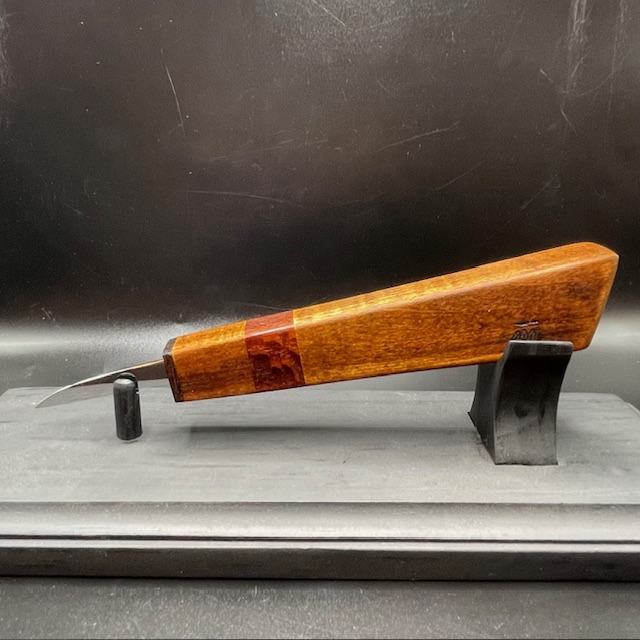
Complimentary Knife Sheath