
Six Reasons Why New Carvers Quit
1. Using dull tools
Working with dull tools is one of the most common mistakes new wood carvers make. Using a dull carving tool can not only be frustrating, but it can also be dangerous. Dull tools require more pressure to be applied to them, which can cause them to slip, resulting in a damaged project or, more importantly, severe injury to the wood carver. Identifying a dull tool is relatively simple. If the tool is not cutting well or if you have to apply excess pressure to it, then the tool is dull and requires attention. Using dull tools is the quickest way to become frustrated and possibly give up. Keep your carving tools sharp at all times with frequent stopping.
2. Using the wrong (hard to carve) type of wood
Using the wrong type of wood is the second most common mistake new wood carvers make. Basswood is probably the best and most popular wood for typical wood carving projects. It is soft, easy to carve, and holds detail very well. So many new woodcarvers pick up whatever piece of wood is available, only to eventually become frustrated with how poorly it carves. Wood types such as pine, spruce, and poplar are not good choices as these woods have irregular grain configurations and often contain a lot of sap.
That said, there are two different types of basswood: southern and northern. Northern basswood tends to be soft and easy to carve because of the climates in the areas where these woods are grown, whereas southern basswood is hard and challenging. Only carve northern basswood from a reputable supplier and avoid southern basswood often obtained in hobby and craft stores.
3. Starting with a complicated project
When you want to climb a ladder, you must start at the bottom and work your way up. Learn to crawl before you learn to walk. It’s the same thing with woodcarving. New carvers need to start with simple, uncomplicated projects and work up to carving more complex pieces as their skill level improves. Beginning with a highly detailed project will often lead to frustration and failure.
4. Can’t see their progress
Today, we live in a world of instant gratification. Everyone wants to see results immediately. Be patient when beginning your woodcarving journey. It may take a little time, but trust me, you will see results. My best advice here is to try to carve something every day, even if only for half an hour. Like everything else, practice makes perfect; the more you carve, the faster you will see your progress. However, be patient and take your time when you carve. There are no prizes for being a fast carver; enjoy what you are doing. Remember, like I always say, when it comes to woodcarving, “It’s about the journey, not the destination.”
5. Give up when they get stuck or make a mistake
Many new carvers give up when they get stuck or make mistakes and need help figuring out what to do next. Don’t quit; that’s the time to become creative and improvise. For example, if you cut off a part of a mustache, change the style/shape or eliminate it altogether. If you mess up on a hat, change the shape of the hat. There’s nothing saying your carving has to look like the pattern you’re working from. Change things around and make the carving your own. Sometimes, it helps to set the carving aside and return to it later, and in the worst case, if you feel it can’t be corrected, toss it in the firewood box and start over. Remember, it’s not the world’s end; it’s just a piece of wood.
6. Don’t know where to get help
Starting in woodcarving can be daunting. There’s a lot more to woodcarving than meets the eye, and many new carvers don’t know where to start. Fortunately, today, there are many resources new carvers can access to help get them started and keep them going along the way. Thousands of woodcarving books have been written over the years by some of the world’s most accomplished carvers, which are excellent instructional tools, and nowadays, there are also videos for wood carvers to explore. YouTube, for example, is loaded with free videos made by leading experts on almost every aspect of woodcarving imaginable.
Look to join a local woodcarving club. Being a club member is one of the best ways to obtain personal advice and answer all your questions.
Reader’s Comments

My good friend, Andy from Michigan wrote with a question about the Second Mate pattern I posted last month. Andy writes:
“Greetings from Michigan! Thanks for the latest Wood Chip Chatter. On the second mate pattern, would this best be done as a corner carve or just straight on? I seem to have an issue with faces.
Regards,
Andy”
Hi Andy,
I provided a front and side view of the Second Mate, if you have a means (band saw) to do it. cut out both views. That will greatly help you get started on the face. If not, I suggest you work this pattern from the flat side. I hope this helps.
My very good friend, Eric Owens from Boise, Idaho sent in some photos of two excellent carvings he recently finished. Eric Writes:
“Hey, Bob, Eric Owens here. I apologize for not sending submissions of photos and information. I will make a commitment to sending things on a regular basis..
The first picture I attached is a blacksmith I carved this year.It is made of several pieces, with a separate head, hammer, horseshoes, anvil and stand. He was a lot of fun to carve,
The 2nd picture is a cowboy I donated to our annual show, the Idaho Artistry in Wood. He drew a lot of attention. On the body is a separate head, rope and branding iron. Attaching pieces to a body can be quite tricky, but can draw a lot of interest from those who want to carve one or buy one. He had a good expression on his face that looks like a lot of stories and memories.
Thanks. I will try to send some tips and tricks I use, as well as just carving information for others to read. I get really busy during some parts of the year, due to shows, classes and commissions, so you might need to prod me for a submission,
Thanks for all you do! You are awesome!”
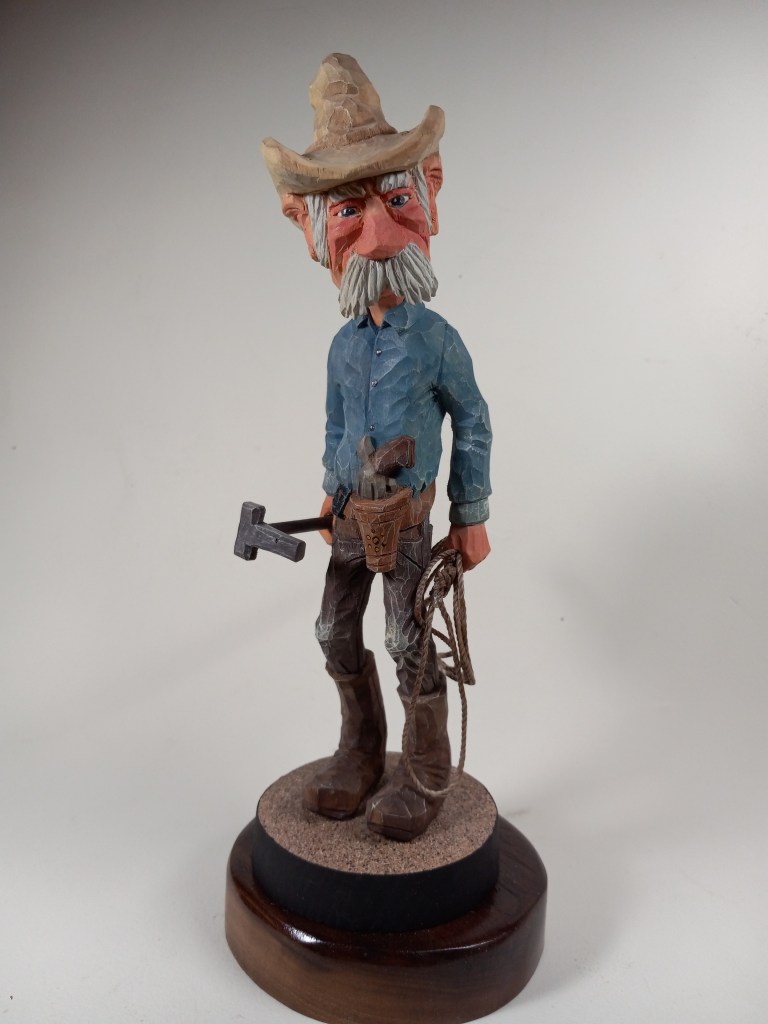

Thanks, Eric! I would greatly appreciate that, it’s just the kind of thing I was hoping for when I started this blog. Your input will be a tremendous help to me and a benefit to others. Your cowboys are fantastic!
My good friend, Jim Carlson from Boone, Iowa sent in an excellent tip in response to last month’s article on band saw safety. Jim writes:
“Hi Bob,
I appreciated your January comments on band saw safety. One of the best safety investments I have made is this $12 foot control for my band saw. With it, I can keep a firm grip on my wood piece with both hands from before the blade starts until after it stops. And if I need to stop and back out the blade, I can maintain control without having to take one hand off to flip a switch on the saw.
Jim Carlson
Iowa”

That’s a great idea, Jim! Thanks for sharing.
Questions & Answers

I received the following question from an unknown reader wanting to know about drying time for walnut oil:
“Hi Bob,
If I were to use refined walnut oil to season a wooden mug, how long should I let it cure before using it?”
I worry about using refined oils on food-grade items. Generally, when oils are refined, other ingredients (some potentially toxic) are added. Try to find an oil that has been made through a natural process.
Oil drying times will always vary with the air’s humidity. The higher the humidity, the longer the drying time.
Photo Shop

“Photo Shop” is the section of Wood Chip Chatter where carvers can send in photos of their wood carvings for display. It’s your chance to show off your work…sort of a show and tell. The photos will only be displayed and no comments or critiques will be made. For critiques on your carvings send them in to the “Carver’s Corner.” Send your photos to: carverbobk@woodchipchatter.com
My good friend, Wayne Arrowsmith sent in some photos of the great Santas he carved and his family members painted. Wayne writes:
"Hi Bob,
For the past 10 or 12 years I have carved a few Christmas ornaments or figures and invited my children to paint the carvings. The group has grown over the years to include their partners, a few close friends and this year my sister. It is one of my favourite days of the year and it’s a joy to watch everyone paint a carving which they can then take home to enjoy. Here’s a few from this years group. The carving pattern is from Sean Cipa’s book.
I really enjoy your newsletter each month! Thank you!!"
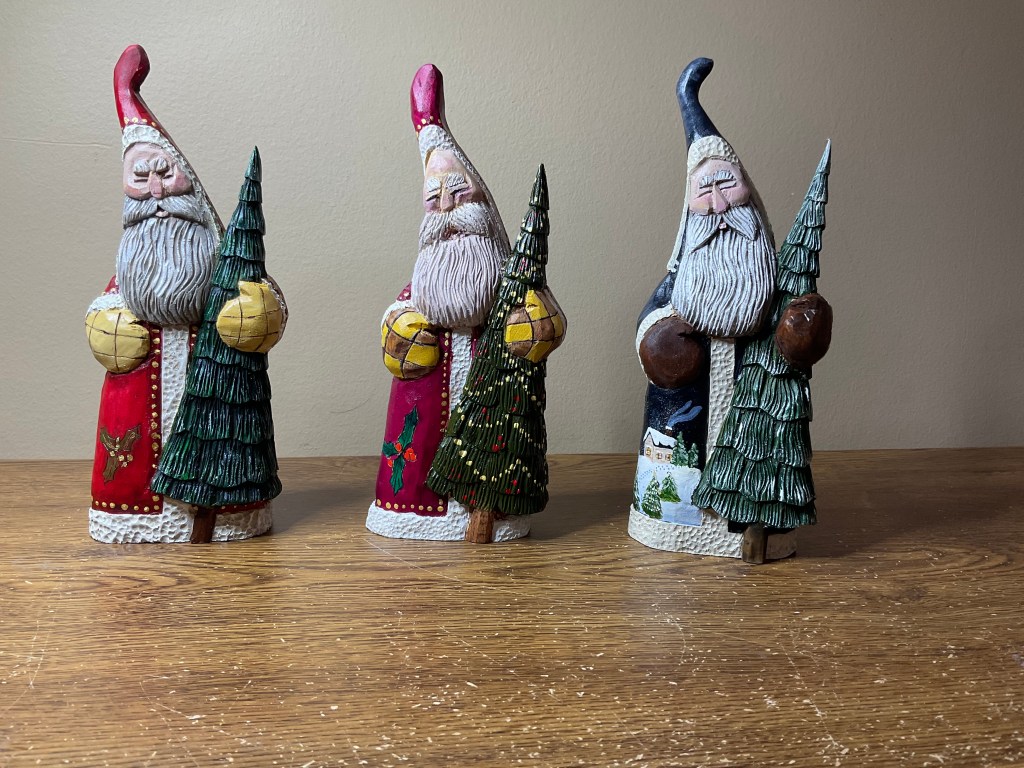
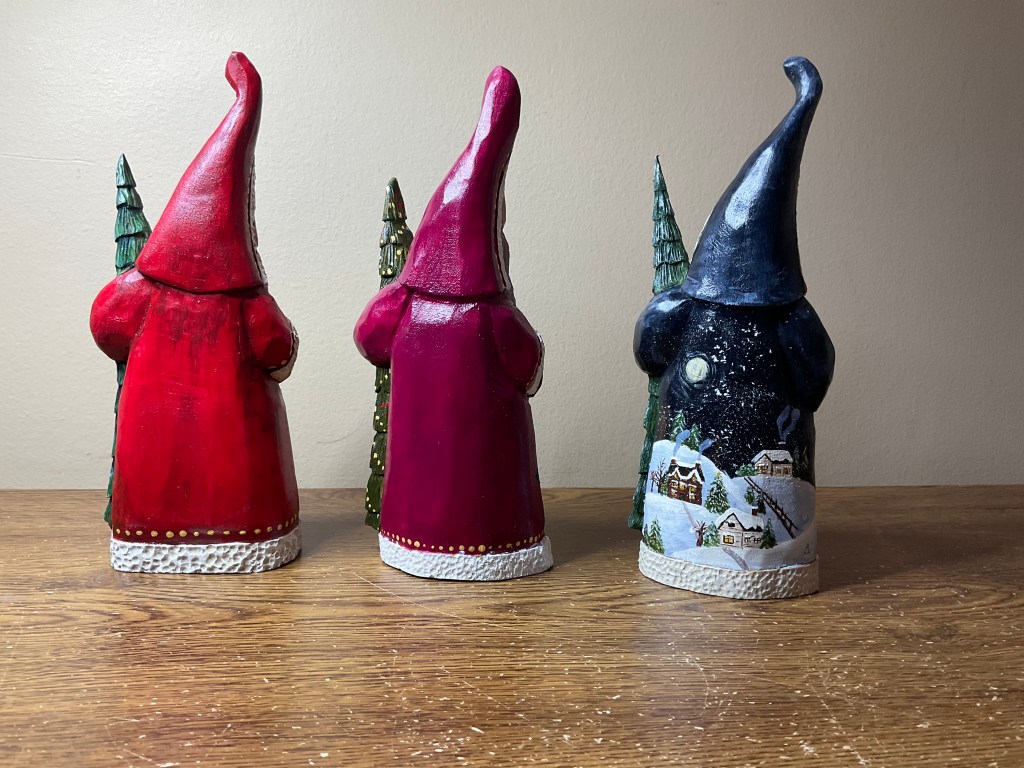
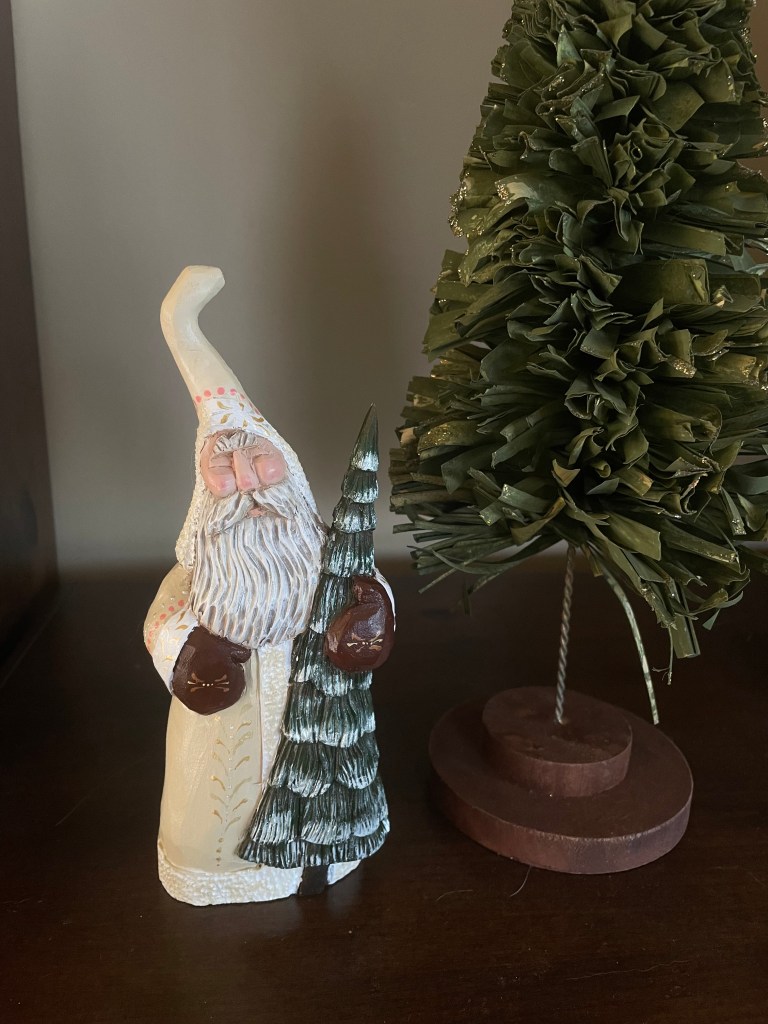
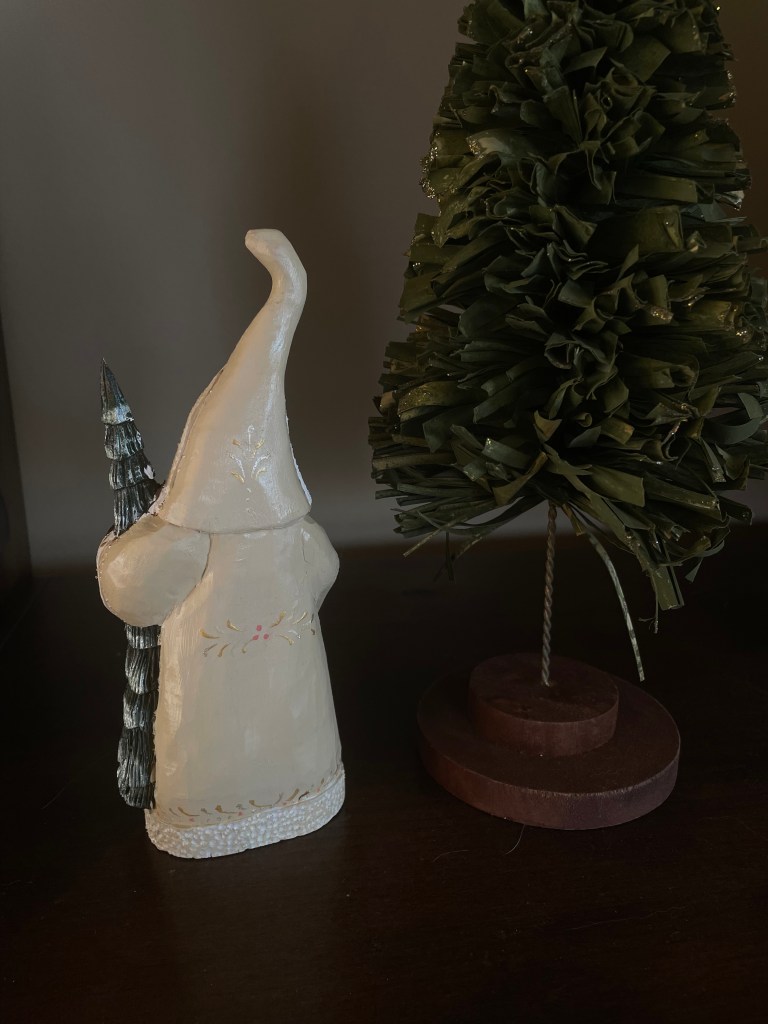
That’s some great work there, Wayne! I can see there’s a lot of artistic talent in your family, and what a terrific annual tradition you have.
My good friend Shannon Coker sent in a photo of a Christmas Moon she recently finished:
“This was a project I completed. Van Kelly inspired pattern
Shannon”

Thank you for the photo, Shannon! Very nice work.
Woodcarving Tip
Add Wrinkles for Realism
Clothing wrinkles add realism to your carvings. Try to add wrinkles to your carvings for a more realistic look. Use various sized gouges along with your carving knife to make cuts that go in different directions to simulate clothing wrinkles. Study pictures or actual clothing for guidance on how it drapes and wrinkles on the body as it moves, twists and turns. There are also some excellent artist’s books on clothing drapery and wrinkles you may want to consider purchasing for reference.
Pattern of the Month
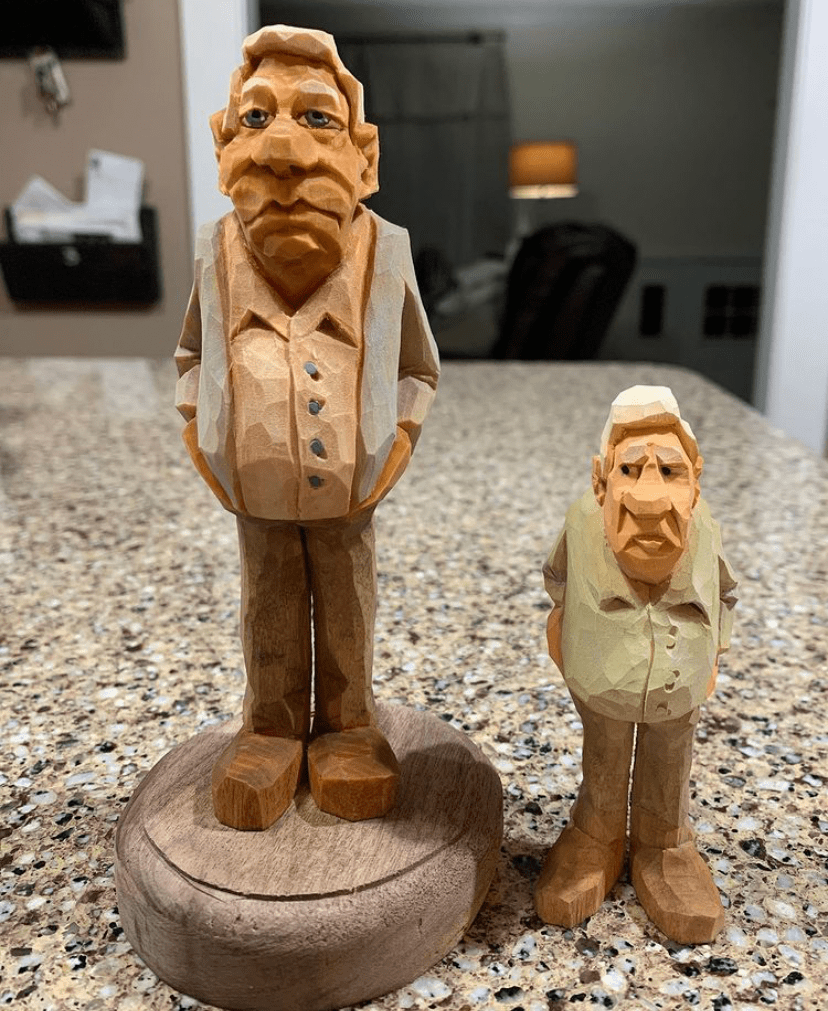
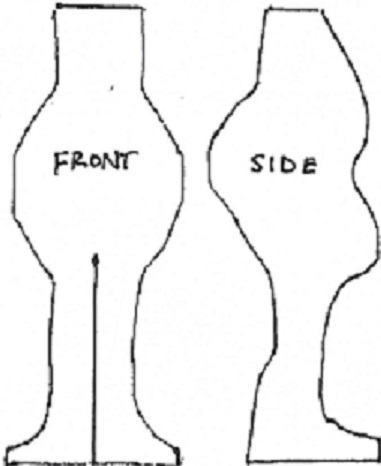
Generic pattern from Ryan Olsen

Upcoming Workshops
Shorties
Teacher: Dale Green
Dates: February 1,2,8,9 2025
Saturday & Sunday both weekends 9:30 am-11:30 Pacific / 10:30 am – 12:30 pm Mountain /
11:30 am- 1:30 pm Central / 12:30 pm – 2:30 pm Eastern
8 hours ( 4 sessions – 2 hours each day)
Location: Online (Via Zoom)
Contact Dale: dalecarves@gmail.com
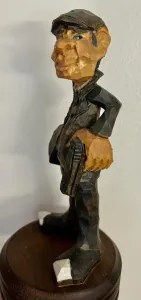
Tony
Teacher: Dwayne Gosnell
Feb 4,18 – 6PM Eastern
Twiitling Tuesday – 4 hours ( 2 sessions – 2 hours each day)
Location: Online (Via Zoom)
2.5×3.5×7.25 basswood block needed for pattern
For details and to sign up click on Dwayne’s website https://www.dgosnellwoodcarving.com/

Cowboy with Bottle
Teacher: Dave Stetson
Dates: March 1,2,8,9,15,16 2025
Times: Sat, Sun – 9:30am-11:30 Pacific /11:30am-01:30pm Central / 12:30pm – 2:30pm Eastern
12 hours (6 sessions – 2 hours each day)
Location: Online (Via Zoom)
For details and to sign up email Dave lcnmichele@aol.com
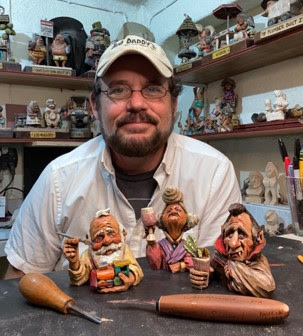
Online Classes With Chris Hammack
Teacher: Chris Hammack
Chris Hammack is offering a new series of online classes to help students learn and sharpen their woodcarving skills. Individual and Group Classes are available through his web site chrishammackart.com/groupclass

Twhitling Tuesdays
Teacher: Dwayne Gosnell
Dates: Two – 2 hour classes each month on Tuesdays
Location: Online (Via Zoom)
To sign up contact Dwayne Gosnell via email dagwood_76@gmail.com

Woodcarving Academy
Established in 2020, the Woodcarving Academy offers dozens of videos and seminars created by some of the country’s top level instructors. More videos are added regularly as they are created by the instructors.
With a paid subscription to the Woodcarving Academy you can view any videos you like for as many times as you like.
Subscription rates: Monthly = $19.95 Quarterly = $49.95 Annual = $139.95
There is even a Free level which allows you to tour the website and watch the sample videos and content, and receive email updates as new content becomes available.
Check out the Woodcarving Academy and learn with the masters right in the comfort of your own home! Go to: www.woodcarvingacademy.com or Email: support@woodcarvingacademy.com
News & Announcements




Some timely show information from my good friend, Jim Carlson from Boone, Iowa:
“Hi Bob,
For anyone who is looking for some great in-person classes in combination with a competition and show, plus some great vendors, I would like to recommend the International Woodcarvers Congress. A wide variety of classes are available from one day to five days. Living in Iowa, I am fortunate to be within 3 hours of the quaint small town of Macquoketa, but instructors and students attend in June every year from all around the USA. If you have any room, I will attach some information and registration forms for the Congress.
Jim Carlson
Boone, Iowa”


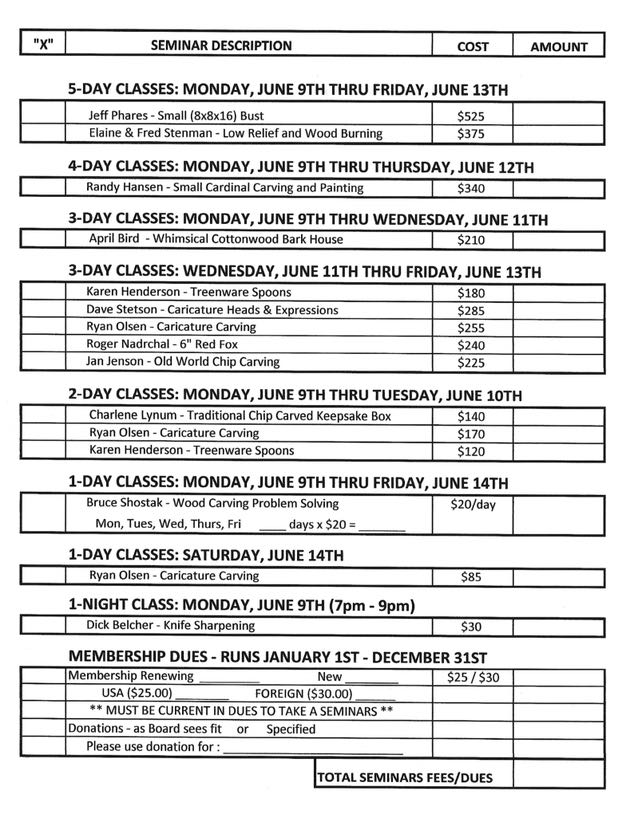


The International Association of Woodcarvers has upcoming Zoom meetings on the following Saturdays at 3PM EST with special guest presenters. Check them out…
Zoom: 310-460-3575
Presentation Schedule:
2/8 – Off
2/15 – Mike Pounders
2/22 – Bruce Ankeny
3/1 – Josh Walters
3/8 – Rod Gatlin
3/15 – Lancaster, PA Show
INTERNATIONAL ASSOCIATION OF WOODCARVERS
COME JOIN US!!!

The Jersey Hills Wood Carvers (JHWC) club is a small but growing group of wood carvers sharing their time, knowledge and joy of woodcarving. The JHWC generally meets from 7:00 PM EST to 9:00 PM EST on the 1st, 3rd and 5th Thursday of each month (when school is in session) at the Jefferson Township High School wood shop classroom.
Membership is “FREE” and open to anyone interested in woodcarving regardless of their ability.
JHWC’s Upcoming Meetings and Events
2025
February – 20th
March – 6th, 20th
April – 3rd, 24th
May – 1st, 15th, 29th
June – 5th
For more information contact:
Al Santucci alsantucci4@gmail.com President
Bill Brunner billbrunnerdesign@gmail.com newsletter/website editor
Or visit:
Website: https://www.jerseyhillswoodcarver.com/
Facebook: https://www.facebook.com/groups/736479646821641/
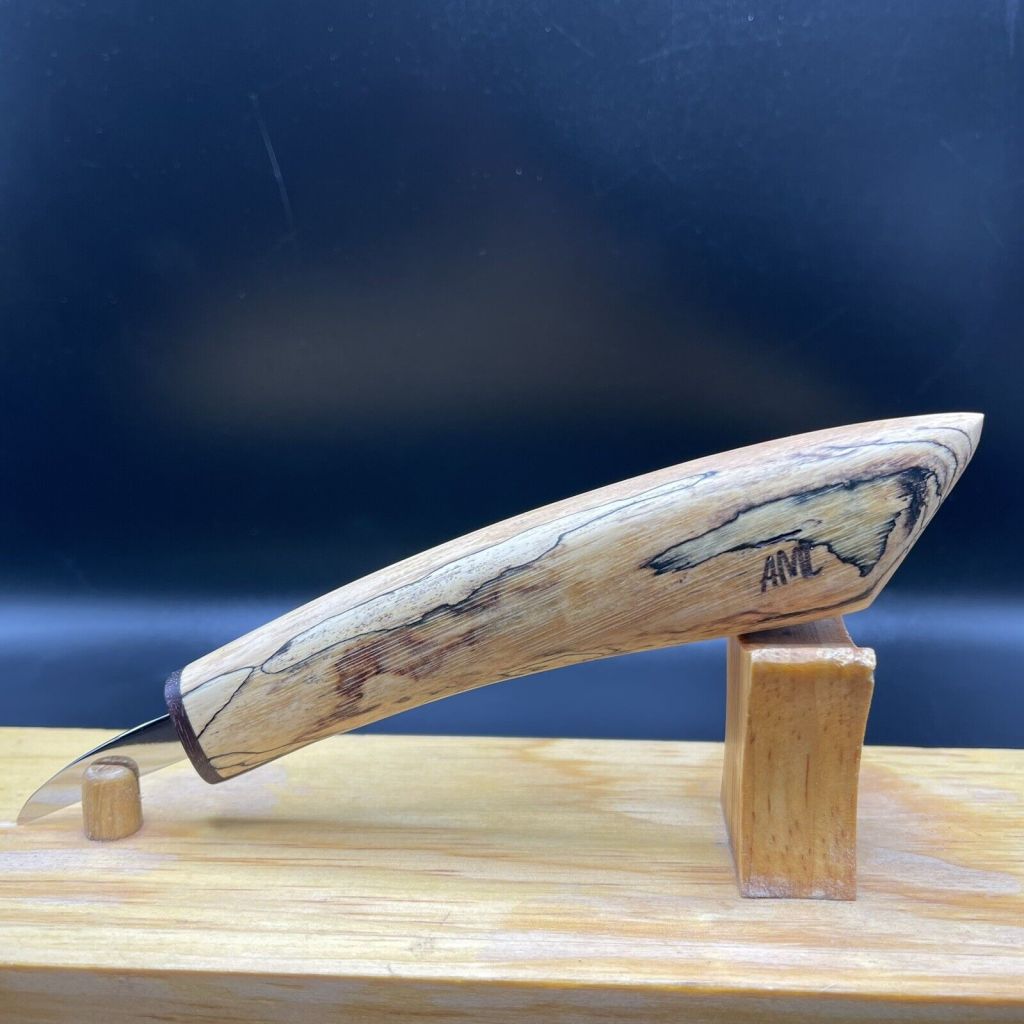
AML Wood Carving Knives

AML Wood Carving Knives are handmade by Andy Loughlin in Monroe, New York.
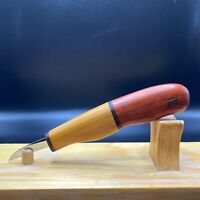
Each blade is meticulously crafted from 1095 high-carbon steel, ensuring easy sharpening and long-lasting edge retention. The diverse exotic woods used for the handle styles are sourced from around the world, adding a touch of elegance to these knives. You can find these exceptional knives for auction on eBay under ‘AML Knives,’ with bidding usually starting at $22 and most knives selling for between $40 and $100.
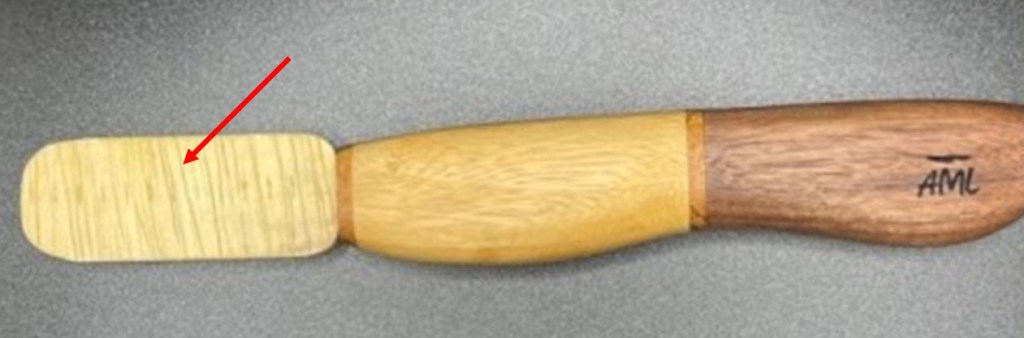
Unpack your AML Wood Carving Knife and experience its razor-sharpness right out of the package. Each knife comes with a custom-made magnetic wooden sheath, a thoughtful addition at no extra cost.
I now own three AML Knives and can speak personally about their quality. These are not production knives. Each knife is handmade by Andy himself. The knives are sturdy, well made, and will stack up to any other knife on the market. These knives have quickly become quite popular and sell out fast, so check the site (“AML Carving Knives” on EBAY) often for availability.
Andy has recently begun making knives with handles made from exotic woods and colored epoxy, creating some stunning and unique handle designs. Below are examples of some knives currently available or which have recently sold:




A big Thank You to everyone who contributed to this newsletter!

The next issue of Wood Chip Chatter will be posted on March 7, 2025.

Keep a sharp eye out for it.
Keep a sharp edge, and keep on carvin’!


Funny Bone



 Wood Chip Chatter
Bob:
As always, enjoy seeing each Wood Chip Chatter when they arrive. Your feature on why new carvers often quit is spot on and important to address. If they can find a mentor, that can be very helpful in learning tips and suggestions. Seems that there are less carving shows post covid, but an excellent way to find local clubs and meet good vendors. Online sources are endless and Wood Chip Chatter, of course. I always suggest to new carvers that they take an early carving and carve it again a year down the road, they see progress and can boost their confidence.
Jim Babcock Columbus, Indiana
LikeLike
Bob: please post an upcoming class for us: The Pennsylvania Delaware Valley Woodcarvers will be hosting Cottonwood Bark Carver Harold Kaltenbach May 3,4th in Suburban Philadelphia. If interested contact Wade Huggins 215-531-0238
Thank you and I will see you in Lancaster this spring. Wade
Sent from my iPhone
>
LikeLike
Can’t agree more on the reasons for quitting. Folks ask me often about learning and always point them to chains, ball in a box, etc. Pick something that doesn’t need to look like a person or animal. Build those skills, make some mistakes, but also get some early wins on relatively easy yet complex looking projects.
LikeLike
Hey Bob, it’s me olivia! I’ve missed you so much hunny can you please reach out to me on my telegram, that’s my link below 👇 t.me/Oliviacastaxx1x
LikeLike