
Due to technical difficulties experienced yesterday, Wood Chip Chatter is being published a day late. I apologize for any inconvenience.
This month (October) is my annual Halloween Special issue where I’ll be telling some Halloween and Wood Spirit stories. Long-time subscribers may have seen a couple of these but I’m posting them again for the benefit of all the new subscribers who just joined this year. However, I’m sure you will all find something new and interesting.
The Story of Halloween

Most people think of Halloween as a night of dress up in ghostly or funny costumes, to have parties, or to go “trick-or-treating” and never consider why or how much a holiday evolved from a serious annual rite in ancient times. What is actually being celebrated is two customs that have been combined into one.
The first tradition is the observance of a Catholic religious day set aside to honor saints. Referred to as “All Hallows Day” or “All Saints Day,” this holy day is held on November 1st. The night before is known as “All Hallows Eve,” from which the name Halloween evolved.
The second celebration is from Northern France and the British Isles where the Celtic people celebrated the end of the Celtic year known as Samhain (pronounced sow-en) or “Summer’s End.” This festival was a time set aside to honor the dead. The Celts believed that the realm of the dead, or the spirit world, and the physical world were closest together during Samhain.
The traditional celebration of Samhain included carving jack-o-lanterns from gourds and turnips and lighting them with coals or candles to show the way for deceased loved ones. At the same time, these lanterns were believed to ward off evil spirits. Another version of the celebration indicates that the disembodied spirits of those who died during the year were intermingled with the living on that night. They attempted to possess the living to hopes of being allowed to have an afterlife. In an effort to frighten away the spirits, people would leave their houses unlit and cold, dress up in ghoulish costumes and parade around town being destructive as possible. This tradition set the stage for today’s children’s refrain “trick or treat.” When the Europeans arrived in the New World, they discovered a new fruit that was larger than the turnip and easier to carve: the pumpkin. The pumpkin has been the symbol of Halloween ever since.
The Story of The Jack-O-Lantern

The story of the name Jack-o-lantern has a history of its own. It derives from a folk tale about a disreputable drunkard by the name of Jack who, upon learning that the devil had come for his soul, tricked the devil into buying him one last drink. Having no money, Jack convinced the devil to transform himself into coins so that Jack could buy his last drink. Instead of buying the drink, Jack placed the coins in his pocket along with a silver cross, thus preventing the devil from returning to his common state. To be released the devil agreed to leave Jack’s soul alone for ten years.
After ten years had passed, the devil appeared to Jack as he was walking down a country road. The silver tongued Jack managed to talk the devil into climbing an apple tree before claiming his soul. While the devil was in the tree, Jack pulled out his knife and carved a cross in the base of the tree, thus trapping the devil again. Again he struck a bargain with the devil, this time extracting a promise that the devil would never take his soul.
When Jack finally died, he went to Heaven but was not allowed in because of his drinking and dastardly ways. With no place to go, he went to Hell. The devil, remembering Jack’s trickery, refused him entrance. Jack then convinced the devil that the way back was so dark and windy that he needed a light to find his way. The devil gave him an ember from Hell to get rid of Jack. Jack placed the ember in a turnip he was eating to shield the flame from the wind and began to wander back into the darkness, forever doomed.
The Legend of the Wood Spirit
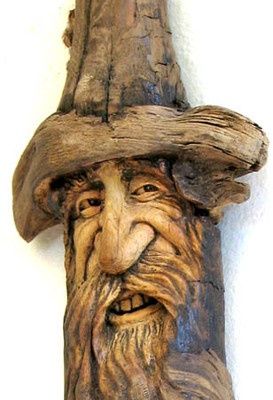
The Wood Spirit is a 15th Century European legend originating from villagers who made long journeys through the forest. Most often glimpsed as a green man with leaves for his beard and hair, the Wood Spirit is said to be Lord of the forest and natural things. Seeing one is said to be quite lucky, and European villagers used to go out on regular hunts, hoping to find a Wood Spirit to foretell the future of their village.
On calm days when the wind does not blow, there is a sense of peace and tranquility in the forest. On days when storms are brewing and winds are blowing, though, the trees of the forest make sounds of moaning and sighing as though voices can be heard from spirits within. For centuries the people believed the forests were filled with mystical evil spirits and that those who dared to enter would earn the spirits’ wrath.
During the 15th Century the villagers believed that when the men went into the woods to hunt and didn’t return, that they had been taken by the evil spirits. They also believed that the tree spirits were the most powerful of all spirits and were good and wise. Wood Spirits are extremely strong. They can tear an opponent limb from limb and can tame any wild animal, including ferocious dragons and skittish unicorns. At the same time, they are gentle with the maidens, children, and men of good heart. They believed that the tree spirits would protect them from the evil spirits. So before they would venture into the woods to hunt, they would knock on a tree to awaken the sleeping Wood Spirits to protect them. This is where we get the saying ‘Knock on wood’.
Wise travelers assured their safety by carving Wood Spirit images on their walking sticks or pieces of wood and bark. These carvings appeased the Wood Spirits, thus the traveler was allowed to enter and leave the forest without difficulty.
It is said that the forest will stand for as long as the Wood Spirit remains to keep order. And if you’re lucky enough to see a Wood Spirit, health, happiness, and good fortune will be yours. However, that does not happen often. Wood Spirits would rather see than be seen. Most sightings are by children or by the pure of heart.
Wood Spirits were carved to bring luck, ward off undesirable spirits, and keep the household safe. Still today, Wood Spirits are being carved into pieces of wood and bark and are often given as gifts. The Wood Spirit should be given a special place within the home for its presence to bring wisdom, prosperity, humor, good health, and good luck to all who live there. Any house home to a Wood Spirit will stand protected and be blessed with good luck, health, and happiness.
Photo Shop

“Photo Shop” is the section of Wood Chip Chatter where carvers can send in photos of their wood carvings for display. It’s your chance to show off your work…sort of a show and tell. The photos will only be displayed and no comments or critiques will be made. For critiques on your carvings send them in to the “Carver’s Corner.” Send your photos to: carverbobk@woodchipchatter.com
My good friend Gene Short sent in two photos of a reindeer and sleigh carving he made out of black walnut. This is what he had to say:
“I have carved reindeer for Christmas decorations in the past but with Basswood I couldn’t shape the antlers without them breaking off! With Black Walnut I could rough them in with a knife then taper them into shape with a Dremel Rasp bit. Each of the legs and heads were individually carved even thought I did have two deer joined at the sides. Sanding was very easy compared to the hardness of the wood which helped me dress the bodies and legs down and finish them off.
Gene Short”

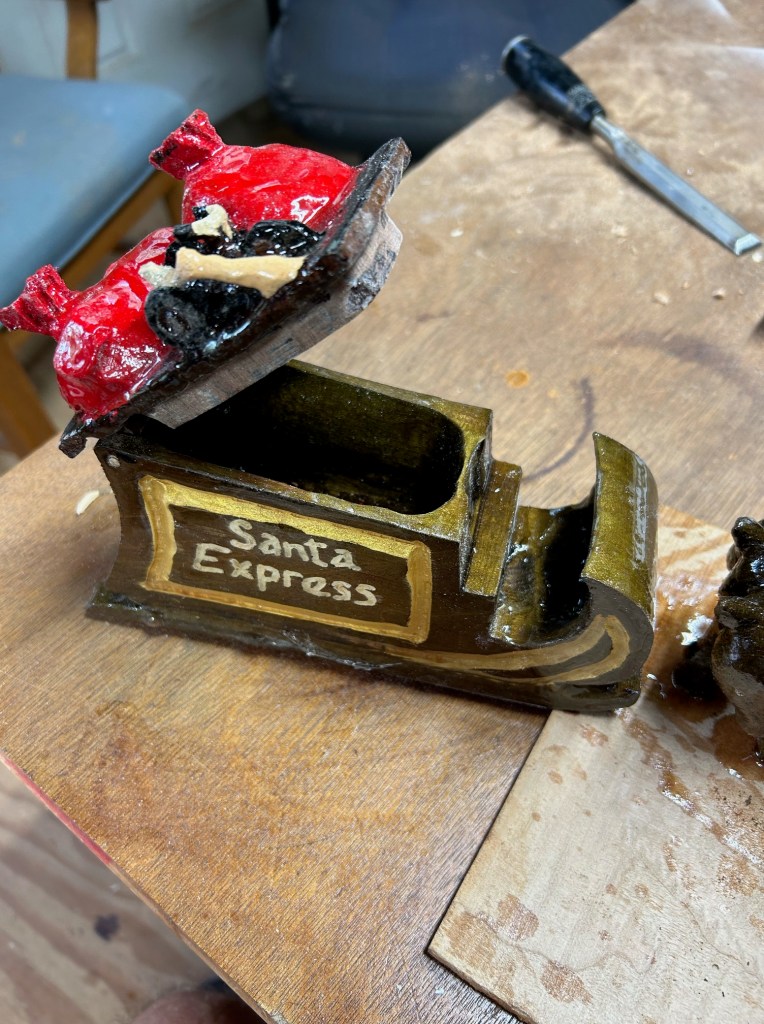
Excellent carving, Gene! I can see how you were able to get nice detail by using black walnut.
Next we have a beautifully done horse sent in by my very good friend, Dick Bonewitz from Carmel, Indiana. Dick writes:
“Bob, here is a horse I carved from a roughout by Janet Cordell. It is basswood sealed with Krylon satin spray. I think it turned out good. It required a lot sanding. Thanks for looking.
Dick Bonewitz
Carmel Indiana”
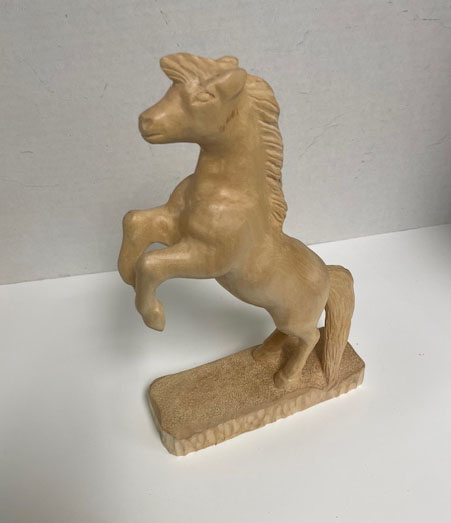
Thank you as always for the photo, Dick! You did an excellent job on your horse…very well carved and neatly sanded. I also like the natural finish.
My very good friend, Laura Jane Aungst sent in a photo of a terrific Ghost and Jack-O-Lantern carving she created. Take a look!
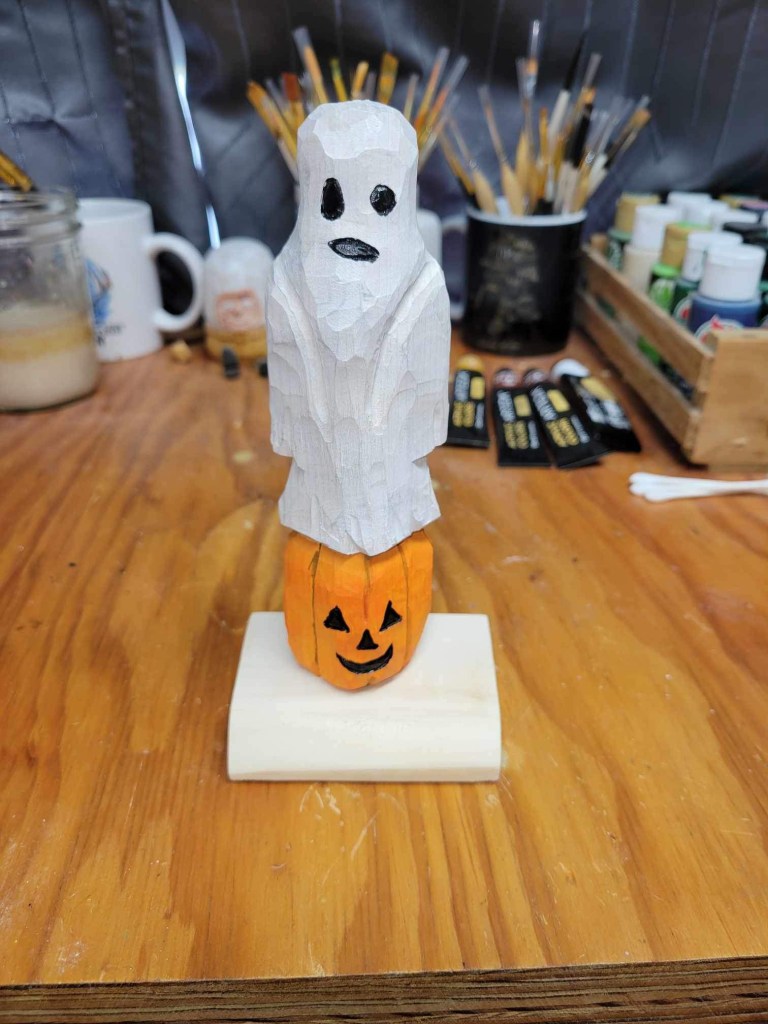
Fantastic job, Laura! Very creative and well done!
My very good friend and frequent contributor, Jim Babcock from Columbus, Indiana sent in a photo of a Wood Spirit he just finished. Jim writes:
“Bob:
Hope all is well with you; enjoy Wood Chip Chatter, keep it up !
Attached is a recent carving of a wood spirit that I saw in the magazine ( E. Shrum ).
I made a few modifications and carved with hand tools. Finished with walnut oil and acrylics.
Jim Babcock
Columbus, Indiana”
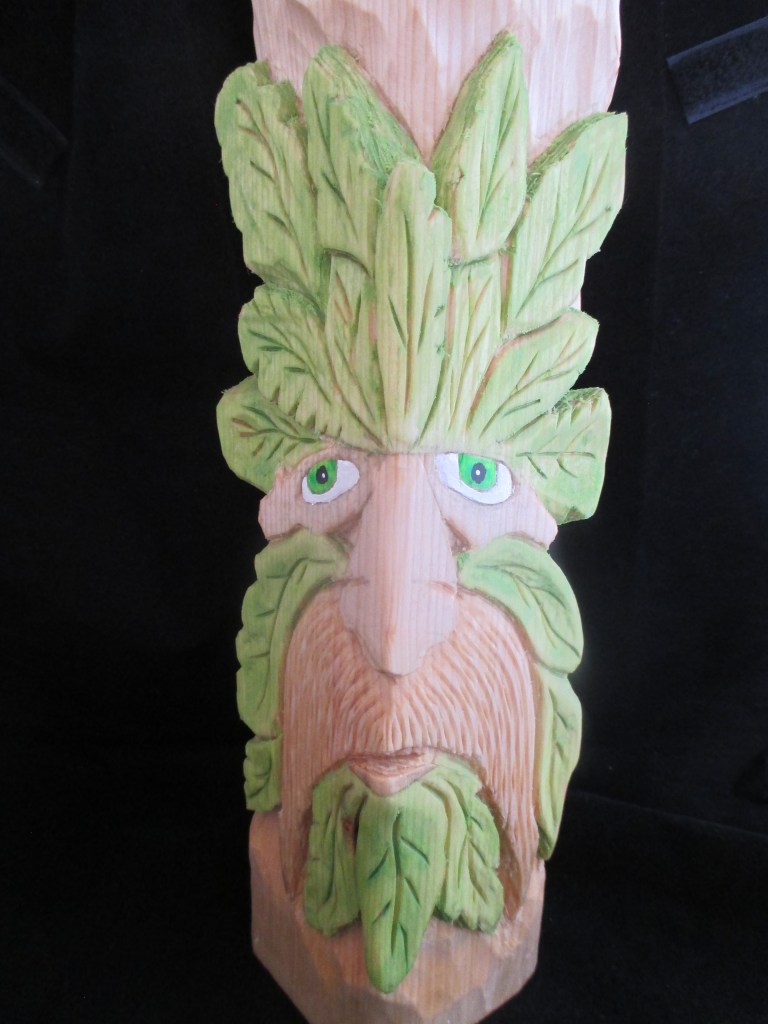
Thank you as always for the photo, Jim! Your wood spirit looks great, very clean work!
Next we have a photo of a couple of carvings my good friend and frequent contributor, Shannon Coker submitted:

Very nice work, Shannon! I especially like the Floppy Hat Santa Ornament which I recognize from my article in the Winter 2022 Issue #101 of Woodcarving Illustrated.
My very good friend, Vern Freer sent in a few photos of two of his latest carvings. Vern writes:
“I just thought I’d send in a few pictures of my most recent carvings. I’m involved in leading a hiking group and a snowshoeing group and there is an upcoming meet and greet for which I needed to have a prize/giveaway so I decided to carve a little bear hiker and snowman snowshoer. Thanks again for all your work in preparing this publication! It is greatly appreciated – there’s always something to be learnt.
Vern Freer”
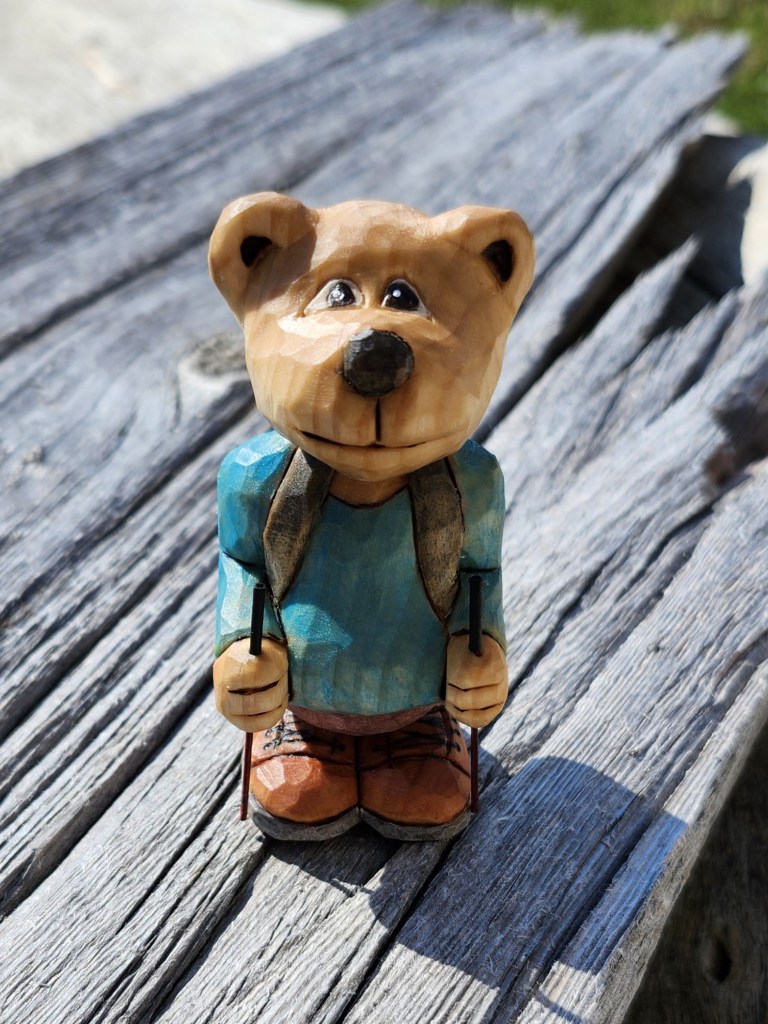
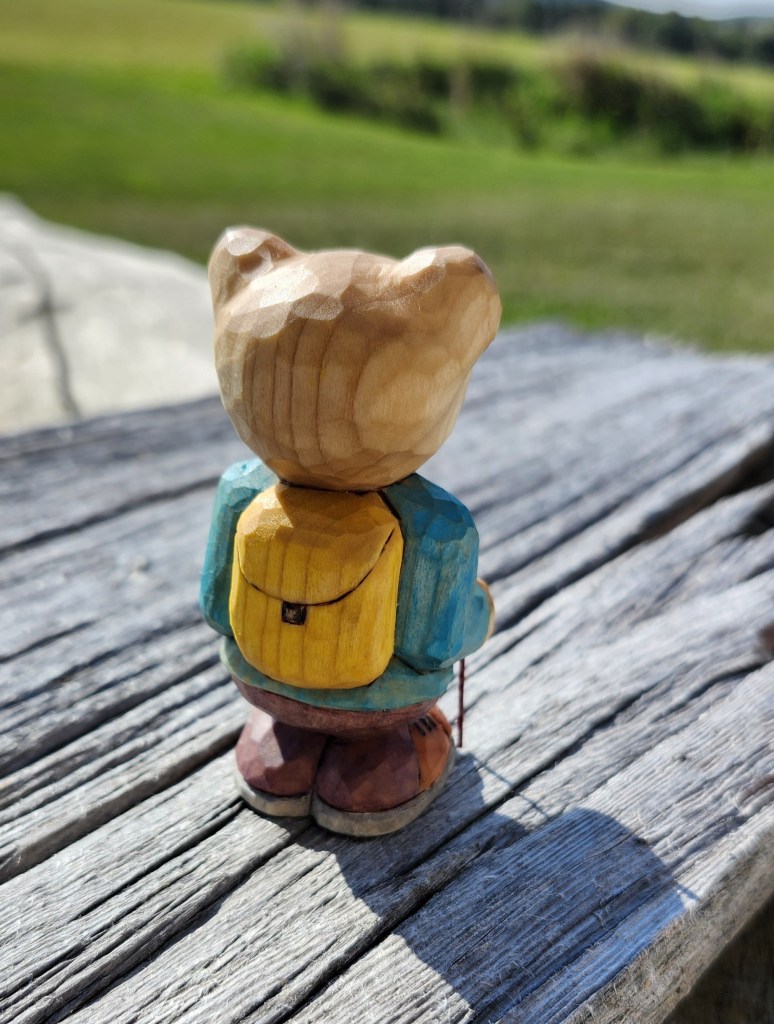
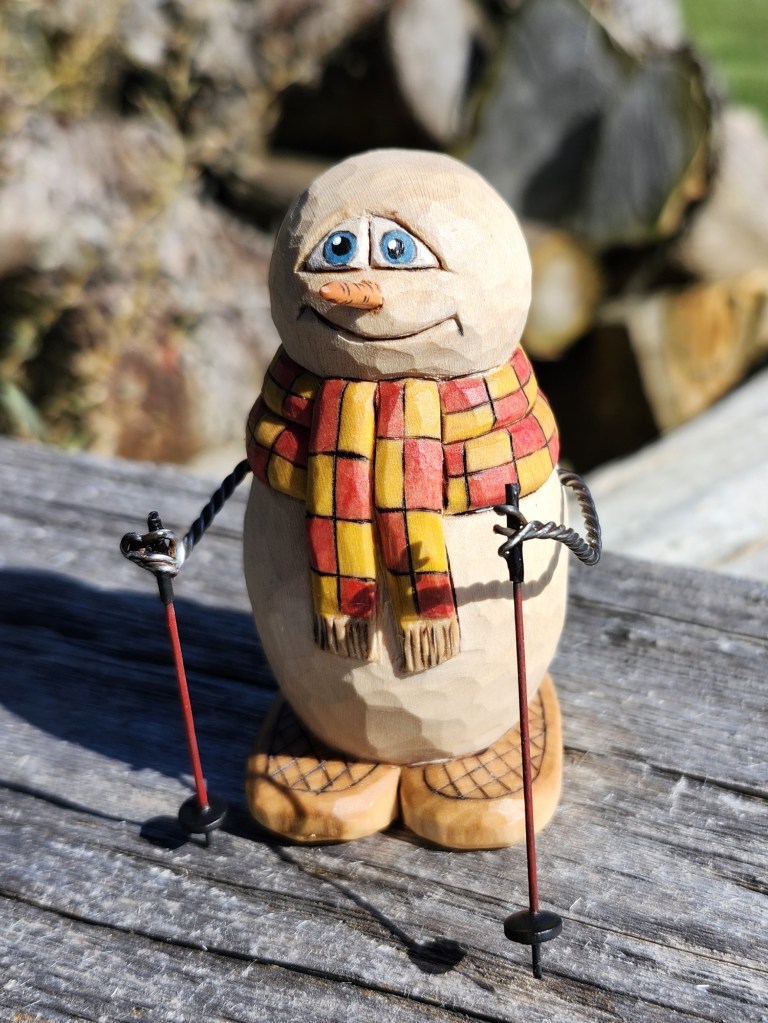
Thanks for the photos, Vern! Great work, as always! Those are very original ideas.
Woodcarving Tip
Easy-Off Bit Cleaner
When your power carving bits/burrs get clogged with wood, use oven cleaner to clean them. Simply spray the bits with a little oven cleaner and let them sit for about an hour. Then rinse them under water, and they will look as good as new again.
Questions & Answers

This month I received a question from an anonymous reader regarding the tutorial I posted on July 24, 2021 about carving a Moravian star ornament:
“good job explaining. I’ve carved about 130 stars, from 3/4″ to 5″, addicted. What is the best way to put in the eyelet?”
Adding the eyelet to the Moravian star ornament is simple.
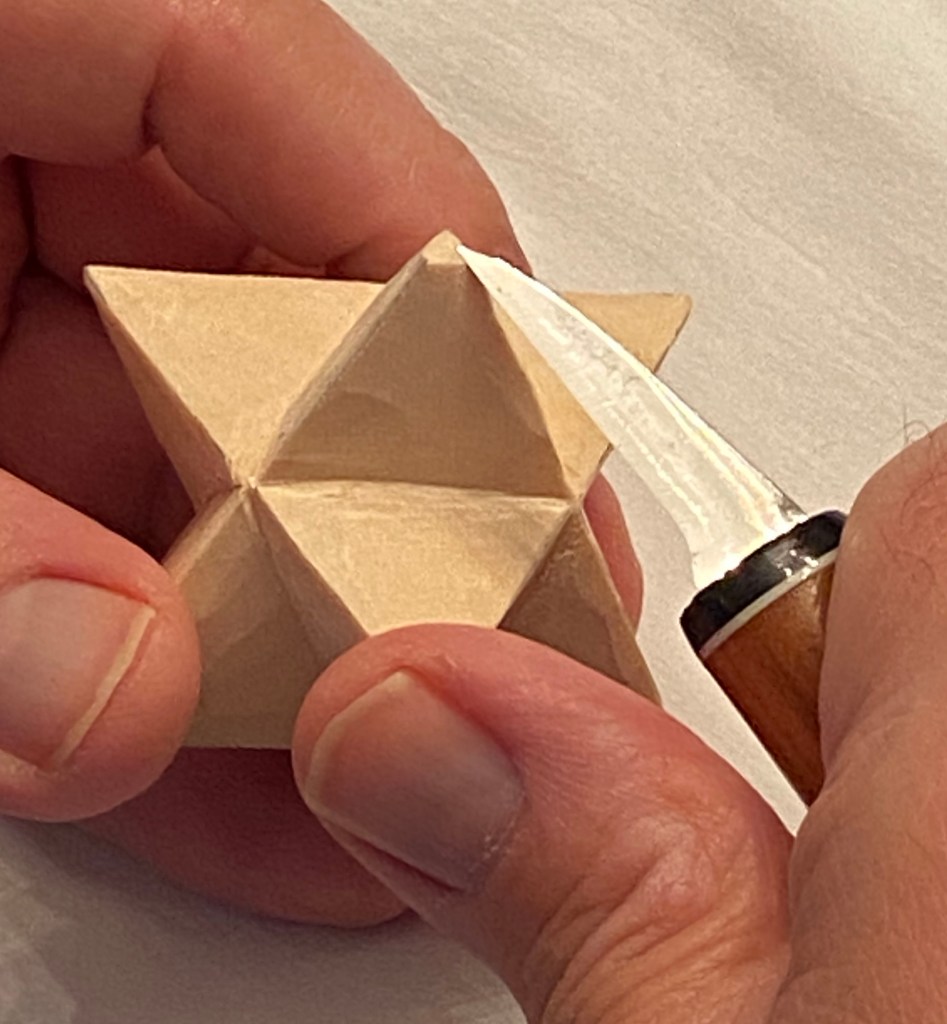
1. Choose one of the star’s points and carefully cut off the tip with your carving knife.
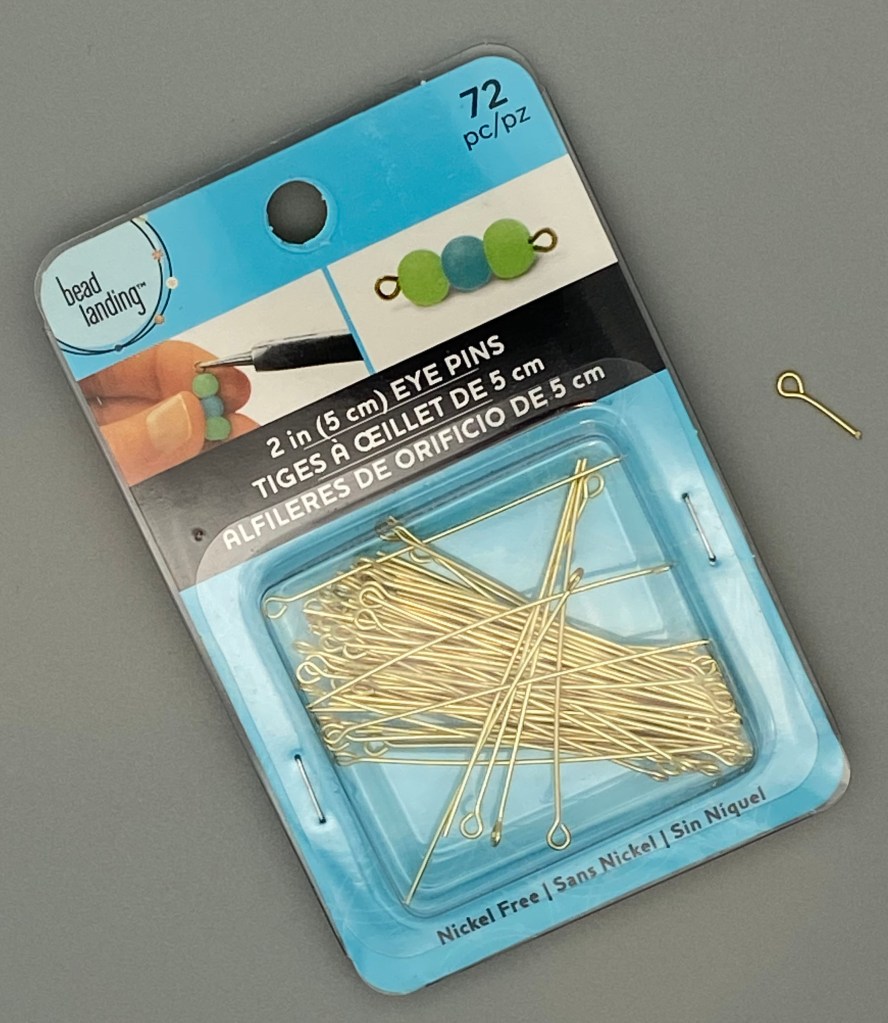
2. Using a pair of needle-nose pliers, cut an eye pin off at about 1/2″. Cut the eye off at an angle to give it a bit of a point. Eye pins are available in gold or silver and can be found in the jewelry-making section of most craft stores.
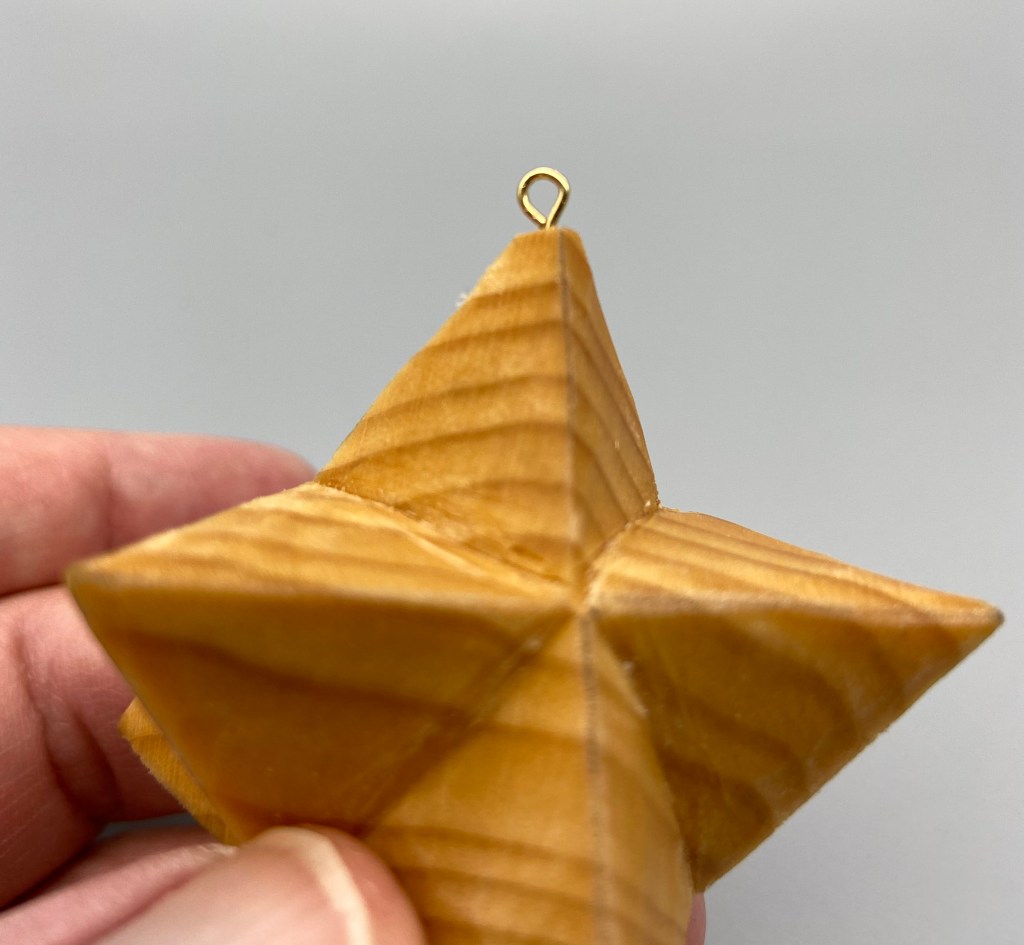
3. Firmly grasp the cut-off eyelet with the needle-nose pliers and push it straight into the flattened point of the star,
My tutorial can be found by typing “Moravian Star Ornament” in the Search box. I will be happy to repost it in a future issue if anyone is interested.
Pattern of the Month
Dracula

Upcoming Workshops & Seminars
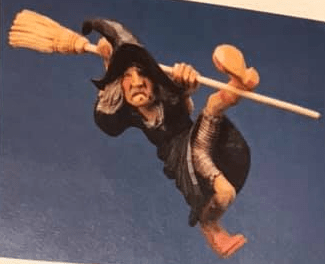
Flying Witch
Teacher: Dave Stetson
Dates: October 5,6,12,13,19,20
Times: Sat, Sun – 9:30am-11:30 Pacific /11:30am-01:30pm Central / 12:30pm – 2:30pm Eastern
12 hours (6 sessions – 2 hours each day)
Location: Online (Via Zoom)
For details and to sign up email Dave lcnmichele@aol.com
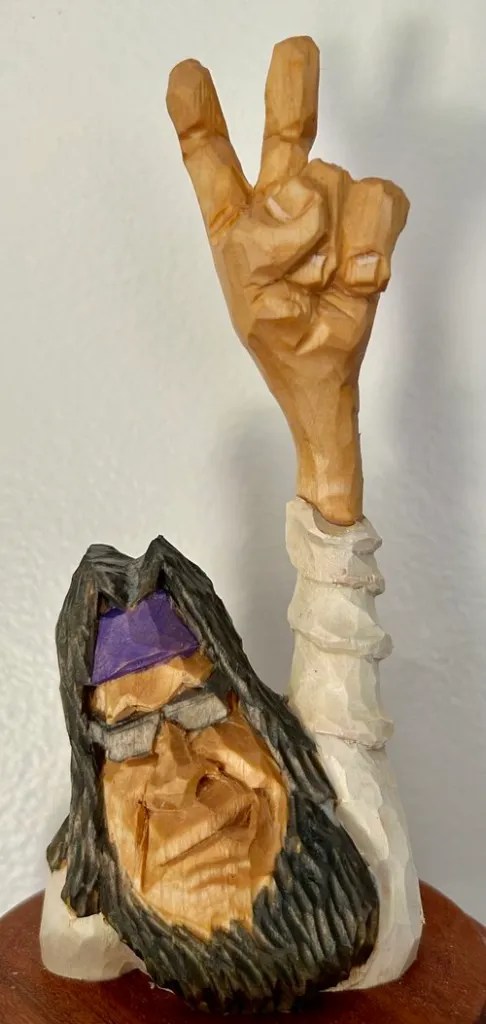
Jim a trippy hippy from the past
Teacher: Dwayne Gosnell
Dates: October 1,15 – 6PM Eastern (Tuesday)
Twiitling Tuesday – 4 hours ( 2 sessions – 2 hours each day)
Location: Online (Via Zoom)
For details and to sign up click on Dwayn’s website https://www.dgosnellwoodcarving.com/

DOLL CARVING CLASS – HITTY OR A TUCK COMB DOLL
Teacher: Janet Cordell
Dates: November 4, 8, 11,15,18,22
Times: 2-4 p.m. Pacific Time // 3-5 p.m. Mountain Time // 4-6 p.m. Central Time // 5-7 p.m. Eastern Time
12 hours ( 6 sessions – 2 hours each day)
Location: Online (Via Zoom)
Cost $185 (includes one project blank)
Description: This class will again cover the basics of carving, jointing, and painting a relatively simple doll, like Hitty, and also get into what makes the tuck comb doll genre so lovely and sophisticated. You may carve either one, or try both if you want to. The Hitty will of course be a little over six inches tall, and the tuck comb will be about 10 inches tall. The cost of the class will include one blank, and you may purchase others. Hitty blanks are $25 and tuck comb blanks are $35
To sign up contact Janet janet_cordell@yahoo.com
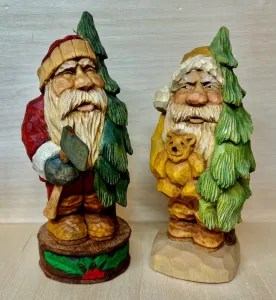
Kringle
Teacher: Dale Green
Dates: November 2,3,9,10
Saturday & Sunday both weekends 9:30 am-11:30 Pacific / 10:30 am – 12:30 pm Mountain /
11:30 am- 1:30 pm Central / 12:30 pm – 2:30 pm Eastern
8 hours ( 4 sessions – 2 hours each day)
Location: Online (Via Zoom)
Cost: $110.00 includes roughout and shipping within the US (International $130)
To pay for registration with Dale visit his website https://dalegreenwoodcarving.com/Woodcarving-Classes.htm
Contact Dale: dalecarves@gmail.com
Visit Dale’s website to sign up

Babushka Santa
Teacher: Dwayne Gosnell
Dates: November 12,26 – 6PM Eastern (Tuesday)
Twiitling Tuesday – 4 hours ( 2 sessions – 2 hours each day)
Location: Online (Via Zoom)
For details and to sign up click on Dwayn’s website https://www.dgosnellwoodcarving.com/
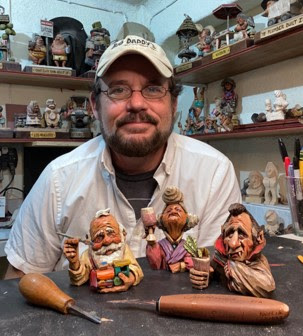
Online Classes With Chris Hammack
Teacher: Chris Hammack
Chris Hammack is offering a new series of online classes to help students learn and sharpen their woodcarving skills. Individual and Group Classes are available through his web site chrishammackart.com/groupclass

Woodcarving Academy
Established in 2020, the Woodcarving Academy offers dozens of videos and seminars created by some of the country’s top level instructors. More videos are added regularly as they are created by the instructors.
With a paid subscription to the Woodcarving Academy you can view any videos you like for as many times as you like.
Subscription rates: Monthly = $19.95 Quarterly = $49.95 Annual = $139.95
There is even a Free level which allows you to tour the website and watch the sample videos and content, and receive email updates as new content becomes available.
Check out the Woodcarving Academy and learn with the masters right in the comfort of your own home! Go to: www.woodcarvingacademy.com or Email: support@woodcarvingacademy.com
News & Announcements

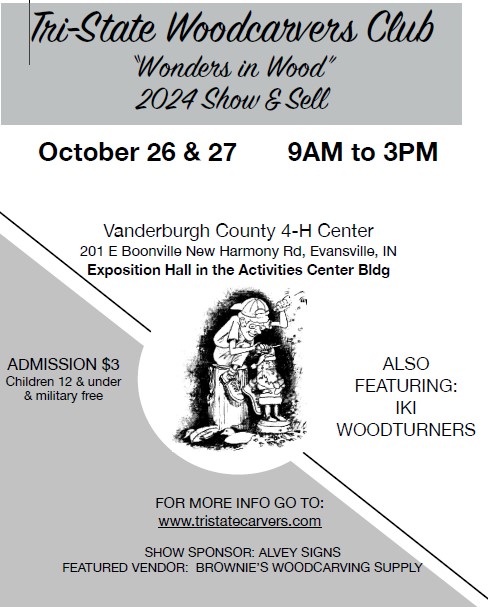

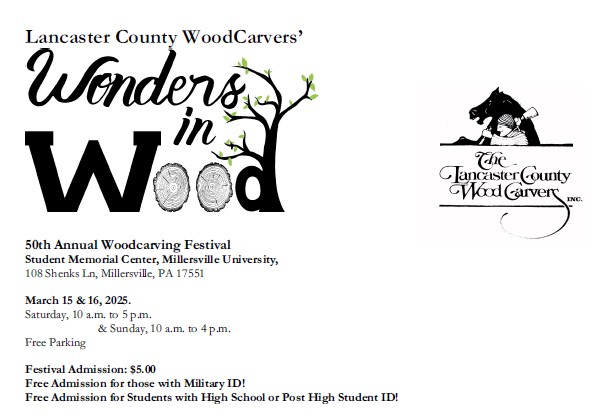


The International Association of Woodcarvers has upcoming Zoom meetings on the following Saturdays at 3PM EST with special guest presenters. Check them out…
Zoom: 310-460-3575
Presentation Schedule:
10/5 – Ashton Brown – Badger State Blades
10/12 – David Young
10/19 – Rich Embling
10/26 – Dale Green
INTERNATIONAL ASSOCIATION OF WOODCARVERS
COME JOIN US!!!

The Jersey Hills Wood Carvers (JHWC) club is a small but growing group of wood carvers sharing their time, knowledge and joy of woodcarving. The JHWC generally meets from 7:00 PM EST to 9:00 PM EST on the 1st, 3rd and 5th Thursday of each month (when school is in session) at the Jefferson Township High School wood shop classroom.
Membership is “FREE” and open to anyone interested in woodcarving regardless of their ability.
JHWC’s Upcoming Meetings and Events
2024
October – 17th, 31st
November – 21st
December – 5th, 19th
2025
January – 2nd, 16th, 30th
February – 6th, 20th
March – 6th, 20th
April – 3rd, 24th
May – 1st, 15th, 29th
June – 5th
For more information contact:
Al Santucci alsantucci4@gmail.com President
Bill Brunner billbrunnerdesign@gmail.com newsletter/website editor
Or visit:
Website: https://www.jerseyhillswoodcarver.com/ Facebook: https://www.facebook.com/groups/736479646821641/
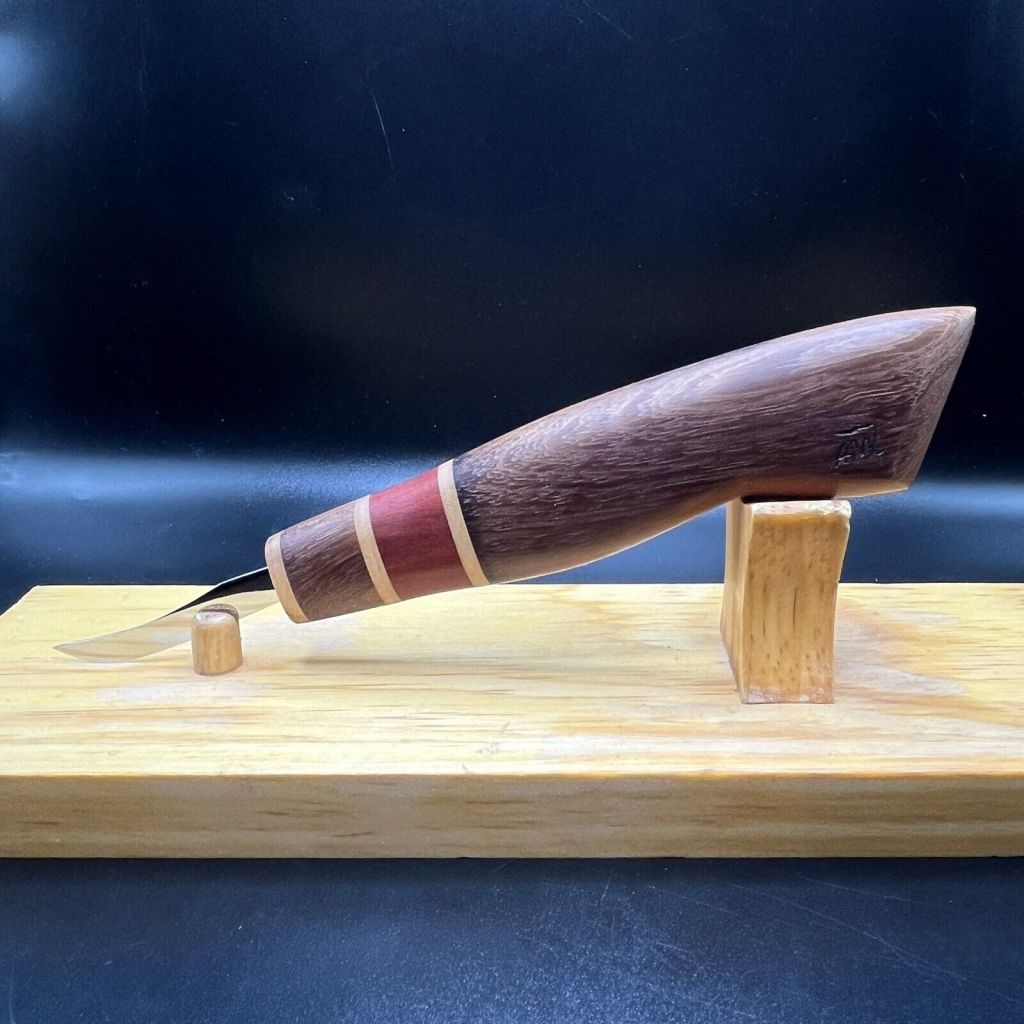
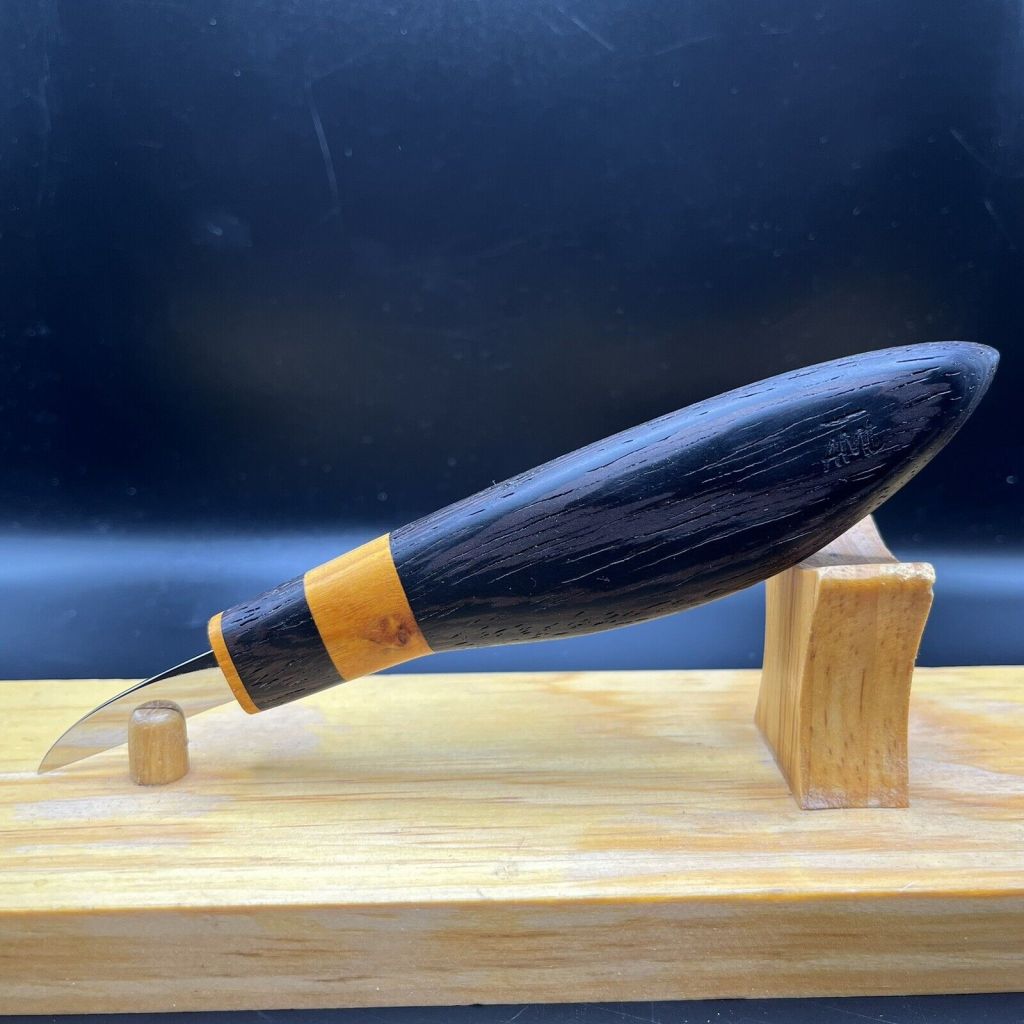
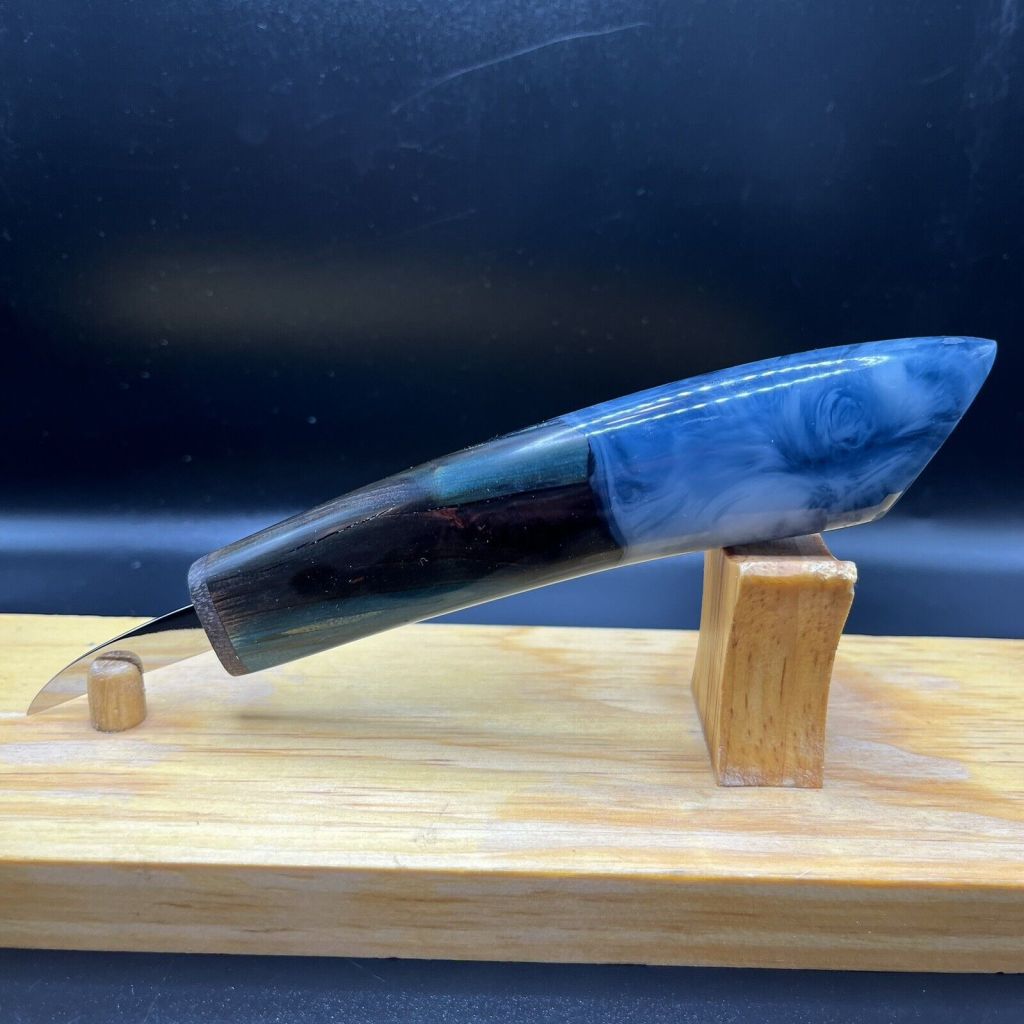
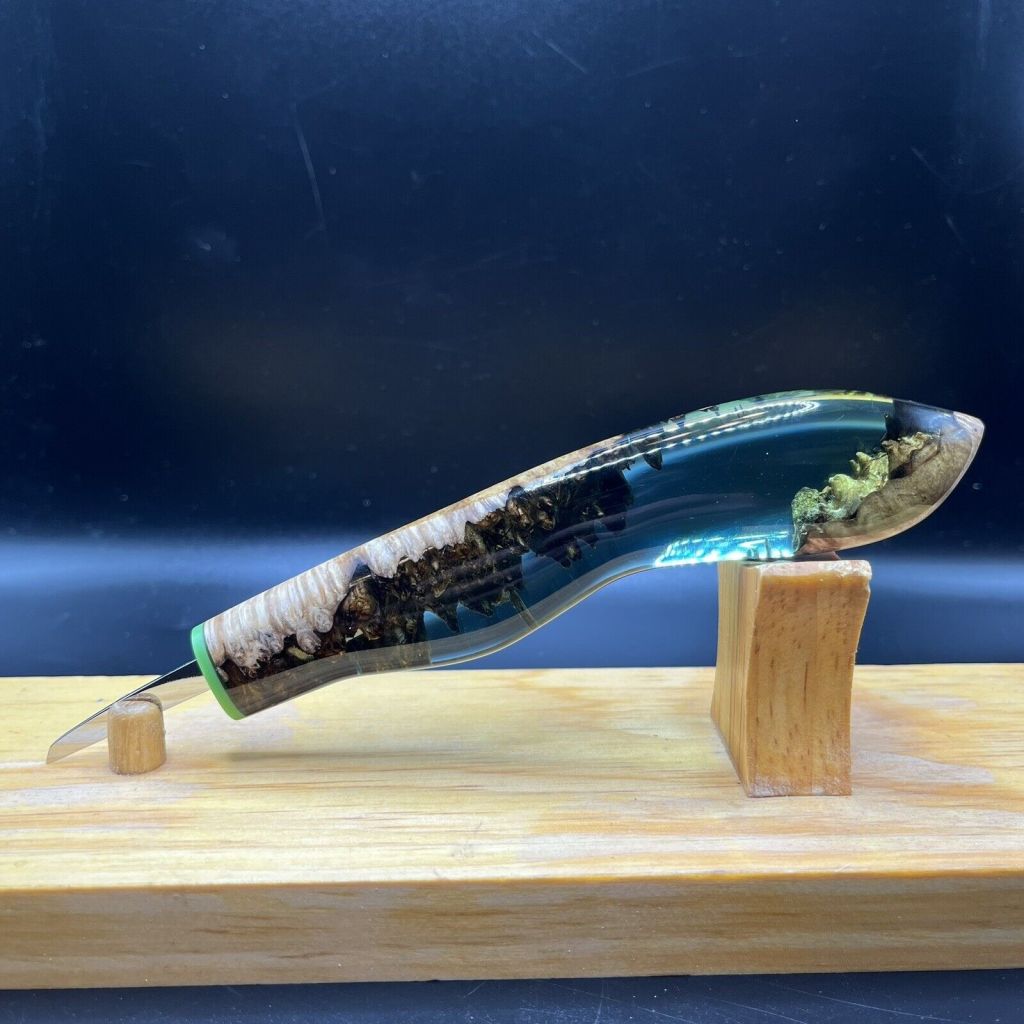
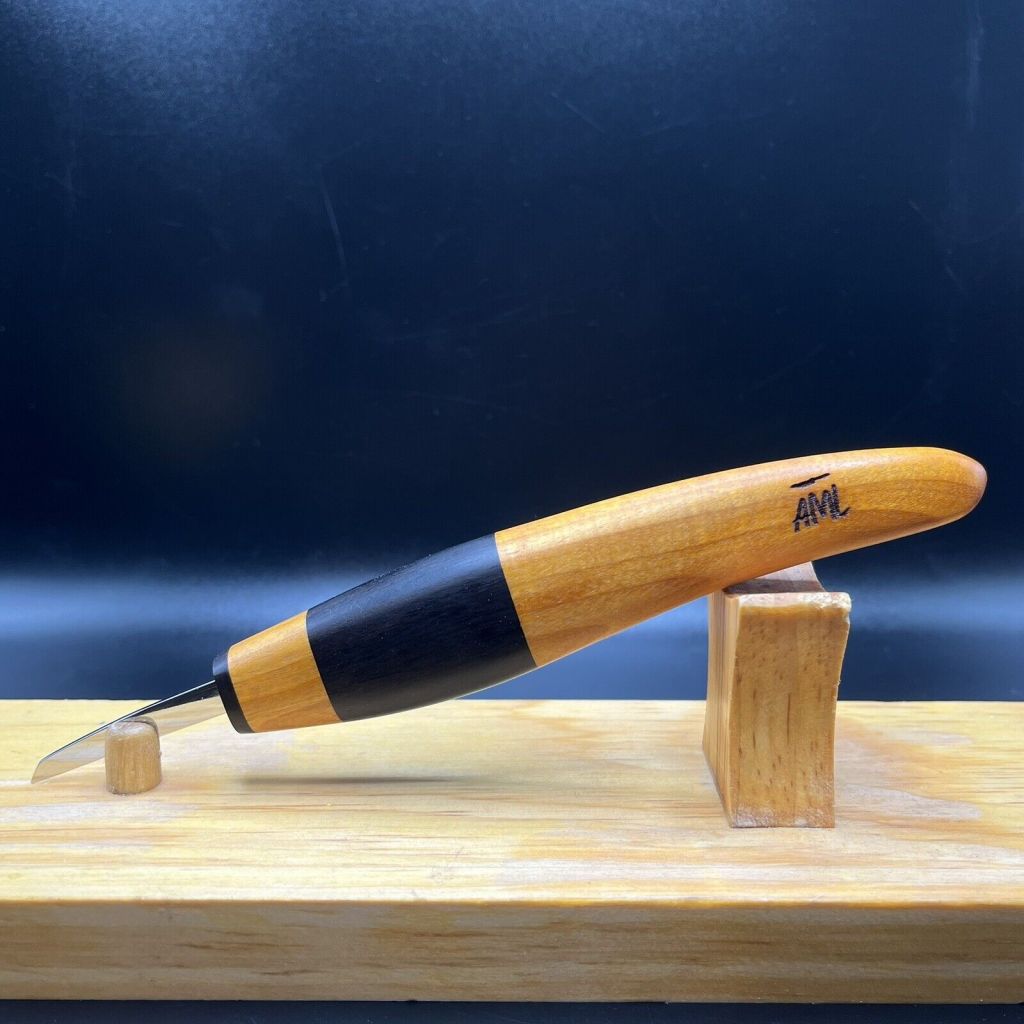
AML Wood Carving Knives
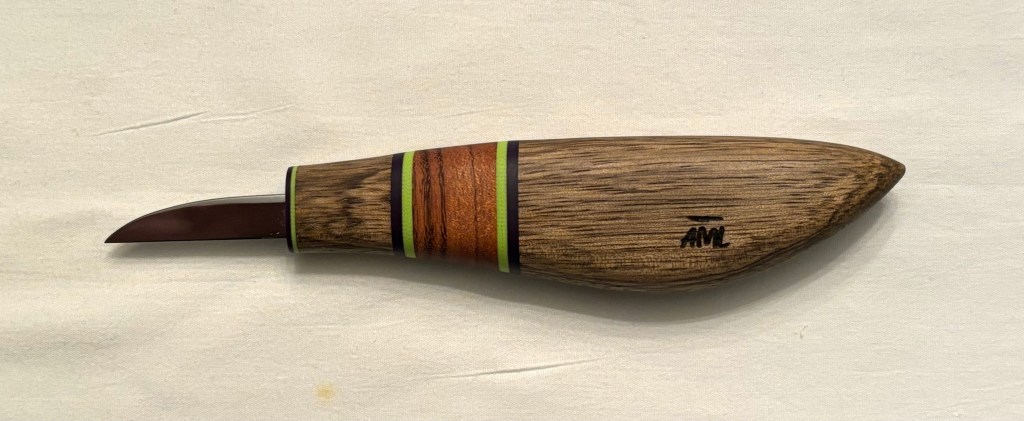
AML Wood Carving Knives are handmade by Andy Loughlin in Monroe, New York.
Each blade is meticulously crafted from 1095 high-carbon steel, ensuring easy sharpening and long-lasting edge retention. The diverse exotic woods used for the handle styles are sourced from around the world, adding a touch of elegance to these knives. You can find these exceptional knives for auction on eBay under ‘AML Knives,’ with bidding usually starting at $22 and most knives selling for between $40 and $100.
Unpack your AML Wood Carving Knife and experience its razor-sharpness right out of the package. Each knife comes with a custom-made magnetic wooden sheath, a thoughtful addition at no extra cost.
I now own three AML Knives and can speak personally about their quality. These are not production knives. Each knife is handmade by Andy himself. The knives are sturdy, well made, and will stack up to any other knife on the market. These knives have quickly become quite popular and sell out fast, so check the site (“AML Carving Knives” on EBAY) often for availability.
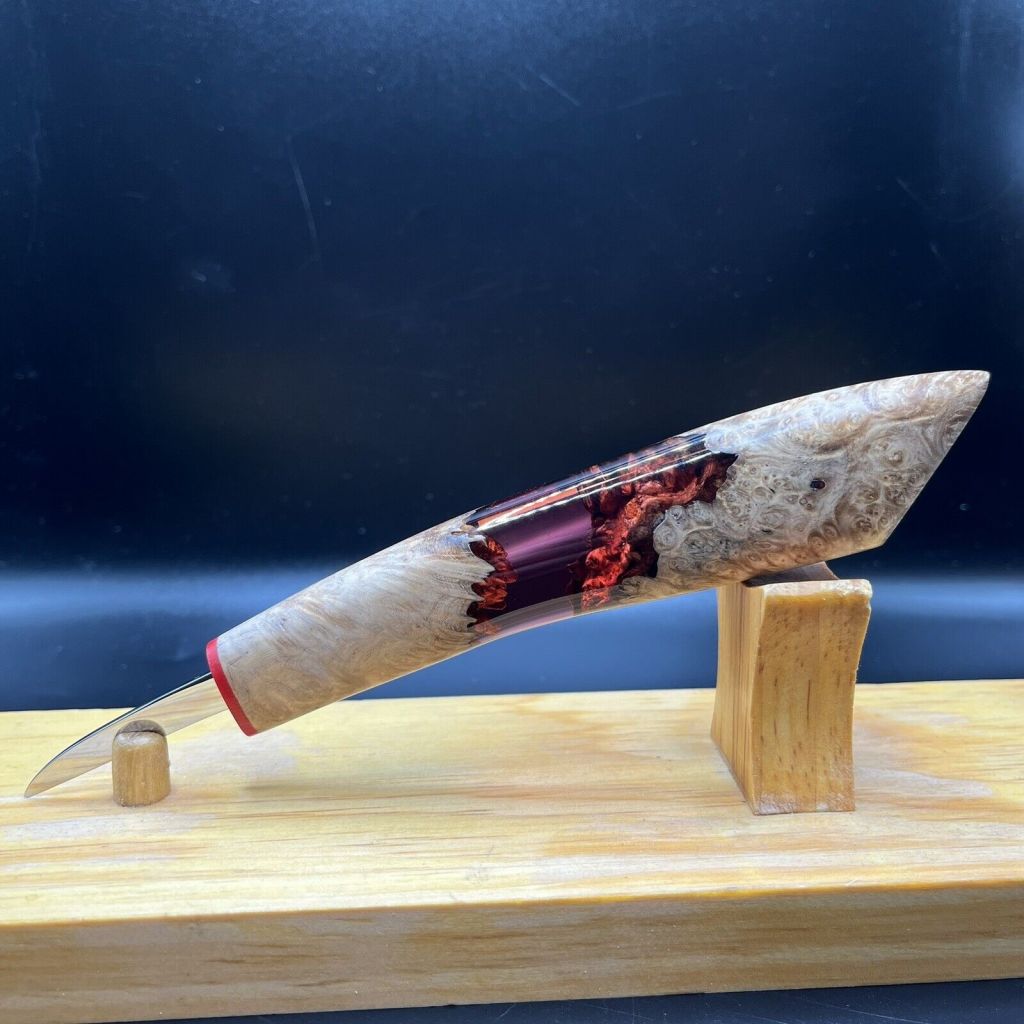
Andy has recently begun making knives with handles made from exotic woods and colored epoxy, creating some stunning and unique handle designs. Below are examples of some knives currently available or which have recently sold:

Harley Refsal
December 25, 1944 – September 8, 2024
Harley Jerome Refsal, age 79, passed away peacefully on September 8, 2024, at Barthell Eastern Star Nursing Home in Decorah, Iowa, surrounded by family and friends.
Harley was an internationally recognized woodcarver who specialized in Scandinavian-style flat-plane carving. In 1996, he received the St. Olav’s Medal from the King of Norway in recognition of his contributions to Norwegian folk art. In 2012, Harley was named the Woodcarver of the Year by “Woodcarving Illustrated” magazine for both reviving the art of flat-plane carving and teaching it across the United States and around the world.
On Christmas Day in 1944, Harley was born to Carl “Arthur” and Clara (Brekke) Refsal, joining his older sister Marcia for an idyllic childhood of traditional farming in rural Hoffman, MN. He learned to live with and love horses from an early age as his father continued the nearly out-dated practice of farming with horses. Harley often recalled setting out on horseback on May Day with a wash tub on his lap, delivering May baskets to friends on neighboring farms. Much later in his childhood, his father put the horses out to pasture and bought a tractor with steel wheels. In their younger years, the siblings attended country school near the farm, and subsequently graduated from high school in Hoffman. He began working with wood early in his childhood. His father, who was a carpenter and farmer, and a beloved woodworker uncle who lived nearby kept Harley well supplied with wood, tools, and encouragement.
After high school, Harley followed in his mother Clara’s footsteps by attending Augsburg College in Minneapolis, MN, majoring in Norwegian and Sociology. He sang in the Augsburg choir, and it was during a choir tour of Norway and Sweden in 1968 that his love of woodcarving took hold as he saw figures depicting traditional rural life in Norway. He was completely captivated, and those images lived on with him as he returned home. Upon graduation from Augsburg he attended the University of Oslo for one year, followed by Luther Theological Seminary in St. Paul, MN, where he graduated with a Master of Divinity degree.
In 1972, Harley moved to Decorah for what would become a 40+ year career at Luther College. He was first hired as the Assistant Campus Pastor and Head Resident of Men’s Tower (now called Dieseth Hall). Harley went on to hold different administrative positions including Director of Study Abroad, both sending Luther students to study in foreign countries and accepting foreign students to study at Luther. He ultimately found his calling as a professor of Scandinavian Folk Art and Norwegian language. His classes were wildly popular, especially his Scandinavian Fine Handcraft January term course where students had to eat a bowl of ice cream with a spoon they carved in order to pass the final exam.
Shortly after joining Luther College, Harley met the love of his life, Norma (Boots) Refsal, at a Halloween party in 1974. A month later the two were engaged and married on June 8, 1974. They celebrated 50 years this summer. Over the years they became proud parents of two sons: Carl, who was born in Nottingham, England, the year they directed the Luther College program there, and Martin, who was born in Decorah. The family spent another year abroad when Harley attended Telemark University College in Rauland, Norway, studying traditional Norwegian art and handwork. It was during this year that he realized what he had come to study was essentially gone from the Norwegian landscape and began his work bringing it back into Norway’s mainstream artistic expression.
Primarily a self-taught woodcarver, Harley began winning awards in regional and national carving exhibitions in the late 1970s. He continued his research on the history of Scandinavian carving, and in the early 1980s, coined the phrase “flat-plane carving” as an article was being written about him for Midwest Living. The term stuck and continues to be associated with that style of carving. During his research, he discovered that most of the artists who worked in this style during the height of its popularity in the early decades of the 20th century in both Scandinavia and America had died. The tradition of flat-plane carving had faded to near extinction.
Since the 1980s, Harley, who spoke fluent Norwegian, shared his knowledge of, and skills in, Scandinavian flat-plane carving with thousands of carvers in classes across North America and Scandinavia. The list of places he taught at and held dear was long and included Vesterheim Museum (Decorah, IA), North House Folk School (Grand Marais, MN), Raulandsakademiet (Rauland, Norway), John C. Campbell Folk School (Brasstown, NC), Milan Village Arts School (Milan, MN), and Fletcher Farm School for the Arts and Crafts (Ludlow, VT). He was a founding board member of North House Folk School. In addition to writing many books and articles on woodcarving, he was also featured on numerous radio and television programs, including the PBS Peabody Award-winning series “Craft in America” and Garrison Keillor’s “A Prairie Home Companion.” Pioneer PBS, with producer Dana Conroy, did a remarkable video retrospective of Harley’s carving career. His name is so integrally linked with the revival of flat-plane figure carving that it is often referred to as the “Refsal style.”
Harley will be remembered as a gentle, compassionate, and inspiring man who greatly enriched the lives of those around him. His spirit will live on in the countless students he taught, the beautiful works he created, and in the warm memories shared with his family and friends. He will also be remembered for his iconic look, which included a tollekniv on his belt and a carved wooden one carrot necklace. He was uniquely Harley.
Harley was preceded in death by his parents; sister Marcia Sanders; mother- and father-in-law Julie and Kenneth Boots; sister-in-law Justine Boots; niece-in-law Jodi Sanders; numerous aunts and uncles; and faithful shadow Maybe, his Yorkshire terrier. Harley is survived by his wife Norma, of Decorah; their two children, Carl of Memphis, TN and Martin of Decorah; brother-in-law Walt Sanders of Wadena, MN; brother-in-law John Boots of Ogema, MN; brother- and sister-in-law Owen and Linda Christianson of Decorah; and brother- and sister-in-law Paul Boots and Katryn Gabrielson of North Yarmouth, ME. He is also survived by 9 nieces and nephews: Shari Hoffmann (Tracy); Tom Sanders (Jane); Trevor Sanders (Dawn); Jennifer Boots-Marshall (John); Mary-Catherine Boots-Sacra; Peter Christianson; Rebekah Fonkert (Jeff); Christopher Boots (Letson); and Anna Boots. His life was enriched by the presence of 11 great nieces and nephews: Kristi Hoffmann; Tony Hoffmann; Brittany (Sanders) Riedesel; Ryan Sanders; Joel Boots-Marshall; Owen Boots-Marshall; Alice Boots-Sacra; Jens Fonkert; Gus Fonkert; Nell Boots; and Max Boots.
A Celebration of Life will be held on Friday, October 11, 2024, at Good Shepherd Lutheran Church in Decorah, IA at 11:00 a.m. with Rev. April Larson presiding. Visitation will be from 9:45 a.m. until the time of service at the church. There will be a lunch and time of remembrance following the service.
Wishing everyone a Happy Halloween!!!

The next issue of Wood Chip Chatter will be posted on November 1, 2024.

Keep a sharp eye out for it.
Keep a sharp edge, and keep on carvin’!


Funny Bone



 Wood Chip Chatter
Bob:
Saw the new Wood Chip Chatter come through, so I had to check it out. Always appreciate the updates on materials and the calendars. The extra background histories on Halloween and woodspirits was interesting. Keep up the good work !
Jim Babcock Columbus, Indiana
LikeLike
Hello Bob, I’ve missed you so much , I really want us back my love , I promise I’m now a changed person. I know you miss me too
LikeLike
Hi Olivia, I miss you too and always think about you.
LikeLike